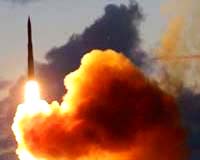
Target launch vehicle IFT-8 takes off from Vandenberg Air Force Base, CA March 15, 2002 6:15 p.m. PST.
Photo Copyright Tom Rogers.
Target launch vehicle IFT-8 takes off from Vandenberg Air Force Base, CA March 15, 2002 6:15 p.m. PST. Photo Copyright Tom Rogers. |
While too early to give the system itself a thumbs-up, "I think what we can say is that our test program is proceeding and showing some quite impressive success," Wolfowitz said on CNN's "Novak, Hunt and Shields" program.
"I'll say right off the bat, before some critic discovers it, this was not a quote, realistic test of exactly what a war, a interception would have to do.
"But it's the first time that we had anything that looked like a decoy warhead, and it picked out the real warhead from the decoy."
The decoy was "not as good a decoy as we would expect to face later," Wolfowitz acknowledged.
"We're in a development program. People need to understand that. We are going to push where there's success," Wolfowitz said. "It's an important area where we going to go down the avenues that work and cut off the avenues that don't work."
The program is designed to protect the United States from the limited missile capabilities of countries like Iran, Iraq and North Korea, which President George W. Bush has collectively labelled an "axis of evil."
And while he could not say the missile defense system would "neutralize" the threat posed by such countries, Wolfowitz said "we'd be a lot better off than in a situation where we're completely vulnerable."
The Pentagon scored its fourth successful missile interception Friday when a ground-based interceptor missile destroyed a dummy warhead in a test high over the Pacific, Pentagon officials said.
Roaring into space from the Kwajalein Atoll, the interceptor released a "kill vehicle" that sought out and struck the target exactly 30 minutes after it was launched from Vandenberg Air Force Base in California.
It was the third consecutive intercept for the Pentagon's ground-based midcourse missile defense system, formerly known as the National Missile Defense (NMD) system. In six tries, it has hit its target four times.
Friday's 100-million-dollar test is a boost for a program that had been plagued by problems.
But Bush's decision to withdraw from the 1972 ABM treaty and pursue a gamut of missile defenses in addition to the ground-based interceptor has removed much of the pressure for instant success.
Pentagon officials have added 19 progressively more realistic tests to the program and face no immediate deadline for deploying the system.
All rights reserved. � 2002 Agence France-Presse. Sections of the information displayed on this page (dispatches, photographs, logos) are protected by intellectual property rights owned by Agence France-Presse. As a consequence, you may not copy, reproduce, modify, transmit, publish, display or in any way commercially exploit any of the content of this section without the prior written consent of Agence France-Presse.
Related Links
 Billion Dollar Battle Over Central Pacific US Missile Range
 Kwajalein (AFP) March 4, 2002
 Dulles - March 4, 2002