SPACER
SPACER |
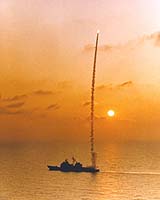
This test was the most challenging to date and tested the system's ability to engage the target during the ascent phase of flight, then subsequently intercept.
With the success of the FM-3 flight test on June 13, 2002, the Aegis BMD project accelerated its flight-testing objectives. FM-4 marks the beginning of a flight test series to develop an emergency deployment sea-based ballistic missile defense against short- to medium-range ballistic missiles.
FM-4 is the first developmental flight test against more complex and stressing ballistic missile engagement scenarios.
Boeing has been teamed with Raytheon Company, the prime contractor for the program, since 1996 to build the Standard Missile-3 (SM-3) kinetic warhead and is responsible for the guidance unit, ejector, kinetic warhead integration, and environmental testing. All Boeing components and systems performed exceptionally during the test.
"This latest intercept again validates the viability of hit-to-kill technology and the ability to field systems that will help protect our homeland, as well as deployed troops, allies and friends abroad," said Debra Rub, vice president, Boeing Air & Missile Defense Systems, part of Boeing Integrated Defense Systems.
"Boeing has been developing and proving this technology for more than 15 years and we are proud to be a part of this latest success."
In addition to its work on the Aegis Ballistic Missile Defense/SM-3 program, Boeing holds key roles in each element of the Ballistic Missile Defense System architecture. Boeing also leads the System Engineering and Integration effort on the Missile Defense National Team.
Related Links
 US Carries Out Successful Missile Defense Test Over Pacific
 Washington (AFP) Oct 15, 2002