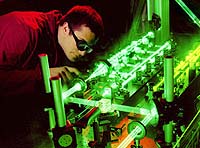
illustration only
illustration only |
The MDA chose Space Technology for Phase 2 of the next generation of illuminator laser under an $18 million, 18-month contract managed by the U.S. Air Force. The SILL is a four-kilowatt-class, solid-state, pulsed laser with excellent beam quality.
"SILL is the next step toward the generation of high-power, pulsed illuminator lasers," said Jackie Gish, director of DE technology for the sector.
"Because of SILL's high power, excellent beam quality and environmental specifications, it will yield an enhancement over existing illuminators. We are very pleased and excited about being chosen for this important step."
Space Technology performed trade studies and produced a conceptual design for the SILL earlier this year under the contract's phase one. Two other companies also received phase one contracts, but Space Technology was the only one selected for phase two.
This phase will demonstrate a full power breadboard and perform the design of the flight-qualifiable laser. A third phase will culminate in 2006 with delivery to the government of a rugged, flight-qualifiable laser with a development path for space applications, such as long-range illumination.
The SILL program builds on Space Technology's legacy of delivered solid-state lasers, including the Beacon Illuminator Laser for the ABL and others for the Air Force and the Defense Advanced Research Projects Agency. The sector delivered a flight-qualified Beacon Illuminator, containing two-kilowatt-class solid-state lasers, to the ABL program in 2002.
This work under the SILL contract complements Space Technology's work on the Joint High Power Solid-State Laser program awarded in December 2002, when the sector won a Joint Technology Office and Air Force contract to develop the high-power, solid-state laser, a program that will result in demonstration at the end of 2004 of a 25-kilowatt electric-powered laser.
Northrop Grumman also specializes in fully militarized, lower-power lasers and has produced and fielded more than 25,000 laser systems, including several that have flown in space.
Related Links
 Positron Systems To Supply Material Research For Missile Defense
 Boise - Sep 16, 2003