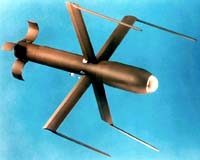
Following the test maneuvers and seeker moding, the RBAT's recovery parachute and landing spikes enabled a flawless landing that resulted in zero damage to the dual-mode radar/infrared (RF/IR) seeker.
Following the test maneuvers and seeker moding, the RBAT's recovery parachute and landing spikes enabled a flawless landing that resulted in zero damage to the dual-mode radar/infrared (RF/IR) seeker. |
Launched from a Cessna aircraft, the RBAT flew over a formation of 17 remotely controlled, moving armored vehicles. It executed all required flight maneuvers and detected, acquired and initiated track on targets.
"P3I BAT, delivered into a target area by the long-range Army Tactical Missile, will improve substantially the warfighting capabilities of the Army's Legacy, Interim and Objective Forces," said Dr. William H. Forster, vice president, Land Combat Systems, Northrop Grumman Electronic Systems sector.
"These developmental tests allow us to improve, refine and mature these advanced sensors and algorithms, leading to the next generation of precision Army munitions."
Following the test maneuvers and seeker moding, the RBAT's recovery parachute and landing spikes enabled a flawless landing that resulted in zero damage to the dual-mode radar/infrared (RF/IR) seeker.
This rendered the seeker immediately available for the next test in the series.
Emmitt Gibson, vice president of Precision Munitions at Northrop Grumman, added, "P3I BAT continues to progress on its development schedule. Using the recoverable BAT for these tests provides the Army with a cost-effective means of reusing hardware for multiple flights."
The baseline BAT, currently in production at Northrop Grumman's Land Combat Systems facility in Huntsville, is an autonomous submunition that uses a combination of passive acoustic and infrared sensors to seek, identify and destroy moving armored targets deep in enemy territory.
The P3I BAT, a planned block upgrade, adds an advanced millimeter-wave radar and improved imaging IR sensors, providing a co-boresighted, dual-mode RF/IR seeker that works with the baseline acoustic sensors.
The new seeker enhances BAT's capability against a wider range of stationary and moving targets, particularly missile launchers. It also improves BAT's performance in adverse weather conditions and against sophisticated countermeasures.
Related Links
 CIA Chief Cites Russia, China, North Korea As Proliferators
 Washington (AFP) Mar 19, 2002