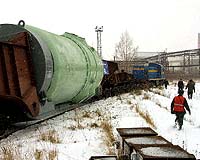
File Photo: A part of the newly designed nuclear reactor for the Iranian power station Busher leaves by train the plant 'Izhorkiye zavodi' in Kolpino, on the outskirts of St. Petersburg, 16 November 2001. AFP/EPA photo by Nikita Infantyev
File Photo: A part of the newly designed nuclear reactor for the Iranian power station Busher leaves by train the plant 'Izhorkiye zavodi' in Kolpino, on the outskirts of St. Petersburg, 16 November 2001. AFP/EPA photo by Nikita Infantyev |
"Iran remains a strategic partner of Russia," said Mikhail Margelov, head of the foreign affairs committee of the Federation Council, following the vote by 127 senators.
The Duma or lower house ratified the treaty last week in a near-unanimous vote.
Intrernational concern has risen in recent months in the United States over military links between the two countries, particularly over Russia's controversial construction of Iran's Bushehr nuclear power plant.
The United States and Israel fear that Iran could acquire nuclear arms technology through its partnership with Moscow. Russia, though, has tried to dismiss these fears.
"Russia will continue construction of the Iranian nuclear power station at Bushehr, and will also develop joint space projects," Margelov told AFP.
Deputy Foreign Minister Alexander Losyukov said last week Russia's involvement in the Bushehr plant marked a "symbol of the new stage of cooperation" between the two countries.
On October 2, Moscow and Tehran also signed a military cooperation agreement in a deal that, according to estimates, could bring Russia around 400 million dollars in sales of its medium-range air defense systems and other arms.
Russia last year scrapped an agreement with the United States barring future arms sales to Iran.
Losyukov told the State Duma after last week's vote on the new cooperation treaty that relations between Moscow and Tehran had entered a new era following Iranian President Mohammad Khatami's visit to Moscow in March.
"The key areas of our cooperation will be in the military-technological sphere and the peaceful use of the nuclear atom," Losyukov said moments before the Duma ratified the treaty, signed by Khatami and President Vladimir Putin on March 12.
The new coperation treaty commits Russia and Iran not to use force or the threat of force against each other, and to prevent either country being used to harbour "aggression, subversive or separatist acts against the other."
"The previous treaty signed by Iran and the USSR in 1940 envisaged Soviet troops entering Iranian territory if Iran's security was threatened," Meregelov said Wednesday, adding: "This principle has been eliminated in the new treaty."
All rights reserved. � 2001 Agence France-Presse. Sections of the information displayed on this page (dispatches, photographs, logos) are protected by intellectual property rights owned by Agence France-Presse. As a consequence, you may not copy, reproduce, modify, transmit, publish, display or in any way commercially exploit any of the content of this section without the prior written consent of Agence France-Presse.
Related Links
 Civilian Nuclear Industries Under Siege Of New Concerns
 Dublin (AFP) Nov 18, 2001