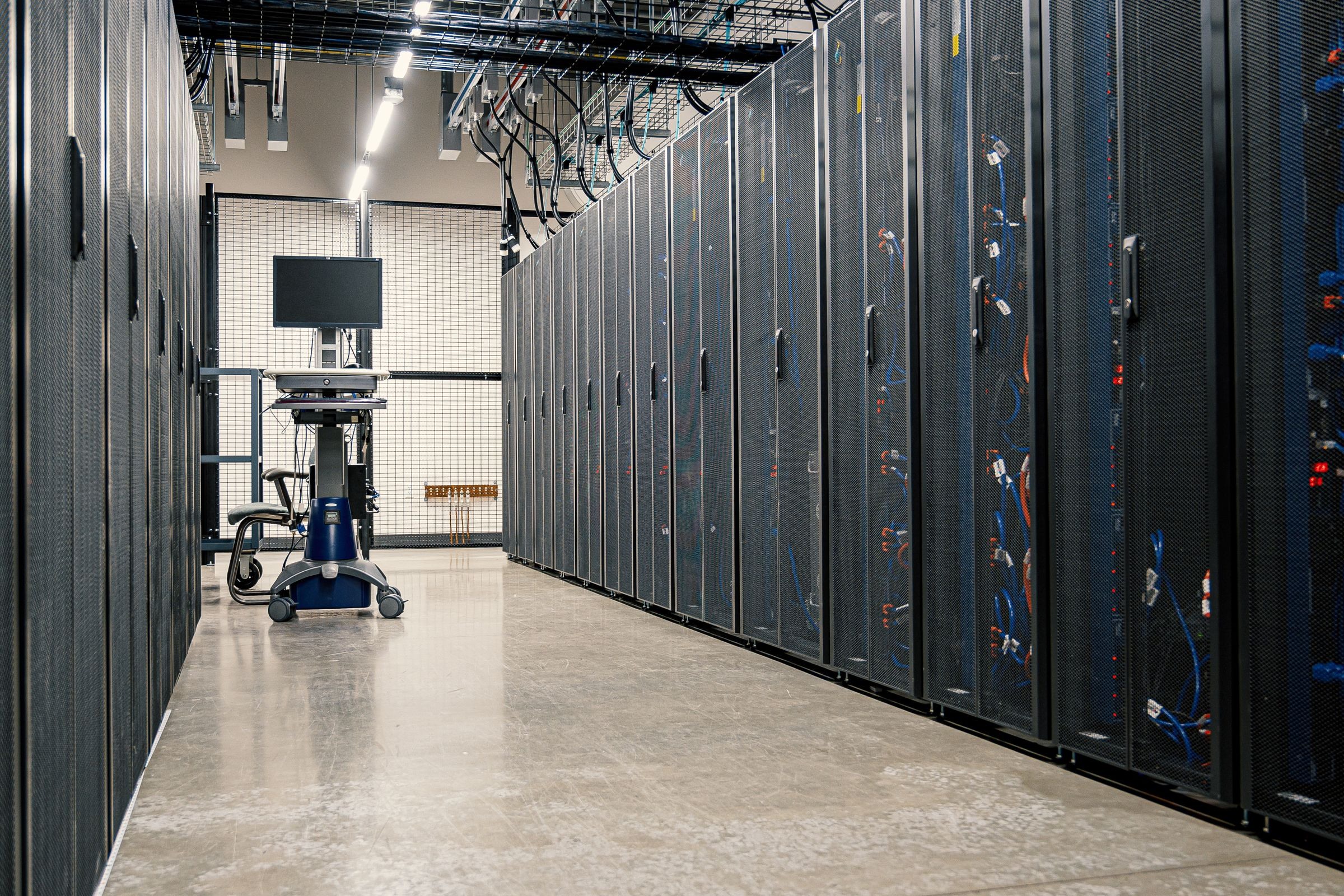
I run an online business, so I spend a large part of each day using services described as being in the cloud. The language makes the physical machinery easy to forget. A prompt appears on one screen, a reply appears on another, and nothing seems to have moved between them.
But every answer is produced by chips drawing electricity inside a building that must remove their heat.
One widely reported estimate gives that hidden infrastructure an unusually tangible form: about 519 millilitres of water for ChatGPT to produce a 100-word email using GPT-4. That is a little more than a standard bottle.
The number is interesting, but it is not a universal price attached to every email. It is a modelled estimate for a particular task and infrastructure scenario. It combines water used directly in data-centre cooling with water associated with generating electricity, and it depends heavily on assumptions that can change by location, season, model and hardware.
The larger number in the headline needs the same treatment. A research team projected that global AI demand could account for 4.2 to 6.6 billion cubic metres of water withdrawal in 2027. That is a scenario, not a measurement of what AI is using today.
The physical problem is real. The precision of the popular comparisons is less secure.
Where the bottle-per-email estimate came from
In September 2024, The Washington Post worked with Shaolei Ren, an electrical and computer engineering researcher at the University of California, Riverside, to estimate the resources used when GPT-4 generated an average 100-word email at an average American data centre.
The calculation produced two headline figures: about 0.14 kilowatt-hours of electricity and 519 millilitres of water.
This was not a direct measurement taken inside an OpenAI server hall. The Post says Ren calculated the figures using the methodology behind his team’s work on AI water use. OpenAI has not published enough model-level operational data for an outside researcher to measure the exact water footprint of a particular ChatGPT response.
There is another distinction worth keeping in view. The team’s later peer-reviewed article in Communications of the ACM gives a different, more general example: roughly one 500-millilitre bottle for every 10 to 50 medium-length responses from GPT-3, depending on when and where the model runs.
The one-email estimate and the 10-to-50-response estimate are therefore not interchangeable. They refer to different models, workloads and calculations.
That does not make the 519-millilitre number meaningless. It makes it an estimate that should travel with its conditions rather than a fixed fact about ChatGPT.
Water enters the calculation in two places
The first pathway is inside the data centre. Nearly all the electricity used by computing equipment eventually becomes heat. That heat has to move from chips into the facility’s cooling system and then into the outside environment.
Some facilities use cooling towers. Warm water transfers heat to moving air, and a portion evaporates. The remaining water becomes more concentrated with minerals and must sometimes be discharged and replaced. Other facilities rely more heavily on air-cooled chillers or closed-loop systems, which can reduce on-site water demand but may require more electricity.
The second pathway sits beyond the data-centre fence. Thermal power stations use water to produce steam and to remove waste heat. The amount varies enormously by fuel, generation technology and cooling design. Wind and solar photovoltaics use little water during electricity generation, while some coal, gas and nuclear configurations withdraw much more.
A review in npj Clean Water found that electricity-generation water requirements can differ by several orders of magnitude between technologies. That means the same computing job can have a different indirect water footprint at two data centres connected to different grids.
Weather matters too. Evaporative cooling generally needs more water during hot periods. A workload run in a cooler place or at a cooler time can require less cooling, although moving it may change the electricity mix and network demands.
Chip manufacturing adds a third pathway because semiconductor plants use ultrapure water. The headline estimates focus mainly on operating AI through cooling and electricity. They are not complete cradle-to-grave accounts of the servers, buildings and chips.
Withdrawal and consumption are not synonyms
This is the part of the discussion I initially found easiest to miss.
Water withdrawal means taking water from a river, lake, aquifer or supply system. Some of that water may later be returned. Water consumption is the portion not returned to the immediate water environment, commonly because it evaporates or becomes incorporated into a product.
Both matter, but for different reasons. A large withdrawal can compete with other users and strain pipes, treatment plants or a river during a dry period even if much of the water is eventually discharged. Consumption more directly reduces the water available downstream at that time and place.
The AI projection in the headline is for withdrawal. In the same paper, Pengfei Li, Jianyi Yang, Mohammad A. Islam and Ren projected 0.38 to 0.60 billion cubic metres of water consumption in 2027, compared with 4.2 to 6.6 billion cubic metres withdrawn.
In other words, the model does not say that all 4.2 to 6.6 billion cubic metres vanish.
It says AI-related facilities and electricity generation could take that volume into their systems. How much is returned, where it is returned, its temperature and the timing of the withdrawal all affect the local result.
The 2027 figure is a forecast built from other forecasts
The study, first released in 2023 and revised before its 2025 journal publication, estimated global AI’s future electricity demand and applied direct and indirect water-intensity assumptions.
The paper used a projected global AI electricity demand of 85 to 134 terawatt-hours in 2027. It then estimated the water associated with running and cooling the servers and producing that electricity.
Every stage introduces uncertainty. AI demand can grow faster or slower than forecast. New chips can perform more calculations per unit of electricity. A more capable model may use those efficiency gains to perform more work. Cooling designs can change. Grids can add low-water wind and solar power, or continue relying on water-intensive thermal plants.
The authors’ range is consequently best read as a warning about plausible scale under stated assumptions, not a prediction accurate to the nearest hundred million cubic metres.
This is one paper, not a meter attached to the global AI industry.
More recent estimates also use different boundaries. A 2025 UK government report on water use in AI and data centres cites an International Energy Agency estimate of roughly 560 billion litres of annual global data-centre water consumption, potentially rising to 1.2 trillion litres by 2030. That covers data centres more broadly and measures consumption rather than the much larger withdrawal category, so it cannot be placed beside the 4.2-to-6.6-billion-cubic-metre figure as though they were counting the same thing.
The UK comparison has already shifted
The research paper describes its projected withdrawal as roughly half the United Kingdom’s annual total. That comparison was reasonable within the baseline the authors used, but national water statistics are revised and change over time.
The most recent World Bank series, sourced from the UN Food and Agriculture Organization’s AQUASTAT database, lists UK annual freshwater withdrawal at 8.419 billion cubic metres for 2022.
Against that figure, 4.2 billion cubic metres is almost exactly half. The upper estimate of 6.6 billion is closer to 78 per cent.
So “roughly half the UK” works as a memorable description of the lower end, but it understates the upper end when compared with the latest value. This is a good example of why country comparisons can clarify scale while also creating false permanence.
There is a deeper problem with global comparisons. One cubic metre withdrawn from a water-abundant basin during a wet season does not have the same consequence as a cubic metre of potable water consumed during drought. The global total matters for infrastructure and resource planning, but local scarcity determines much of the actual environmental pressure.
The huge gap between estimates is itself information
In June 2025, OpenAI chief executive Sam Altman wrote that an average ChatGPT query used about 0.000085 US gallons of water, or roughly 0.32 millilitres. That is more than 1,600 times smaller than the bottle-per-email estimate.
Altman did not publish a methodology detailed enough to reconcile the figures. The two numbers may count different things. The smaller figure may reflect newer hardware, a shorter average query, a narrower operational boundary, less on-site evaporation or some combination of them. The larger estimate includes indirect water associated with electricity and describes a specific 100-word GPT-4 task.
Without common reporting rules, the public is left comparing numbers whose boundaries do not match.
I do not think the useful conclusion is that one ordinary email is an environmental offence. Nor is it sensible to decide that the infrastructure is weightless because an individual response can be made more efficient.
What matters is the multiplication. Billions of interactions, repeated continuously, determine where companies build data centres, how much electricity grids must supply, what cooling systems operators choose and which communities share the water.
The most useful disclosures would therefore report direct withdrawal and consumption separately, identify the watershed and water source, include the electricity-related footprint, state the model and task measured, and show how the figure changes through the year.
AI may begin as software, but it runs as physical infrastructure.
Water is one of the clearest ways to see it.