The pigeons are the part everyone remembers. Two birds nested inside a giant antenna in New Jersey, left a mess, and became suspects in one of the most important measurements in modern cosmology.
Arno Penzias and Robert Wilson removed the birds and cleaned the droppings from the instrument. The unwanted signal became slightly weaker, but it did not go away. Nor did it disappear when they checked the receiver, the atmosphere, the warm ground, nearby cities or the Milky Way.
I have spent enough time chasing small technical faults in ordinary work to recognise the temptation here. When one number refuses to fit, it is easy to call it a glitch and move on. Penzias and Wilson kept trying to make the noise disappear. Their failure was the discovery.
The familiar telling makes this sound like a lucky accident involving pigeon droppings. Luck mattered, but it is not the most useful part of the story. The signal became evidence only because the antenna was unusually precise, the two astronomers were unwilling to discard an awkward residual, and a separate group at Princeton knew what that residual might mean.
The antenna had been built to hear a balloon in space
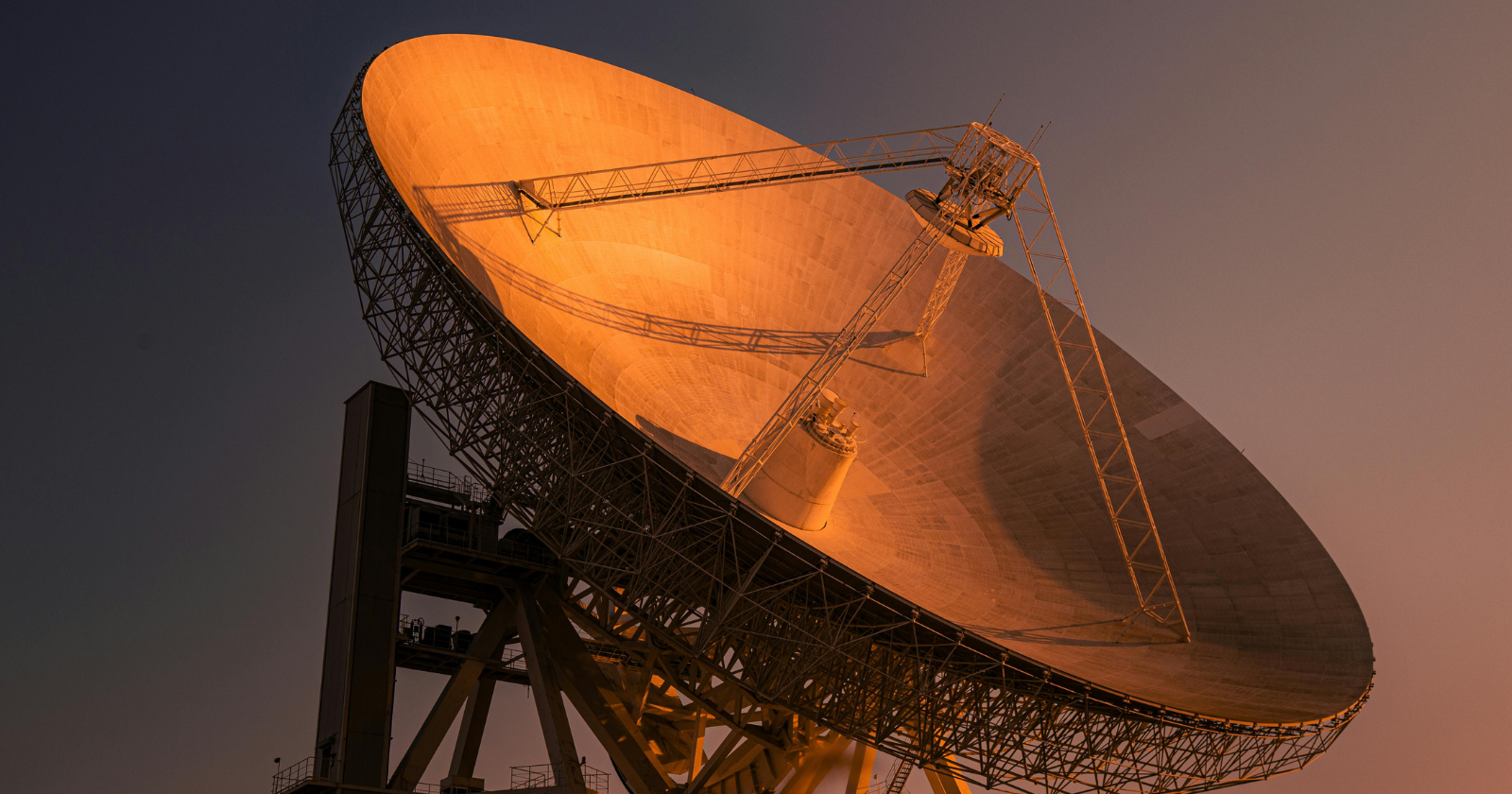
Bell Telephone Laboratories built the Holmdel horn antenna in New Jersey for Project Echo, an early experiment in satellite communication. Echo was not a modern powered communications satellite. It was a huge metallic balloon designed to reflect radio signals from one part of Earth to another.
The horn was about six metres across at its opening and roughly 15 metres long. Its shape shielded the receiver from radio emission coming from the ground, while a low-noise amplification system made it exceptionally sensitive to faint microwave signals.
Once the Echo work ended, Penzias and Wilson adapted the antenna for radio astronomy. They wanted to measure known radio sources and faint emission from the Milky Way. Before trusting any observation, however, they needed to account for every contribution made by the instrument and its surroundings.
That process revealed an excess they could not explain.
The hiss was really 3.5 kelvin of excess power
The antenna was not playing an audible hiss through a loudspeaker. “Hiss” is a useful way of describing radio noise, but the actual result was an electrical measurement expressed as an equivalent temperature.
In their 1965 paper in The Astrophysical Journal, Penzias and Wilson reported about 3.5 kelvin more antenna temperature than their known sources could supply. They measured at 4.080 gigahertz, corresponding to a wavelength of a little over seven centimetres.
The unexplained component was nearly the same wherever the horn pointed. It was not polarised and did not vary with the seasons during observations made from July 1964 to April 1965.
Those details ruled against many ordinary explanations. A signal from a city, a part of the Galaxy or an unnoticed object in the Solar System should change as the antenna moved or as Earth travelled around the Sun. Atmospheric emission could be estimated. Noise made inside the receiver could be measured against a carefully controlled reference source.
The astronomers checked joints and components, covered seams and examined the narrow throat of the horn. Then there were the pigeons. The birds had coated part of the antenna with what Penzias called a “white dielectric material”. Removing them and cleaning the horn reduced the noise only a little.
Wilson’s 1978 Nobel lecture gives a useful first-person account of the long elimination process. By the time the excess survived the cleaning and equipment checks, it had stopped looking like dirt or a loose connection.
Princeton had been preparing to look for the same signal
A few dozen kilometres away, Robert Dicke’s group at Princeton University was thinking about a hot early universe. P. James Peebles had calculated that a relic bath of radiation might still be detectable, and Peter Roll and David Wilkinson were building an instrument to search for it.
The connection did not happen in one cinematic moment. Penzias discussed the unexplained signal with radio astronomer Bernard Burke at MIT. Burke knew about the Princeton work and suggested he contact Dicke.
The two groups eventually published companion letters in the same issue of The Astrophysical Journal. Penzias and Wilson’s paper remained deliberately observational. It described an isotropic, unpolarised excess without claiming to have proved a cosmology.
The Princeton team’s accompanying paper supplied the interpretation. Dicke, Peebles, Roll and Wilkinson argued that the Bell Labs measurement could be the cooled black-body radiation expected from a dense, hot phase early in the universe.
Even that prediction had a history. George Gamow, Ralph Alpher and Robert Herman had discussed relic radiation from a hot early universe in the late 1940s. Their work was not front of mind for either group in 1964. The discovery was therefore not a simple case of one prediction followed neatly by one experiment. Several lines of theory, engineering and measurement had to meet.
The radiation was released long after the beginning
Calling the cosmic microwave background the “afterglow of the Big Bang” is useful, provided we do not picture light escaping at the first instant.
For roughly the first 380,000 years, the universe was a hot, opaque plasma. Photons repeatedly scattered from free electrons and could not travel far. As expansion cooled the universe to around 3,000 kelvin, electrons combined with atomic nuclei. Space became transparent enough for the radiation to travel freely.
Over the billions of years since, the expansion of space has stretched those photons to microwave wavelengths. According to the European Space Agency’s explanation of the CMB, that radiation now appears at about 2.7 kelvin, only a few degrees above absolute zero.
It arrives from every direction because the early hot universe was not an explosion from one point into empty space. Space itself expanded, and every region we can observe passed through that early state. The horn at Holmdel was detecting a background that fills the sky.
Later instruments turned the hiss into a map
The Bell Labs measurement was strong evidence for a hot Big Bang, but one frequency could not establish the full shape of the radiation’s spectrum. Other ground and balloon experiments followed. Space missions later measured the background across the sky and across many frequencies.
NASA’s Cosmic Background Explorer, or COBE, found a near-perfect black-body spectrum with a temperature of 2.725 plus or minus 0.002 kelvin. It also detected tiny temperature variations at roughly the level of one part in 100,000.
Those variations are not unwanted noise. They record small differences in the density of the young universe, the seeds from which gravity eventually built galaxies and clusters. WMAP and ESA’s Planck mission later mapped them in much finer detail.
Penzias and Wilson shared half of the 1978 Nobel Prize in Physics for discovering cosmic microwave background radiation. The award recognised more than an accidental encounter. Their short paper was the endpoint of months spent showing what the signal was not.
That is what I keep coming back to. The universe did not announce itself with a dramatic message. It appeared as a stubborn remainder in an accounting problem. The pigeons made the story memorable. The refusal to erase an inconvenient number is what made it science.