

Titan sits 1.4 billion kilometers from the Sun, wrapped in a nitrogen haze so thick that when the European Space Agency’s Huygens probe parachuted through it on January 14, 2005, the descent took two hours and twenty-seven minutes. When it finally touched down on a plain of icy pebbles, the pressure gauge read 1,467 millibars — about 1.45 times the atmospheric pressure at sea level on Earth. A person standing on Titan’s surface, ignoring the -179°C cold for a moment, would feel roughly the same squeeze on their eardrums as a swimmer resting on the tiled floor of a five-meter pool.
No other moon in the solar system comes close. There are more than 150 confirmed moons circling the eight planets, and every one of them is either airless or dressed in a whisper-thin exosphere too faint to register on a barometer. Titan alone has weather, wind, seasons, rain, and a sky.
The only moon with a barometer reading
Ganymede is bigger. Io is more geologically violent. Europa hides an ocean. But when it comes to atmosphere, Titan is the outlier — a moon behaving like a planet. Its air column is about 95 percent nitrogen and 5 percent methane, with traces of hydrogen, ethane, and a stew of complex hydrocarbons produced when sunlight cracks methane molecules apart in the upper atmosphere.
That composition is uncannily close to what Earth’s atmosphere may have looked like before life started pumping out oxygen roughly 2.4 billion years ago. Titan is often described as a primitive version of Earth, frozen at a stage our own planet passed through before the first cyanobacteria showed up.
The pressure at Titan’s surface is the giveaway. On Mars, atmospheric pressure is about six millibars — less than one percent of Earth’s, so thin that liquid water would boil off instantly at any temperature above freezing. On Venus, pressure is 92 times Earth’s. The Soviet Venera landers were designed to withstand Venus’s extreme pressure, with several successfully transmitting data from the surface for periods ranging from 23 minutes to over two hours before succumbing to the extreme heat and corrosive conditions. Titan sits between them, but much closer to Earth’s number, and that quiet fact is what makes it one of the most Earth-like surfaces in the solar system.
Why a small moon holds onto so much air
Titan is only 5,150 kilometers across — smaller than Mars, only slightly larger than Mercury. By the usual rules of planetary science, a body that size should not be able to hold a substantial atmosphere. Mercury has almost none. The Moon has essentially none. Both are close enough to the Sun that solar heating strips light molecules away over geological time.
Titan gets to keep its air for two reasons. The first is temperature. At -179°C, nitrogen molecules move slowly enough that Titan’s modest gravity — about one-seventh of Earth’s — can hold onto them for billions of years. The second is distance from the Sun. Out at Saturn’s orbit, solar wind is weaker and ultraviolet radiation is diluted by roughly a factor of 100 compared to Earth’s neighborhood, so atmospheric erosion is gentler.
Even so, methane in Titan’s upper atmosphere is being destroyed by sunlight on a timescale of about 30 million years — a geological blink. Something has to be resupplying it. Recent work on cryovolcanism on Titan suggests ice volcanoes may be venting methane from the interior, refilling the atmosphere the way ordinary volcanoes on Earth exhale carbon dioxide and water vapor.

What Huygens saw on the way down
The Huygens probe, built by the European Space Agency and delivered to Saturn aboard NASA’s Cassini spacecraft in 2004, remains the only human-made object ever to land on a moon other than our own. It carried instruments designed to sniff, photograph, and listen to Titan’s air during descent.
What came back was disorienting. The images showed drainage channels branching like river deltas, rounded pebbles that looked water-worn, and a dark plain that turned out to be soft, damp material with the consistency of wet sand. But the liquid doing the erosion was not water. At Titan’s surface temperature, water is a rock. The rivers and lakes are made of liquid methane and ethane, falling as rain from methane clouds, pooling in basins the size of the Great Lakes.
The Huygens probe detected acoustic signatures of wind during its descent. The data captured the interaction of hydrocarbon air moving across a hydrocarbon landscape.
The wobble in the sky
Titan’s atmosphere behaves in ways that still puzzle the scientists who have been studying it since Cassini arrived in 2004. One of the strangest findings, published in recent years, is that Titan’s upper atmosphere does not rotate in sync with the moon’s solid body. The whole gaseous envelope wobbles and spins like a gyroscope, tilting relative to Titan’s spin axis and shifting position with Saturn’s seasons.
Titan orbits Saturn once every 16 Earth days, but a Saturnian year lasts 29.5 Earth years, so each Titan season stretches for more than seven years. During that time, the atmospheric bulk sloshes around, driven by solar heating and by the changing angle of sunlight as Saturn’s axial tilt swings the moon through its long seasonal cycle.
The ocean question
For nearly two decades, the working assumption has been that Titan hides a global subsurface ocean of liquid water, buried under about 100 kilometers of ice. Cassini’s gravity measurements in 2008 suggested the interior was flexing in a way that made sense only if a liquid layer lay beneath the crust.
That picture is now being reexamined. A 2025 analysis from NASA suggests Titan may not have an ocean after all, or at least not the deep, planet-wide ocean that had been assumed. The interior may be more solid, with liquid water confined to smaller pockets or a much thinner layer than earlier models predicted.
The atmosphere, in the meantime, does not care. It keeps circulating, raining methane onto dunes of frozen hydrocarbons, feeding lakes at the north pole that Cassini’s radar mapped in detail between 2006 and 2017.
A moon that may have been two moons
How Titan ended up with so much atmosphere is a question that leads back to how Titan formed at all. Work published in February 2026 suggests a lost moon may have created Titan and Saturn’s rings in a single ancient collision. In the model developed by researchers at the SETI Institute and collaborating institutions, an earlier generation of mid-sized Saturnian moons smashed together, and the debris reassembled into what is now Titan while spraying icy fragments outward to form the rings.
The SETI team’s description of Titan forming in a merger of two old moons would help explain why the moon is so much larger than any of Saturn’s other satellites, and why it retained the volatile ices — ammonia and methane — that later outgassed to build the atmosphere. A violent merger heats the interior, and a hot interior belches gas.
The same collisional history may explain the moon’s slightly tilted orbit and the peculiar chemistry of its upper atmosphere, where nitrogen isotope ratios hint at material that was cooked and reprocessed rather than inherited pristine from the solar nebula.
Walking on Titan
The pressure comparison to a swimming pool is not just a rhetorical trick. It has physical consequences that make Titan strange in a way no other moon can match.
At 1.45 atmospheres, with air four times denser than Earth’s because of the cold, and gravity one-seventh of Earth’s, a human standing on Titan could strap wings to their arms and fly. The math has been checked repeatedly: the lift-to-weight ratio is favorable enough that flapping human-powered flight, impossible on Earth, would work on Titan. NASA’s Dragonfly mission, scheduled to arrive at Titan in the mid-2030s, will take advantage of the same physics with a nuclear-powered rotorcraft that hops from site to site through the dense air.
The surface itself is a chemist’s dream and an engineer’s nightmare. It holds vast reserves of liquid hydrocarbons, water ice, and nitrogen — raw materials that could, in principle, be turned into fuel, plastics, and breathable atmosphere. One analysis argues Titan may hold the resources for a space colony, though the cold and the distance from the Sun make it a challenging destination even by the standards of the outer solar system.
The view from the surface
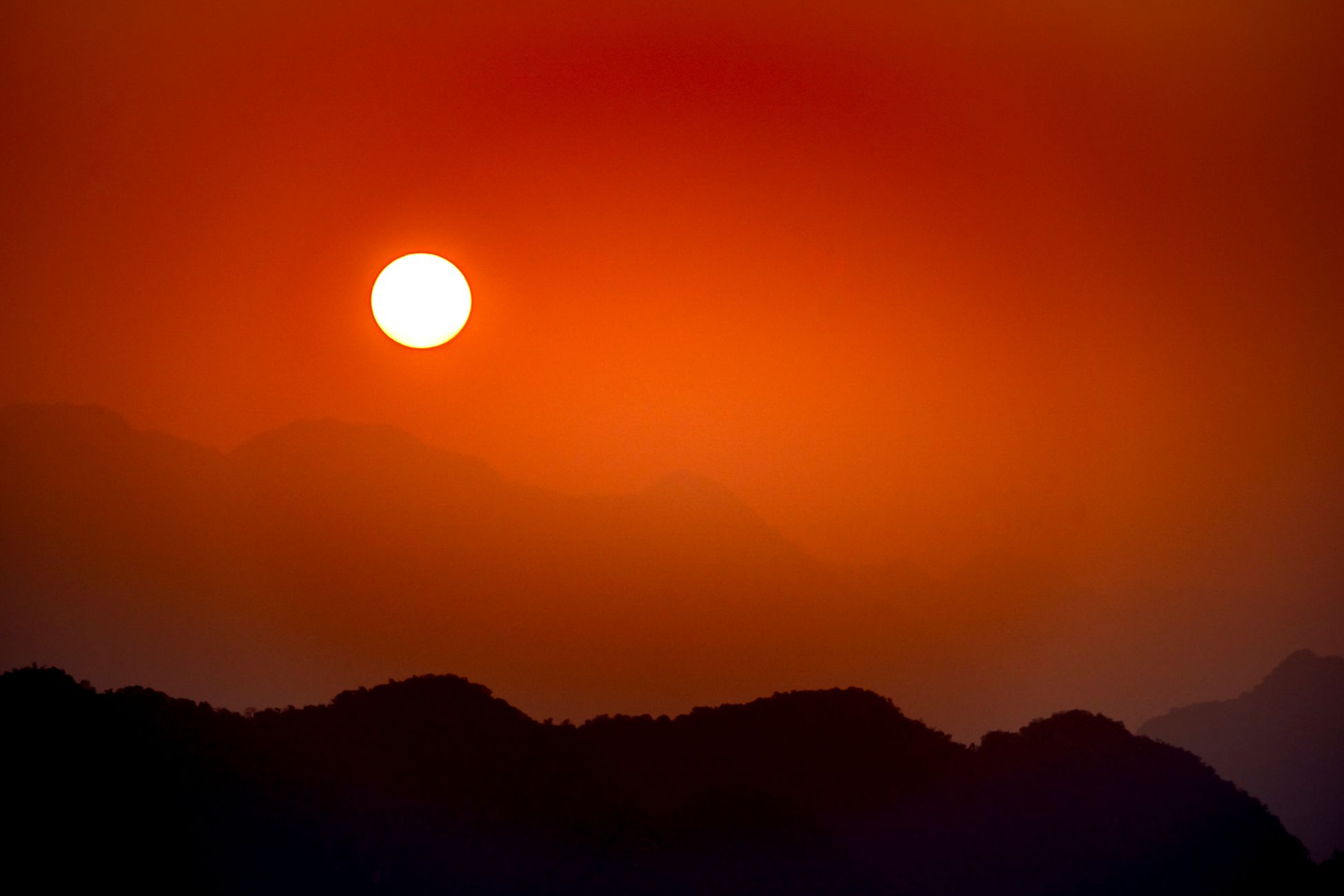
What Huygens could not photograph well, because of the dim orange light filtering through the haze, is what a human eye would see standing on Titan. Sunlight at Saturn’s distance is about one percent as bright as on Earth — roughly the illumination of a heavily overcast twilight. The sky is a deep orange-brown, colored by the same photochemical smog that gives the moon its indistinct fuzzy appearance in telescope images.
Saturn, hanging in the sky, would usually be hidden by the haze. On clear days, when the upper atmosphere thins near the poles, it might loom faintly through the murk, ringed and pale.
The rain, when it falls, falls slowly. Methane droplets in Titan’s low gravity and thick air drift down at a few meters per second, more like snowflakes than raindrops. A methane shower would take minutes to reach the ground from a cloud a kilometer up, and the drops would be larger than terrestrial rain, closer to the size of small marbles.
Somewhere on the plain where Huygens landed twenty-one years ago, the probe is still sitting, its batteries long dead, its instruments frozen to the pebbles. The wind that hissed past its microphone is still blowing across the same plain, the same pressure squeezing the same rocks, the only real atmosphere on any moon we know of, still there in the dark.
