
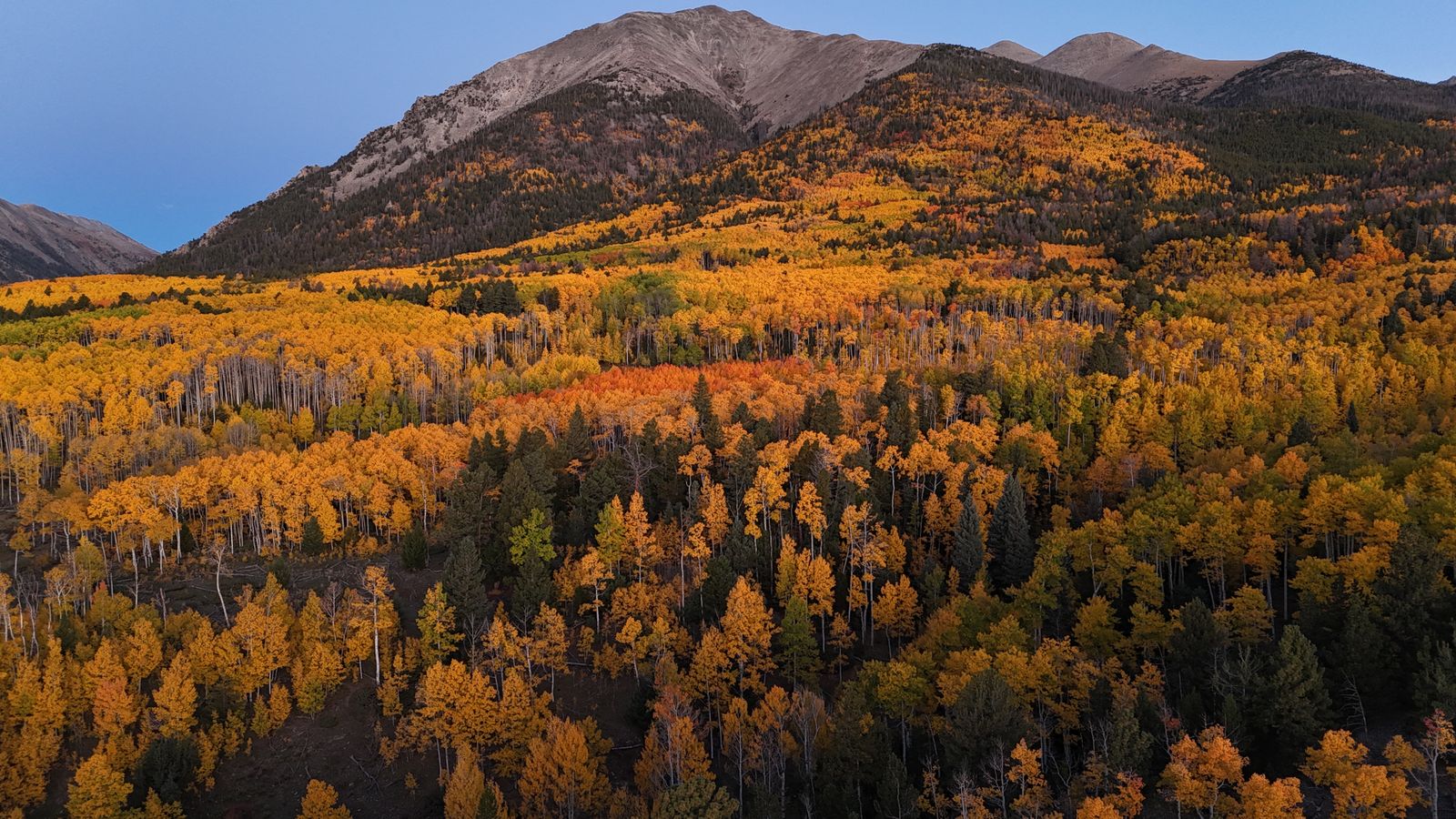
In a canyon on the Fishlake National Forest in south-central Utah, a single quaking aspen has spread itself across 106 acres of hillside as roughly 47,000 genetically identical stems sharing one root system. Walk through it and you appear to be walking through a forest. You are walking through one tree. Its name is Pando, Latin for “I spread,” and by mass it is the heaviest known living organism on the planet.
Each pale trunk with its powder-white bark and coin-shaped leaves is a stem, not an individual. Underground, they are all the same aspen, sprouted from the same rootstock, carrying the same DNA. Estimates of Pando’s age range from a conservative 14,000 years to speculative figures near 80,000, though as ecologist Paul Rogers of Utah State University has pointed out, the dating methods for a clonal organism this old are imprecise enough that no one can nail the number down.
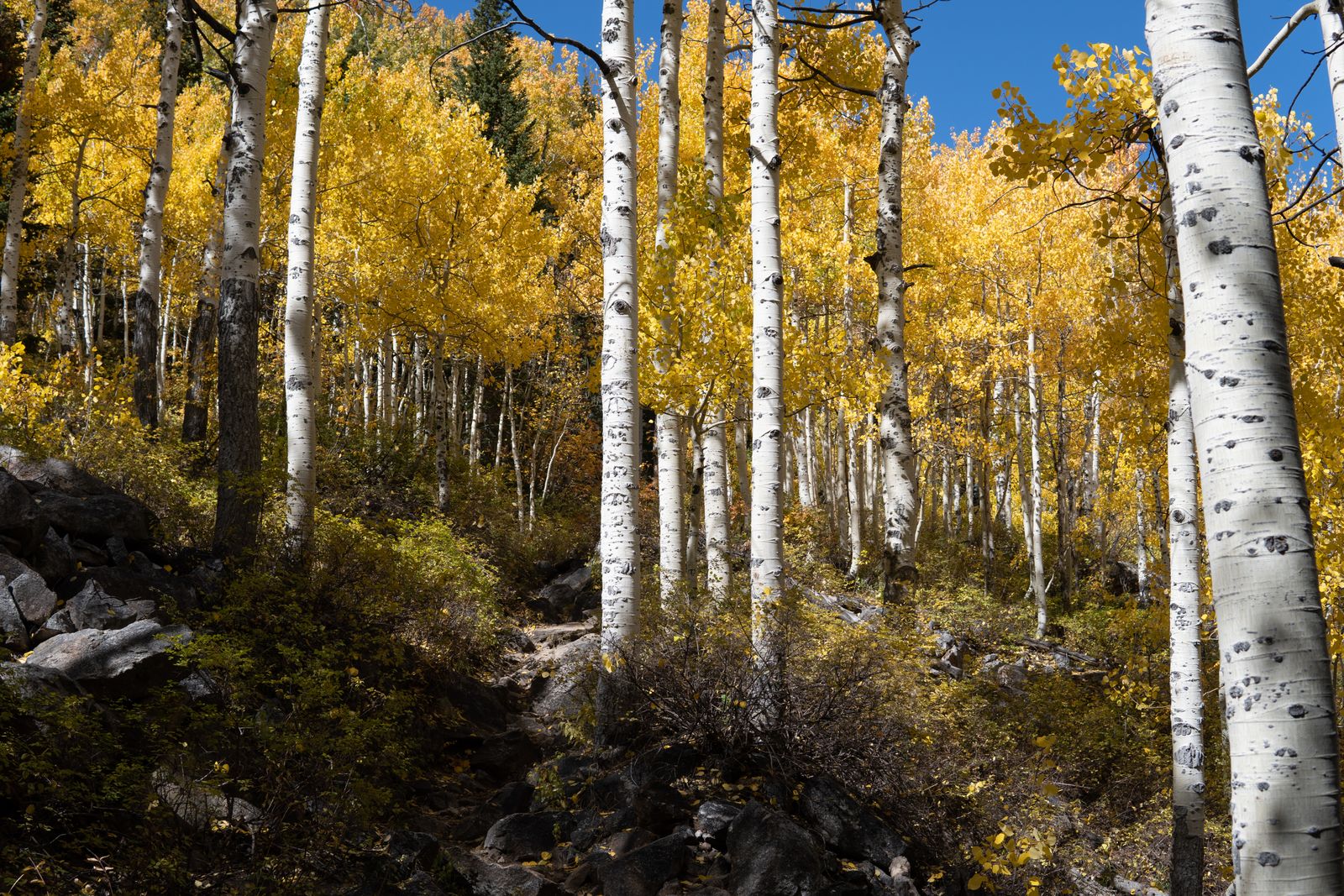
One tree, 47,000 trunks
Quaking aspen (Populus tremuloides) is a species built to clone. A single seedling, once established, sends horizontal roots outward through the soil. From those roots, new vertical shoots — called suckers or ramets — push up into the light. Each sucker looks like a young tree. Genetically, it is the same tree.
Pando has been doing this for a very long time. The grove sits on the western edge of the Colorado Plateau, and its individual stems are replaced by fresh sprouts from the shared root mass over time. The root system itself — the actual continuous organism — is the ancient part. The trunks are more like leaves on a longer-lived body.
Weighed as a single entity, Pando comes in at around 6,000 metric tons, which is roughly forty times the mass of a blue whale. Spread across 106 acres, it covers a vast expanse of terrain.
How you know it’s one tree
The first clue was visual. Aspen groves change color in synchronized patches — in autumn, one clone might turn brilliant gold while its neighbor across a small gully is still green. In spring, one clone leafs out days before another. Botanists surveying the Fishlake basin noticed that a huge portion of the forest was leafing and coloring in unison, suggesting a single genetic identity.
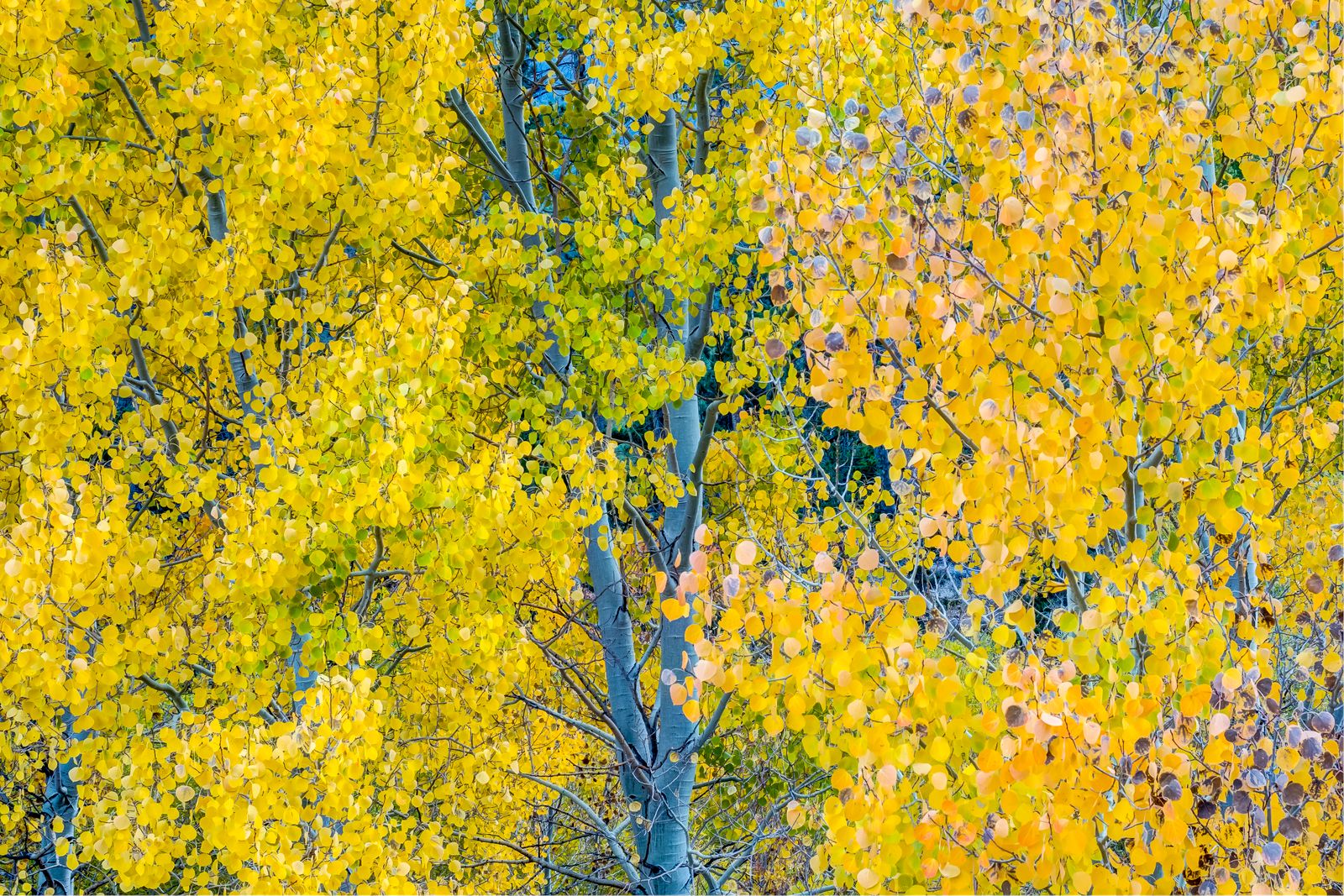
Later genetic sampling confirmed it. Cores taken from stems across the 106-acre patch all returned the same genotype. The trembling leaves — that soft, papery rattle the wind makes in aspen groves and the reason the species is called “quaking” — are shivering on the same body.
A team of researchers has even recorded Pando’s acoustic signature, dropping a hydrophone into a hollow at the base of a stem and capturing the low rumble of water moving through the shared root system during storms. The sound propagates along the roots because the roots are physically connected. You are, in effect, listening to the plumbing of one organism the size of a small neighborhood.
The age problem
How do you date a tree that keeps replacing itself? You can’t count rings, because the current stems are only a century or so old. You can’t carbon-date the roots reliably, because they are constantly being renewed as well. Instead, researchers estimate Pando’s age by modeling how long it would have taken a single seedling to spread across 106 acres given aspen’s typical rate of clonal expansion, and by cross-referencing with pollen records and post-glacial vegetation history for the region.
The conservative estimate is around 14,000 years — placing Pando’s germination near the end of the last Ice Age, when the glaciers were retreating and much of the American West was reorganizing into the ecosystems it holds today. Some researchers have proposed ages as high as 80,000 years, which would make Pando older than anatomically modern humans leaving Africa. Most working ecologists treat that upper bound with skepticism. The middle estimate — several thousand years, at minimum — is uncontroversial.
Either way, a single organism has been standing on that Utah hillside since long before writing, farming, or the domestication of the dog.
Not the only claimant
Pando is not entirely unchallenged as the largest organism on Earth. By footprint, a honey fungus in the Malheur National Forest of eastern Oregon covers about 2,385 acres — more than twenty times Pando’s area — with a subterranean network of fungal threads called mycelium. That organism, Armillaria ostoyae, is estimated to weigh around 35,000 tons and to be roughly 2,400 years old.
So which is largest depends on what you weigh. By mass, Pando wins comfortably — the fungus’s estimated tonnage is disputed and much of it is diffuse mycelium rather than concentrated tissue. By ground area, the fungus wins. By visibility, it isn’t close: the fungus is almost entirely underground, revealing itself only through the occasional cluster of honey mushrooms in fall. Pando is a forest you can walk through.
The trembling giant is aging out
The trouble is that Pando has stopped reproducing itself. Aspen clones stay healthy the way any long-lived population does — by constantly pushing up new stems to replace the old ones. In a functioning aspen stand, you should see stems of every age: newborn suckers a few inches tall, saplings, mature trunks, and dying elders. In Pando, the stems are aging without sufficient replacement. The nursery has closed.
The reason is appetite. Mule deer, and to a lesser extent cattle grazing on nearby permits, are eating the young suckers as fast as they emerge from the ground. According to Live Science, researchers have observed that mule deer are eating young aspen shoots (called suckers) almost immediately as they emerge from the ground, preventing new growth in the Pando grove. Aspen shoots are nutrient-dense and, to a hungry deer, irresistible — the grove has become a salad bar for herbivores.
Two human-caused shifts made this worse. First, wolves and cougars were removed from most of the Intermountain West a century ago, and mule deer populations expanded without predators to keep them moving. Second, a campground sits inside Pando itself, and cabins ring its edges. Hunting is prohibited near human structures, so deer have learned to congregate in the exact area where the aspen most needs protection from them.
Fences and sharpshooters
Rogers and colleagues have been running experiments on how to keep Pando alive. The clearest finding is that fencing works — if the fences are tall, well-maintained, and left in place until the young stems clear roughly six feet, above the browsing height of a mule deer. Fenced sections of Pando have produced dense, healthy stands of new suckers. Unfenced sections have produced almost nothing.
The remaining question is scale. Fencing 106 acres of rugged terrain is expensive, the fences are constantly breached by deer squeezing through gaps or under wires, and the exclosures create an odd two-tier forest where some sections are recovering and others continue to age out. Rogers has floated the possibility of hiring professional sharpshooters to reduce the resident deer herd around the grove, on the theory that a handful of deer with a tolerance for aspen’s bitter chemical defenses are doing most of the damage.
State wildlife agencies have been slow to embrace culling, partly because hunting license revenue depends on maintaining large deer populations. Small changes in reproduction or mortality compound quickly over long time frames — and Pando runs on very long time frames.
What it means to be one
There is something disorienting about standing in Pando once you know. The wind moves through the leaves and they clatter softly against each other, and every leaf is part of the same organism. The tree next to you is not a tree. It is a branch, essentially, extended vertically out of a body that lies beneath the soil.
The genetics researcher Michael Grant, who was among the first to characterize Pando in the 1990s, gave the clone its name. He chose Pando — “I spread” — because that is what the organism does. It does not reproduce sexually very often. Aspen do produce catkins and seeds, but conditions have to be exactly right for a seedling to establish, and in the arid West those conditions are rare. Most aspen expansion happens through the roots.
Which means Pando has been, essentially, the same individual for its entire history. It has not exchanged genes with another aspen in thousands of years. It has weathered the entire span of human civilization as one continuous body of tissue.
The end that is not certain
Pando is not dead. The 47,000 stems standing today are healthy in themselves, and the root system beneath them is intact. What is failing is renewal. If the current stems die off in the next fifty to hundred years without replacements, the organism will finally, after millennia, stop being.
Or it will not. Aspen root systems are patient. If the deer pressure eases, if fencing expands, if a cold winter or a disease knocks back the local herd, the roots will push up suckers and the forest will begin repopulating itself within a single season. Aspen are one of the fastest colonizers in the Rocky Mountain flora. Pando has waited out worse.
What the current moment demonstrates is that even the largest, oldest, most quietly persistent organisms on Earth are permeable to small daily choices — a fence line, a campground boundary, the reintroduction or absence of a predator. A creature that has stood on that hillside since the last glaciers withdrew is being edited, sucker by sucker, by the mouths of animals whose ancestors were kept in check by wolves that no longer live in Utah.
Walk into the grove in October, when the leaves have turned and the entire 106 acres flares gold in the same week because every leaf answers to the same clock. The rattle overhead is one tree talking to itself.
