
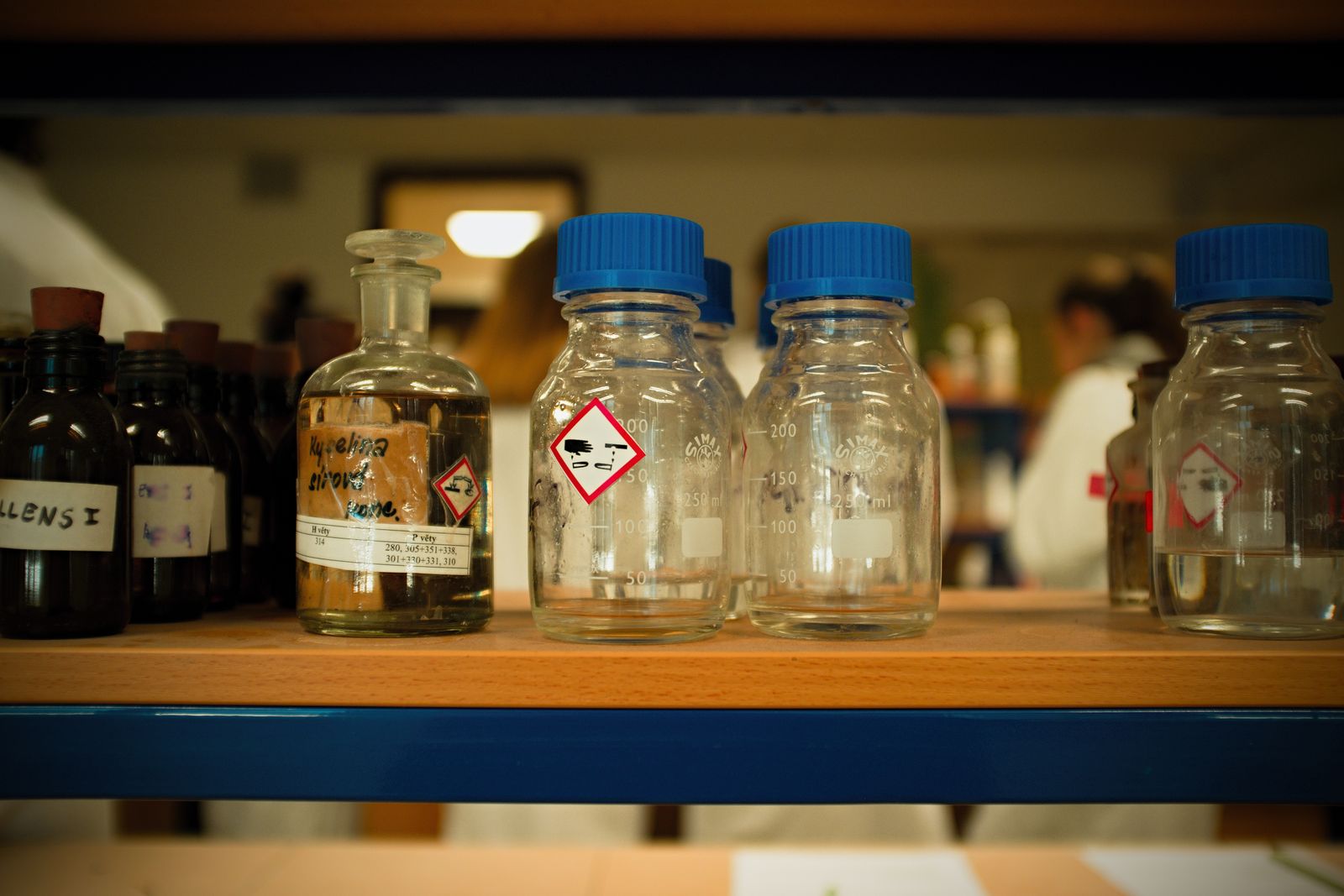
In March 1856, an 18-year-old chemistry student named William Henry Perkin was working through the Easter holiday in a makeshift home laboratory in London, trying to synthesise quinine from coal tar to impress his professor. What he got instead was a black, tarry mess at the bottom of a flask. When he tried to clean it out with alcohol, the solvent turned an intense, otherworldly purple — a colour no European had ever produced from anything other than a Mediterranean sea snail. That flask launched the entire synthetic dye industry.
The compound Perkin isolated is now called mauveine. It was the world’s first synthetic organic dye, and it emerged from a failed malaria drug experiment run by a teenager on his school holiday.
A schoolboy chemist with a coal-tar problem
Perkin was born in 1838, in London’s East End. According to the Science Museum Group, his interest in chemistry took hold in boyhood, after a friend showed him how soda and alum form crystals; he soon began experimenting on his own, later making use of a disused laboratory at his grandfather’s old home.
By his mid-teens he had talked his way into the Royal College of Chemistry in London, where he studied under the German chemist August Wilhelm von Hofmann. Hofmann was fixated on coal tar — the black, sticky waste product piling up outside every gasworks in Victorian Britain. Gas lamps lit the streets. Coal tar was the leftover.
Hofmann suspected coal tar hid useful molecules. One of the prizes he dangled in front of his students was quinine, the anti-malarial extracted from the bark of South American cinchona trees. Malaria was killing British troops across the empire. Cinchona was expensive and slow to grow. A synthetic version would be worth a fortune.
The Easter holiday experiment
During the Easter break of 1856, Perkin set up a home laboratory and started trying to build quinine from aniline, a coal-tar derivative. His chemistry was wrong — nobody yet understood molecular structure well enough to know that you cannot get quinine out of aniline that way. The actual structure of quinine would not be fully worked out for decades.
What Perkin got was a black sludge. He was about to throw it out. But before he did, he added alcohol to the flask to dissolve the residue, and the liquid turned a startling, saturated purple. When he dipped a strip of silk in, the silk took the colour and held it — through washing, through sunlight, through soap.
Purple was the point. In 1856, purple cloth was the exclusive property of the very rich. The only reliable purple dye in the West was Tyrian purple, extracted from the glands of murex sea snails on the Mediterranean coast — thousands of snails per small amount of dye, a technique the Phoenicians had used and the Roman emperors had guarded. A rich, colourfast purple pouring out of a coal-tar flask in a London home laboratory was closer to alchemy than chemistry.
From flask to factory in a year
Most 18-year-olds would have written up the observation and gone back to school. Perkin filed a patent in 1856, dropped out of the Royal College of Chemistry against Hofmann’s furious advice, and convinced his father and older brother to help him build a dye factory at Greenford Green, on the outskirts of London.
The timing was almost absurdly lucky. Perkin’s purple hit the market just as fashion trends were shifting toward bolder colours, and Queen Victoria wore a mauveine-dyed gown to the Royal Exhibition of 1862. The resulting fashion craze spread rapidly across society.
Within five years, mauve was on bonnets, gloves, ribbons, and postage stamps across Europe. The British Penny Lilac stamp, issued in 1881, used a Perkin-descended aniline dye.
What was actually in the flask
For most of the 20th century, chemists assumed mauveine was a single compound. It is not. In 2007, a team led by João Seixas de Melo of the University of Coimbra and Maria João Melo of the New University of Lisbon, in Portugal, used chromatography and mass spectrometry on museum samples of Perkin’s dye and identified two more compounds hiding in the mixture — mauveine B2 and mauveine C — building on 1990s work that had first pinned down two isomers. Later analyses pushed the count past a dozen related molecules, all dominated by the two labelled mauveine A and mauveine B.
The reason is that the aniline Perkin used was not pure. It was contaminated with toluidines — closely related molecules with an extra methyl group — and it was the impurities, cross-reacting with the aniline, that produced the purple. If Perkin had used clean aniline, he would have got a different, less useful mess. The failed malaria experiment worked because the starting material was dirty in exactly the right way.
Louis Pasteur’s line — “chance favours only the prepared mind” — gets quoted a lot around this story, and for once it earns its keep. A less curious 18-year-old rinses the flask and moves on.
The industry that grew out of a purple stain
Mauveine itself had a short commercial life. By the late 1860s, German chemists — many of them Hofmann’s other students — had figured out how to synthesise magenta, then alizarin (the red of madder root, first made synthetically in 1869), and eventually the full rainbow of aniline dyes. The German firms that grew up around this chemistry included Badische Anilin und Soda Fabrik, Farbenfabriken Bayer, and Aktiengesellschaft für Anilinfabrikation. Today they are known as BASF, Bayer, and Agfa.
The same coal-tar chemistry that produced mauve went on to produce aspirin and the first sulphonamide antibiotics, and much of the early pharmaceutical industry. As chronicles of accidental discoveries have documented, Perkin’s purple stain is arguably the single most consequential lab accident of the 19th century — the moment organic chemistry stopped being an academic curiosity and became an industry.
A plaque outside Perkin’s former London house commemorates his role in founding science-based industry. That is not hyperbole. Before mauveine, chemistry was mostly a discipline for describing what nature had already made. After mauveine, chemistry was a way to manufacture molecules nature had never produced.
Synthetic dyes also became one of the great environmental legacies of industrial chemistry, and that legacy is still being tallied. The textile-dye industry now discharges substantial quantities of dye into waterways every year, much of it in South and Southeast Asia. As the Victoria and Albert Museum has documented in its work on textile sustainability, the rivers downstream of dyeing towns in Bangladesh, India, and China sometimes run the exact colours of that season’s fast-fashion collections.
Aniline itself is toxic. Perkin’s own factory workers at Greenford Green worked with compounds now known to be carcinogenic. Bladder cancers among 19th-century dye workers in Germany were among the first documented industrial cancer clusters.
The synthetic-materials arc that started in Perkin’s flask now extends to graphene fabrics and shape-memory polymers, as a recent Domus feature on the future of textiles traces. Every one of those materials descends, in a genealogical sense, from a black sludge in a London flask in 1856.
A colour that changed what colour meant
Perkin sold his dye company in the 1870s, still in his thirties, and retired wealthy to spend the rest of his life on pure research. He worked out the Perkin reaction, a method for making unsaturated organic acids that still bears his name in undergraduate textbooks. He was knighted in 1906, on the fiftieth anniversary of the mauveine discovery, and died the following year, in 1907.
The jubilee staged in his honour that year drew chemists from across Europe and the United States; guests wore mauve. The Society of Chemical Industry still awards the Perkin Medal — the highest honour in American applied chemistry — every year, and Perkin himself was its first recipient, at a banquet in New York in 1906.
Before 1856, colour was agricultural. Red came from madder roots or cochineal beetles. Blue came from indigo plants or woad. Yellow came from weld or saffron. The palette of any given culture was constrained by what grew nearby and what could be traded in from far away, and the deepest, most saturated colours were reserved for the people who could afford imported bugs and snails.
After 1856, colour became a manufacturing question. Any hue could be built from coal tar if you knew the recipe. The democratisation of bright clothing — the fact that a factory worker in Manchester in 1880 could wear a purple ribbon without being mistaken for a duchess — starts in that Easter-holiday flask.
The same chemistry that gave the world cheap purple silk gave it aspirin and antibiotics and, eventually, the reactive dyes now running through rivers in Dhaka. Terra Daily has written before about how a single decision in 1850s London can echo across centuries, and Perkin’s flask belongs on that same short shelf of Victorian accidents that quietly rearranged the modern world.
A scrap of silk dyed with Perkin’s mauve still survives, in the Science Museum in London. Under museum lighting, more than 170 years after a schoolboy tipped alcohol into a ruined flask, the purple is still there.
