

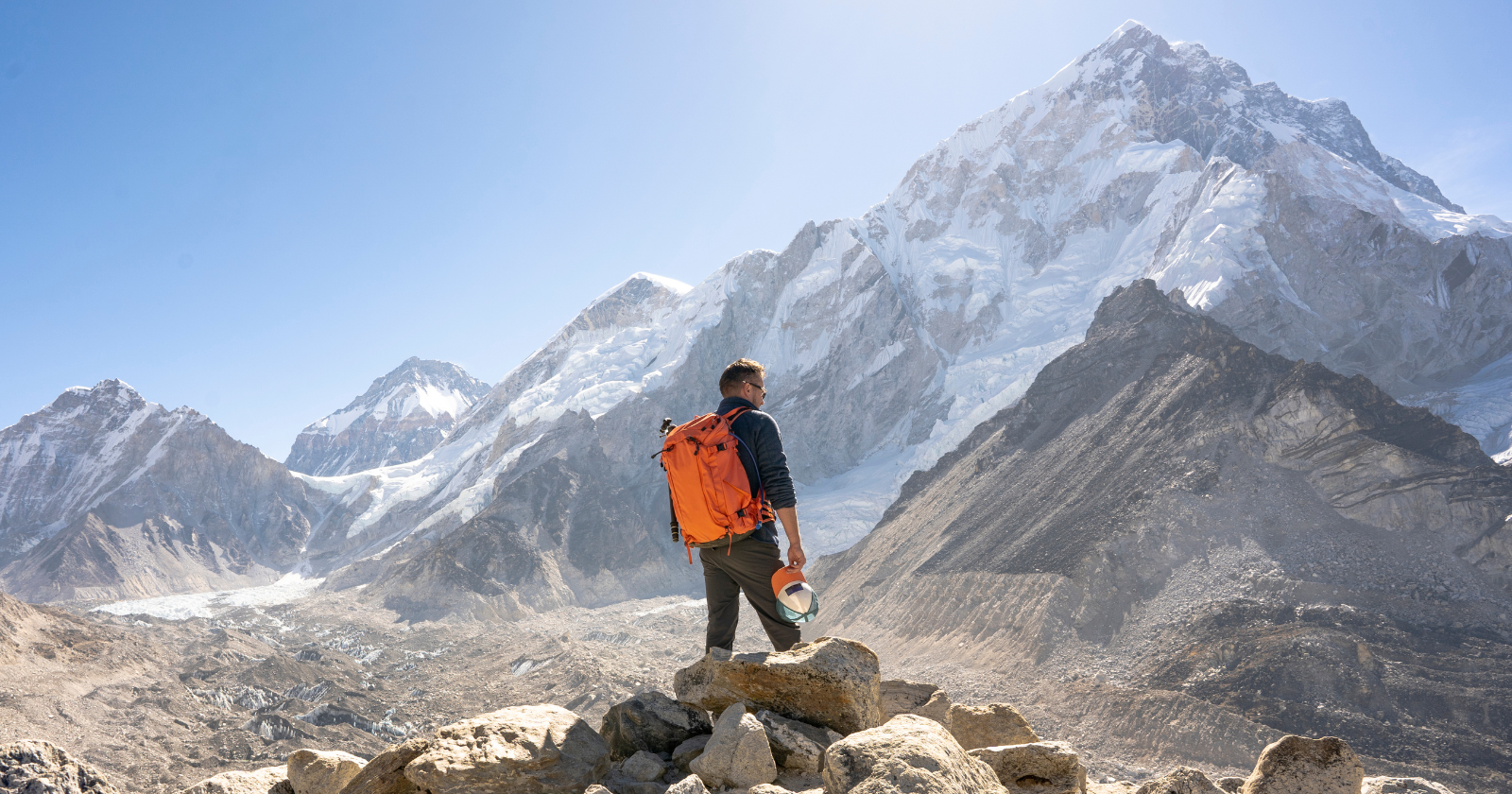
Ask almost anyone which point on Earth is closest to space and you’ll hear “Everest” straight away. It’s the answer taught in schools, printed in atlases, repeated at trivia nights. And it quietly assumes something most people never question: that “highest” has only one meaning. It doesn’t. Pick a different meaning and the crown goes to a mountain in Ecuador that most people have never heard of.
That mountain is Chimborazo, a potentially active volcano in the Andes. It’s more than two kilometres shorter than Everest, so by the usual measure it isn’t even in the running. But by a different, equally valid measure, it beats Everest and every other peak on Earth. The reason has nothing to do with the mountains. It has to do with the shape of the planet.
Everest’s title depends on how you measure “high”
Start with what’s true. Everest is the point with the highest elevation above sea level on Earth. Its summit sits at 8,848.86 metres above that baseline, a figure Nepal and China agreed after separate surveys and a joint announcement in 2020. No other peak comes close by that standard.
But notice the qualifier. “Above sea level” is a choice. It measures a mountain from a reference surface approximating global mean sea level. That baseline is convenient, and it’s the one we’ve agreed to use. It is not the only way to ask how far a summit reaches.
Swap the baseline for the centre of the Earth, and the ranking changes. Everest is not the summit that is farthest from the Earth’s centre. It keeps its sea-level title. It just loses a different contest most people never knew was being run.
A bulging Earth changes the finish line
The Earth isn’t a perfect sphere. It spins, and that rotation pushes its middle outward, so the planet bulges at the equator and flattens a little at the poles. A slightly squashed ball, not a clean round one.
The difference is not trivial. Measured from the centre, the Earth’s polar radius is about 6,356.8 km, while its equatorial radius is about 6,378.1 km. That’s a gap of roughly 21 kilometres. A point at sea level on the equator is already about 21 kilometres farther from the core than one at sea level at a pole, before it climbs a single metre.
That head start is enough to reorder the world’s summits. So the question “which summit reaches farthest from the centre” is about latitude as much as elevation. The winner will be a very high mountain sitting close to the equator.
Chimborazo’s case, by the numbers
Chimborazo sits about one degree south of the Equator, where the bulge is near its fullest. A 2016 geodetic survey measured its summit at 6,263.47 metres above sea level, more than two and a half kilometres below Everest. The Library of Congress geography blog notes it is reportedly only the 39th tallest mountain in the Andes.
Add its equatorial position and the maths flips. NOAA states it plainly: “the summit of Chimborazo is over 2,072 meters farther from the center of the Earth than Everest’s peak. That makes Chimborazo the closest point on Earth to the stars.” Take “closest to the stars” as shorthand for farthest from Earth’s centre, not a literal astronomical measurement. The 2016 survey placed Chimborazo’s summit about 6,384.416 km from the centre, against Everest’s roughly 6,382.3 km.
The win is real but narrow and Everest is beaten on this measure by at least 26 other summits, all at relatively low latitudes.
So which definition should win?
I don’t think there’s a clean answer, and the muddle is arguably the interesting part. If “closest to space” means “highest above sea level and highest into the atmosphere,” Everest holds firm. Its summit reaches much thinner air than Chimborazo’s. On the scale that governs how hard it is to breathe, height above sea level is the honest measure.
If “closest to space” means “farthest from the middle of the planet,” Chimborazo takes it. Distance from Earth’s centre is a real physical fact. The point of the solid Earth reaching farthest outward being a volcano in Ecuador, not the peak on every poster, is worth sitting with for a moment.
Both mountains are telling the truth. The disagreement isn’t about the rocks. It’s about which starting point we treat as the real bottom, sea level or the core, and neither choice is wrong. They’re answering different questions. Calling something “the highest” smuggles in a decision about what we’re measuring from. Everest wins the contest we usually mean. Chimborazo wins one we rarely think to ask.