
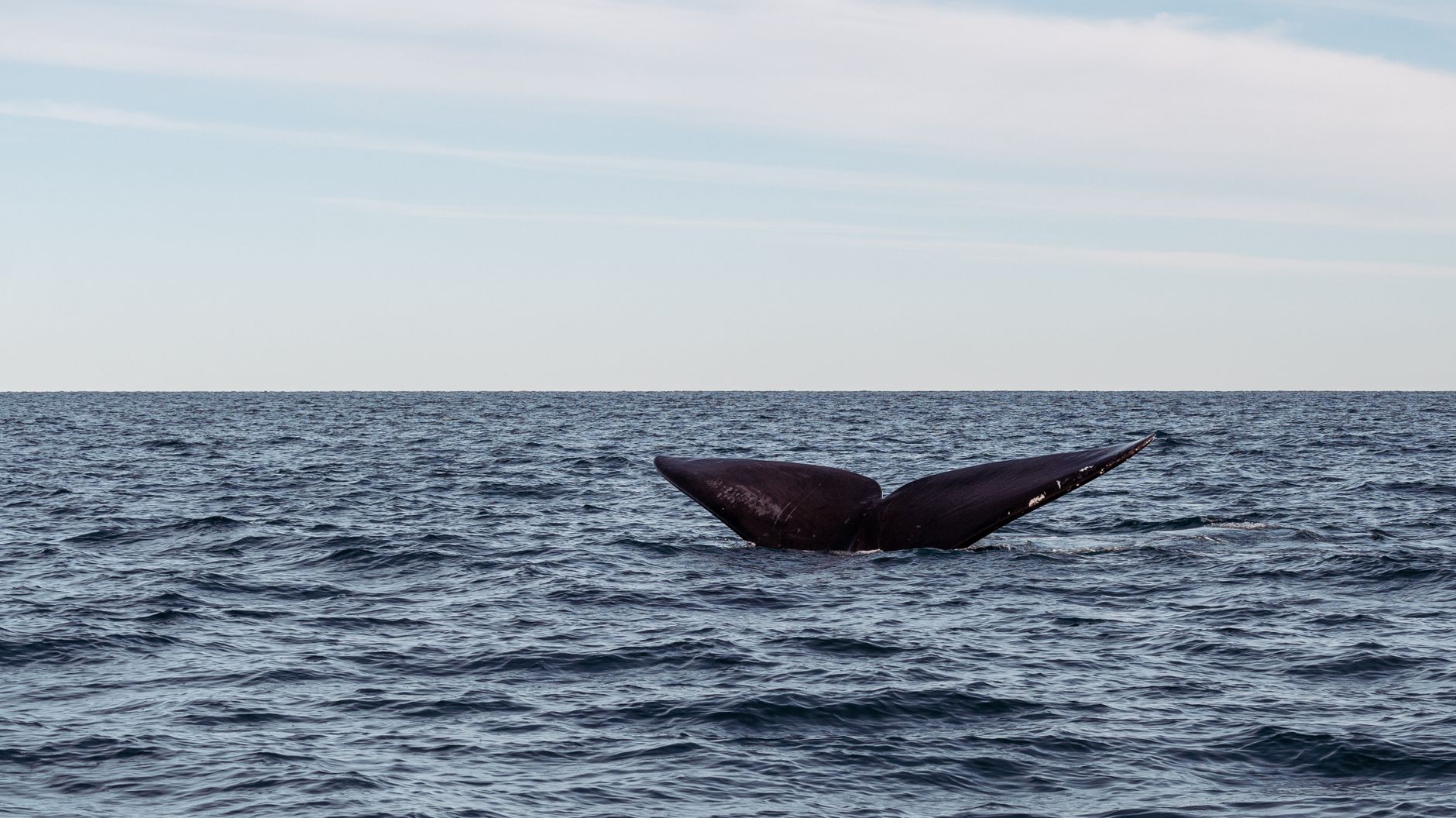
The whale called 52 Blue is famous because of a number, but the story really begins with absence. No confirmed photograph. No satellite tag. No biopsy. No certain species. Only a voice, picked up again and again in the North Pacific, calling at a frequency that did not match the great whales moving through the same ocean.
That is how one animal became one of marine biology’s most haunting mysteries. A team at the Woods Hole Oceanographic Institution first detected the unusual sound in 1989, then recorded it again in 1990 and 1991. WHOI later described it as a repeated, low-frequency whale-like call centred near 52 hertz, much higher than the normal 15-to-25-hertz range then associated with blue or fin whales in that context.
The public gave the unknown animal a name: 52 Blue. It has also been called the loneliest whale in the world. That title is more poetry than proof, but it stuck because the facts themselves are already strange enough. For years, an acoustic signal that looked like it came from a single source kept appearing in the same enormous ocean basin, and researchers could not find another call quite like it.
A whale known only by sound
The best scientific account appeared in 2004 in Deep Sea Research Part I. William Watkins, Mary Ann Daher, Joseph George and David Rodriguez reported that a unique whale call with emphasis around 50 to 52 hertz had been tracked over 12 years in the central and eastern North Pacific. The calls were recorded by hydrophones from the U.S. Navy’s Sound Surveillance System, known as SOSUS, and other arrays.
The paper says the calls were first noticed in 1989 and had been detected and tracked since 1992. It also gives the detail that made the animal famous: no other calls with similar characteristics were identified from any hydrophone system in the North Pacific basin, and only one series of the calls was recorded at a time. That lack of overlap suggested a single whale was producing them.
This is important because the 52-hertz whale was not followed in the way people imagine a whale being followed. No research vessel trailed beside it for decades. Scientists followed a pattern in underwater sound: call groups, timing, direction, arrival at different listening stations and seasonal movement through a basin too large for visual tracking to make sense.
In some ways, that makes the case more remarkable. Most individual whales cannot be tracked acoustically for years. The WHOI team reported seasonal tracks that ranged from 708 kilometres to 11,062 kilometres, with travel speeds between 0.7 and 3.8 kilometres per hour. It was a voice moving through the map.
Why the frequency mattered
A frequency of 52 hertz is not high by human standards. It is a low rumble, close to the bottom of what many people can hear. But in the world of baleen whales, frequency is not just pitch. It is range, identity, habitat and social possibility.
Blue whales and fin whales are famous for very low sounds. NOAA’s Pacific Marine Environmental Laboratory lists an Atlantic blue whale call as a narrow-band low-frequency moan at about 19 hertz. NOAA’s page on the 52-hertz sound describes the mystery signal as whale-like tones with an average centre frequency of 51.75 hertz, lasting about five to seven seconds and usually occurring in small groups.
That made the call unusual rather than simply loud. The NOAA PMEL sound archive labels it cautiously as “52 Hz sound – blue whale call?”, with the question mark doing real work. The sound resembled a baleen whale call, but the species producing it was not known. The authors of the 2004 paper considered possibilities including a malformation or a hybrid, but the acoustic record alone could not settle the animal’s body.
The call’s frequency also drifted over time. In the scientific account, the 52-hertz name is a convenient label, not a perfect metronome. The signal was centred near 50 to 52 hertz, and the source was recognised by a cluster of acoustic features, not one fixed musical note.
The loneliness is harder to prove
The story people tend to tell is that no other whale can hear 52 Blue. That is too simple. Baleen whale hearing is difficult to measure directly, and large whales do not politely report what they can detect. But 52 hertz is not outside the broad low-frequency world of baleen whales.
What the evidence does show is narrower and still compelling. In the data examined by Watkins and colleagues, the call was unique. The tracked paths appeared unrelated to the locations and movements of blue, fin and humpback whales monitored year-round with the same hydrophones. No matching caller appeared in the record. No call overlap suggested a second animal using the same pattern.
That is why “as far as anyone knows” matters. Scientists cannot prove that no whale ever answered outside the range of the arrays. They cannot know whether 52 Blue ever swam near another whale, reproduced, or travelled in company while silent. They cannot know whether the animal experienced anything like loneliness.
But the absence of a matching signal is not nothing. It means that, in one of the best acoustic listening efforts ever applied to the North Pacific, researchers found one extraordinary voice and no confirmed counterpart.
Sound is how the ocean becomes visible
The power of this story comes partly from the way whales live. For large baleen whales, sound can cross distances that vision never could. NOAA Fisheries describes blue whales as among the loudest animals on the planet, producing pulses, groans and moans. In the right oceanographic conditions, NOAA says blue whale sounds may be heard by other whales up to 1,000 miles away.
NOAA’s Ocean Service makes the broader point simply: whales use sound to communicate, locate food and find each other. In water, sound travels faster than it does in air, and the structure of the ocean can carry some sounds over vast distances. In a dark, three-dimensional world, a call is not decoration. It is presence.
That is also why human listening systems changed whale science. SOSUS was built during the Cold War to listen for submarines. Once parts of it were made available for research, the same infrastructure became a way to hear animals across ocean basins. The 52-hertz whale was not discovered because someone saw a strange animal. It was discovered because a military listening network became an ecological instrument.
NOAA’s Pacific marine mammal sound archive places the 52-hertz call alongside blue whale, fin whale and humpback recordings from the Pacific, allowing the difference to be seen as well as heard in spectrograms. The mystery is not just that 52 Blue sounded different. It is that the difference persisted long enough to trace movement through years.
The myth remains, but the science is better
It would be easy to make 52 Blue into a fable and stop there: one whale, one wrong note, one lifetime of unanswered calls. The real animal is harder to hold and more interesting. It may have been a hybrid. It may have had an unusual anatomy. It may not have been as isolated as the legend suggests. It may even be that later listening, with better instruments and different coverage, will complicate the original story further.
Still, the name survives because it captures something true about the evidence. A single distinctive call was followed across the North Pacific for years. It did not match the ordinary acoustic signatures of the blue, fin and humpback whales being monitored around it. No confirmed companion voice appeared beside it in the record.
That leaves 52 Blue suspended between data and metaphor. The data says: a unique whale-like call, detected first in 1989, tracked for 12 years, probably from one individual, moving through the North Pacific in seasonal patterns. The metaphor says: a voice in the dark, audible across great distances, unanswered in every record we have.
The responsible version of the story does not need to choose between them. The science gives the mystery its shape. The mystery gives the science its emotional force. Somewhere in the North Pacific, a whale once made itself known without ever being seen, and the ocean kept enough of its voice for humans to realise how much life can pass through the world as sound alone.
