
For a short stretch of a favorable Martian afternoon, the sunlit ground near the equator can reach roughly 20°C. It is one of those facts that makes Mars sound almost welcoming. Then the light fades, the surface radiates its heat into space, and temperatures can fall through a range that would count as extreme even in Antarctica.
A pre-dawn surface temperature near −84°C is entirely plausible, but the two numbers in the headline should not be mistaken for a universal forecast for every equatorial site or a guaranteed reading on the same day. Mars varies with season, elevation, dust, latitude and the texture of the ground. NASA says the planet as a whole can range from about 20°C at the warm end to −153°C at the cold end. The remarkable part is how quickly a single place can move between extremes.
A warm surface is not warm weather
The first trap in talking about Martian temperature is the word temperature itself. A weather station can measure the thin air around a rover. An infrared sensor can measure the radiating temperature of the soil and rock. Those readings are not interchangeable.
On Earth, dense air, moisture and turbulent mixing usually keep the ground and the air above it coupled closely enough that the distinction can feel academic. On Mars, it can be dramatic. NASA notes that at the equator at noon, a person’s feet could experience a ground temperature near 24°C while the air at head height could be around 0°C. The sun can warm a shallow skin of dark soil without warming much atmosphere above it.
Curiosity showed the gap almost immediately after landing in Gale Crater, just south of the equator. During one early sol in August 2012, its Rover Environmental Monitoring Station recorded ground temperatures from 3°C down to −91°C. The air over the same period ranged from −2°C to −75°C. The soil swung farther because it absorbed sunlight directly and then lost that energy directly to the sky.
That is why a quoted afternoon high of 20°C and a morning low of −84°C are best understood as representative surface values under favorable conditions, not as the daily air-temperature forecast for all of equatorial Mars.
The atmosphere is there, but barely
Mars does have an atmosphere. Calling it absent is a useful image, not a literal description. It is mostly carbon dioxide, with smaller amounts of nitrogen and argon, and its pressure averages only around 0.6 percent of Earth’s sea-level pressure. NASA describes it simply as less than one percent of Earth’s atmospheric pressure.
That thinness changes everything. Earth’s atmosphere acts as a moving reservoir of heat. It absorbs energy, circulates it, and sends some of the infrared radiation leaving the surface back downward. Oceans, water vapor and clouds add still more thermal inertia. Together, they soften the transition from afternoon to night.
Mars has no ocean and almost no water vapor. Its atmosphere contains too little mass to store much daytime heat or redistribute it efficiently. Once the sun drops below the horizon, exposed ground begins radiating energy into a cold sky. The atmosphere offers only a weak thermal blanket.
The phrase “bleeds the heat away” captures the speed of the change, although the main escape route is radiation from the surface rather than warm air physically flowing off the planet. The ground cools first. The thin air touching it follows.
Dust gets cold faster than rock
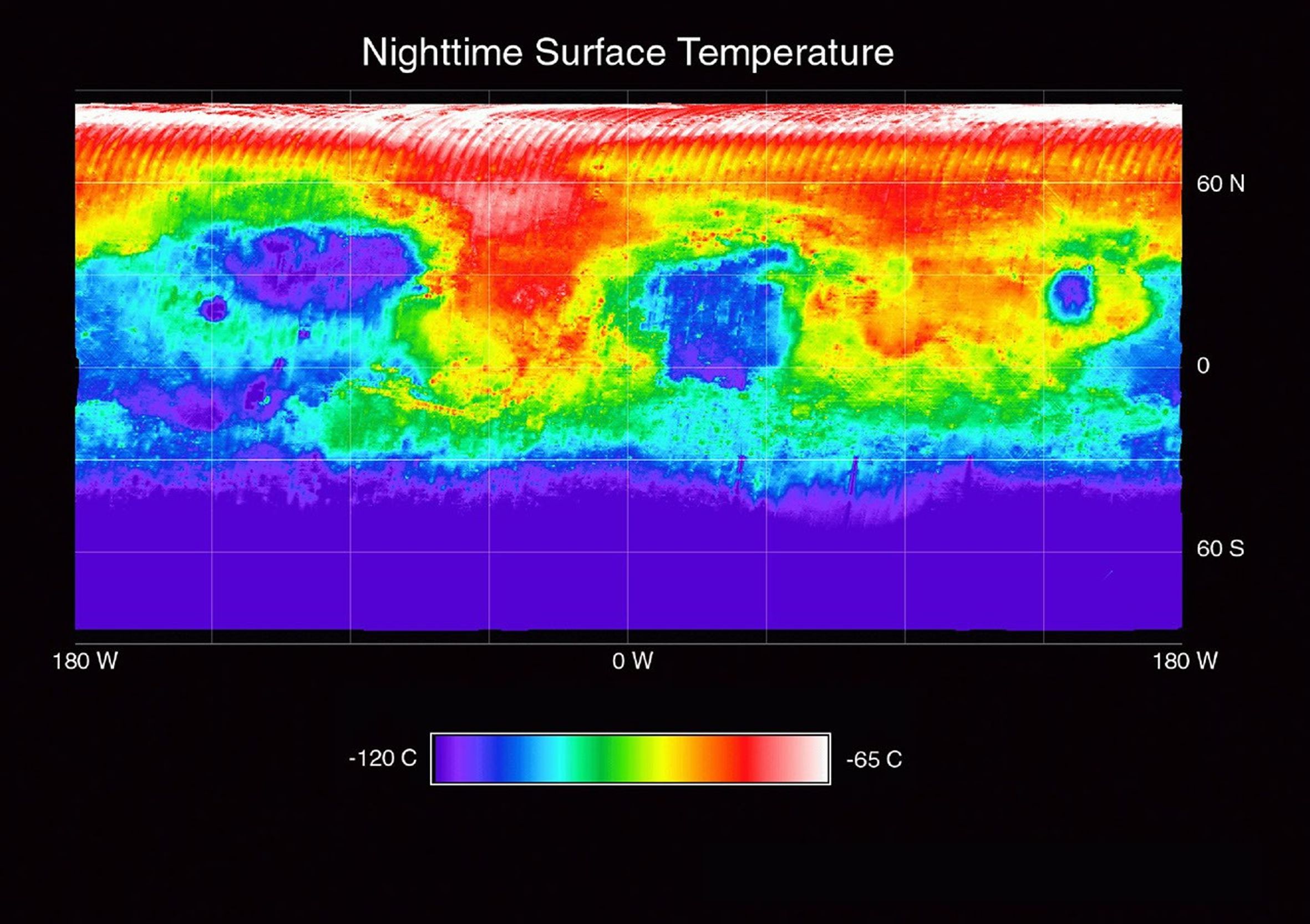
There is no single Martian nighttime temperature because the surface itself is a patchwork. Fine dust has low thermal inertia. It warms quickly in sunlight and cools quickly in darkness. Solid rock and coarse sand can store more heat and release it more slowly.
NASA’s Mars Global Surveyor made that contrast visible from orbit. Its Thermal Emission Spectrometer mapped the planet at roughly 2 a.m. and found nighttime surface temperatures from about −65°C to −120°C in the displayed data. Warm nighttime patches corresponded to rock, gravel and coarse sand. Colder patches marked fine-grained dust.
The map is also a warning against treating “the equator” as one climate station. Elevation changes atmospheric pressure. Slopes receive sunlight at different angles. Crater walls cast long shadows. Airborne dust can reduce daytime heating while also absorbing infrared energy and altering how the atmosphere cools after dark. Season matters, too, because Mars follows a more elliptical orbit than Earth.
The sunset plunge is written into the planet
A Martian sol lasts 24 hours, 39 minutes and 35 seconds, close enough to an Earth day that the rhythm would feel familiar. The thermal rhythm would not.
After sunrise, light strikes the regolith and the uppermost layer heats rapidly. Temperature usually peaks in the early afternoon, after the strongest sunlight, because the ground is still gaining more energy than it loses. Later, incoming solar energy weakens. At sunset it vanishes, but infrared radiation from the surface continues. The balance flips and the temperature falls.
Near dawn, the surface reaches its daily minimum. Then the cycle begins again. InSight, which landed at 4.5 degrees north in Elysium Planitia, was designed for near-surface air temperatures expected to span roughly −100°C to −20°C over its mission. Different instruments and locations report different ranges, but the severe daily pulse is consistent.
Mars also has atmospheric tides and clouds that complicate the simple picture. Water-ice clouds in the equatorial atmosphere can absorb infrared radiation rising from the surface, warming parts of the middle atmosphere. Measurements by the Mars Climate Sounder have even found temperature rises during the night as well as the day. Thin does not mean meteorologically inert.
Why 20°C would not feel like a spring afternoon
The familiar number is deceptive. On Earth, 20°C describes air dense enough to conduct heat, carry moisture and press against the body. On Mars, a 20°C patch of ground would sit under air that could still be below freezing and at a pressure far too low to support an unprotected human.
There is almost no breathable oxygen. The carbon dioxide atmosphere cannot sustain human respiration. The pressure is so low that survival requires a pressurized suit or habitat regardless of whether the soil happens to be warm. NASA researchers discussing human exploration put the point plainly: low pressure and the lack of oxygen would make an unprotected outing end quickly.
Temperature adds another engineering burden. A suit and habitat must survive a wide thermal cycle while keeping seals, batteries, electronics and life-support systems within narrow operating limits. Materials expand in daylight and contract at night. Batteries lose performance in deep cold. Water lines and mechanical joints need heating. Dust works into seals while the surface repeatedly warms and freezes.
For astronauts, the immediate danger outside would not be waiting until morning to freeze. Decompression and oxygen deprivation would come first. The daily temperature swing matters because every shelter, rover and suit must manage it continuously, sol after sol.
A thin line between familiar and alien
Mars is full of numbers that resemble Earth until they are placed in context. Its day is almost the same length. Its axial tilt gives it recognizable seasons. Its equatorial ground can briefly reach a temperature that would be comfortable in a living room.
But the resemblance is skin-deep. The warmth can be confined to the top few millimetres of sunlit soil. A short distance above it, the air may remain bitterly cold. A few hours later, the stored energy is gone and the same landscape is colder than any permanently inhabited place on Earth.
The afternoon reading is real. So is the pre-dawn plunge. What connects them is the defining fact of modern Mars: a planet with enough atmosphere to make weather, clouds and dust storms, but far too little to make a warm afternoon last.
