
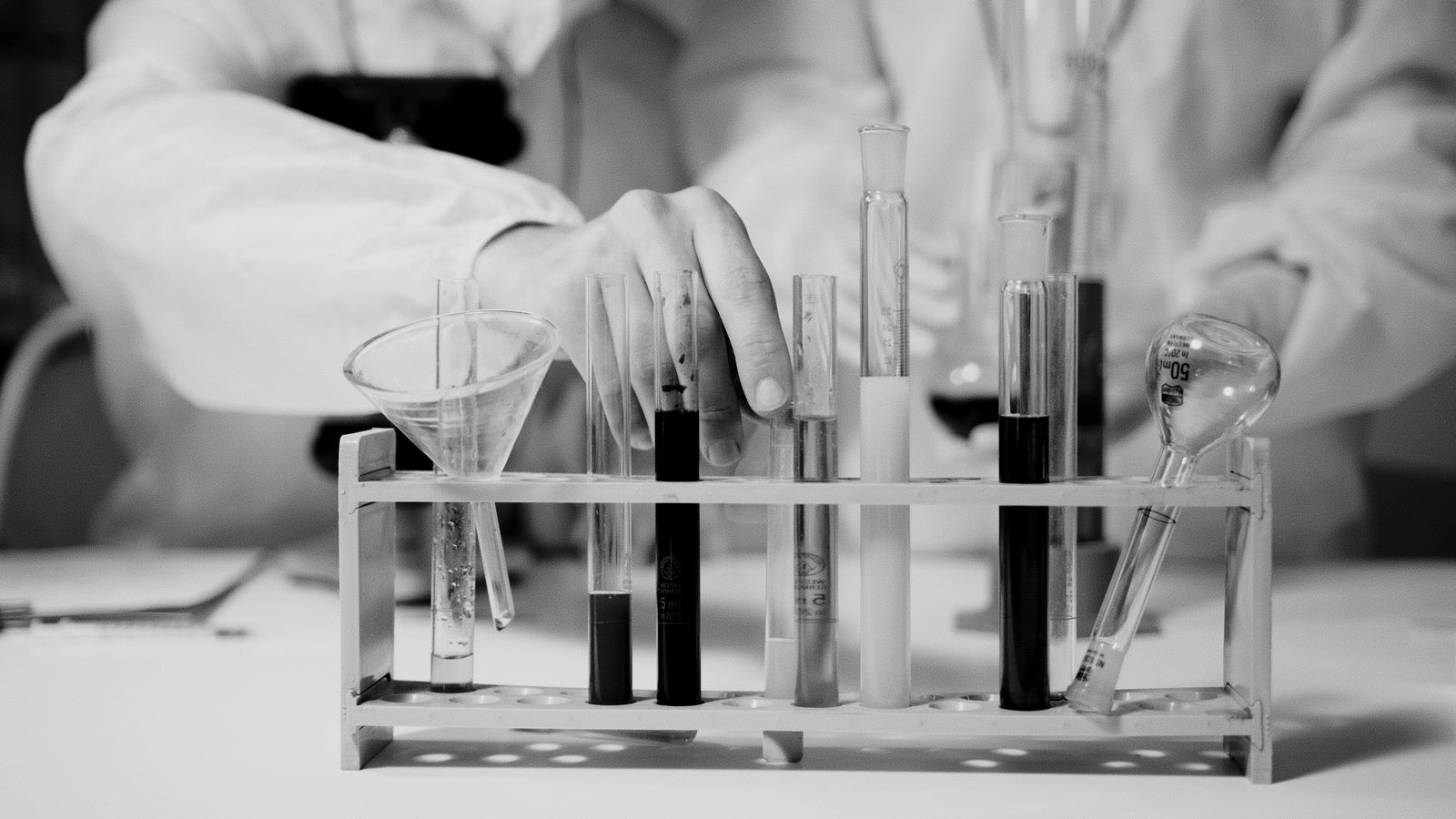
In 1902, after almost four years of chemical separation, Marie Curie possessed one decigram, about a tenth of a gram, of very pure radium chloride. It had come from several tonnes of uranium-mine residue, processed in batches small enough to handle with iron vessels, pine tables and a heavy stirring rod. In her own account of the work, Curie called that decigram the evidence chemistry demanded before radium could be accepted as a new element.
The room was as crude as the work was exacting. It was a wooden shed with a bituminous floor and a glass roof that admitted rain, not a room with beaten earth underfoot. A cast-iron stove barely changed the winter cold, and operations that produced irritating gases had to be moved into the courtyard whenever the weather allowed.
The radium products really did glow, but the best primary account does not place the 1902 decigram in a pale-blue vial on Curie’s nightstand. Curie remembered bottles and capsules arranged across the workroom, their outlines faintly visible when she and Pierre returned after dark. The documented image is already strange enough.
The floor was bitumen, not bare earth
The shed stood across a courtyard from the Curies’ measuring equipment at the École municipale de physique et de chimie industrielles in Paris. It had previously served as a medical dissection room. Curie described worn pine tables, gas burners, the unreliable stove and a blackboard Pierre liked to use, but no proper chemical hoods.
The raw material came from the state-run uranium works at St. Joachimsthal in Bohemia, now Jáchymov in the Czech Republic. Uranium had already been removed from the pitchblende, leaving residues the Curies expected to retain radium. With help from the Vienna Academy of Sciences, they obtained several tonnes at a low price.
The first sacks held brown dust mixed with pine needles because the residues had been left in a heap in the woods near the plant. Curie tested the material and found it more active than the original ore. The debris was a nuisance, but the waste was exactly what she needed.
She handled as much as 20 kilograms at a time. The shed filled with vessels of liquid and precipitate as she moved containers, transferred solutions and stirred boiling material for hours with an iron rod. The scale was industrial, but the labour was manual.
Marie and Pierre worked practically unaided in the shed for about two years before dividing the task. Pierre concentrated on the physical properties of the radiation. Marie continued the chemical purification that would turn a radium-bearing mixture into a measurable salt.
Why one decigram took almost four years
Radium was present only in traces. In a 1921 lecture at Vassar College, Curie said that even good ore held less than one part radium in a million. Working from uranium-processing residue helped, but it did not remove the need to separate an enormous mass of chemically similar material.
Her method followed the radioactivity. After each chemical separation, the Curies measured which fraction remained most active, then carried that fraction forward. Radium travelled with barium because the two elements behave similarly in chemical reactions.
Curie extracted radium-bearing barium, converted the material to chlorides and used fractional crystallisation. Radium chloride concentrated in the less soluble crystals, but only a little more with each cycle. The final stages were especially delicate because iron and coal dust drifted through the shed.
By 1902, the material displayed the properties of a pure chemical substance and produced radium’s characteristic spectrum. Curie had enough radium chloride to determine an atomic weight much higher than barium’s. Her later measurements refined the value to approximately 226.
The chronology matters. Marie and Pierre Curie, with Gustave Bémont, announced evidence for radium in December 1898, but the chemical purification continued for years. The Bibliothèque nationale de France’s history of the discovery records the 1898 identification, the 1903 Nobel Prize in Physics shared with Henri Becquerel and Marie Curie’s 1911 Nobel Prize in Chemistry.
The glow belonged to the workroom
Curie’s description of the night-time laboratory is precise. She and Pierre could see the “feebly luminous silhouettes” of their bottles and capsules, and she compared the tubes to “faint, fairy lights.” The words appear in her autobiographical notes and are reproduced in the American Institute of Physics history of the work.
That account does not assign the light a colour, identify one particular vial as the 1902 decigram or place a sample beside her bed. Later retellings often supply blue or green light and move the material into domestic space. Those details should not be presented as established fact without a contemporaneous source.
What is secure is that material containing concentrated radium could produce visible luminescence. The glow was not proof that pure radium chloride is naturally blue. It was an effect associated with intense radioactive decay and the material surrounding the source.
The bodily damage is documented too. The AIP historical account says both Curies permanently damaged their fingertips through unprotected exposure, and the journalist Marie Mattingly Meloney later described Marie’s fingers as rough and numb. That supports damaged fingertips, not the more extreme claim that her fingers were destroyed.
The draft also gives Pierre an accident that belonged to Becquerel. Curie’s autobiography says Henri Becquerel developed a burn after carrying a tube of radium salt in his vest pocket. Pierre deliberately exposed his arm to radium for several hours, producing a progressive lesion that took months to heal.
The Curies did not understand the risk at the beginning, but Marie did not remain unaware for the rest of her career. By the 1920s she was advocating lead screens and periodic blood tests for radium workers. A Physics Today history of her safety work records her 1929 warning that radium was dangerous in untrained hands.
A burn became a medical clue
Pierre’s skin experiment helped establish that radium could injure living tissue. Physicians then explored whether a controlled exposure could destroy diseased tissue, and Henri-Alexandre Danlos used radium on skin lesions at Paris’s Hôpital Saint-Louis in 1901. The Institut Curie’s historical account places those early treatments at the beginning of curietherapy, now called brachytherapy.
The 1902 decigram should not be confused with the later international radium standard. In 1911, Curie prepared a separate sealed tube containing 21.99 milligrams of pure radium chloride for international comparisons. NIST’s history of the standards records that preparation and the secondary standard sent to the United States in 1913.
The Curies published their separation methods and did not patent them. The decision let other laboratories and manufacturers reproduce the process, but it did not make the family rich. The radium industry expanded rapidly as medical demand grew.
By 1921, radium cost about $100,000 per gram, far beyond Curie’s laboratory budget. The journalist Meloney organised an American fundraising campaign that bought one gram for the Paris institute, and Curie travelled to the United States to receive it. Smithsonian Magazine’s history of the tour makes clear that this was a new gram, not the original decigram from the shed.
The radioactive archive is real, but less cinematic
Marie Curie died on 4 July 1934, aged 66, from aplastic pernicious anaemia. The sanatorium director attributed the failure of her bone marrow probably to a long accumulation of radiation, according to the AIP history of her final years. Her career included early unshielded work with radium and extensive work around X-ray equipment, so the evidence does not justify assigning her fatal exposure to one vial or even to the shed alone.
Her laboratory notebooks do retain radioactive contamination, but the familiar account of universally lead-lined boxes, waivers and protective suits overstates what the BnF now says. The library reports that the most contaminated sheets were encapsulated, some covers were protected with plastic, microfilms were made and access to originals is limited by a strict protocol. In 2026 it also reported that a ten-minute exposure beside two displayed notebooks added no radiation above natural background at the measurement point.
The laboratory visitors see at the Musée Curie is not the leaking shed where the decigram was made. The museum occupies the later Radium Institute, whose buildings were completed in 1914. It is a different laboratory from the wooden shed described in Curie’s account.
What a 1,600-year half-life actually means
Radium-226 has a half-life of about 1,600 years, a value listed by the International Atomic Energy Agency. Applied to a fixed population of radium-226 atoms present in 1902, that means roughly 94.7 per cent would remain in 2026. The original draft’s 97 per cent figure is too high.
The arithmetic cannot tell us where all of Curie’s radium is now. Samples were divided, loaned, transferred into standards and used in experiments, while some atoms decayed into other elements. A half-life tracks an isotope population, not the custody of every grain or the contamination level of every object it once touched.
The same decay arithmetic appears in Terra Daily’s account of the uranium clock on the Voyager Golden Record and in the much larger story of how radioactive decay contributes to Earth’s internal heat. In 3602, one half-life after Curie’s 1902 decigram, about half of its original radium-226 atoms would remain if the material could be gathered back together. The most defensible image is not a blue bedside vial, but rows of faint laboratory silhouettes, barely visible above the pine tables while rain found its way through the glass roof.
