
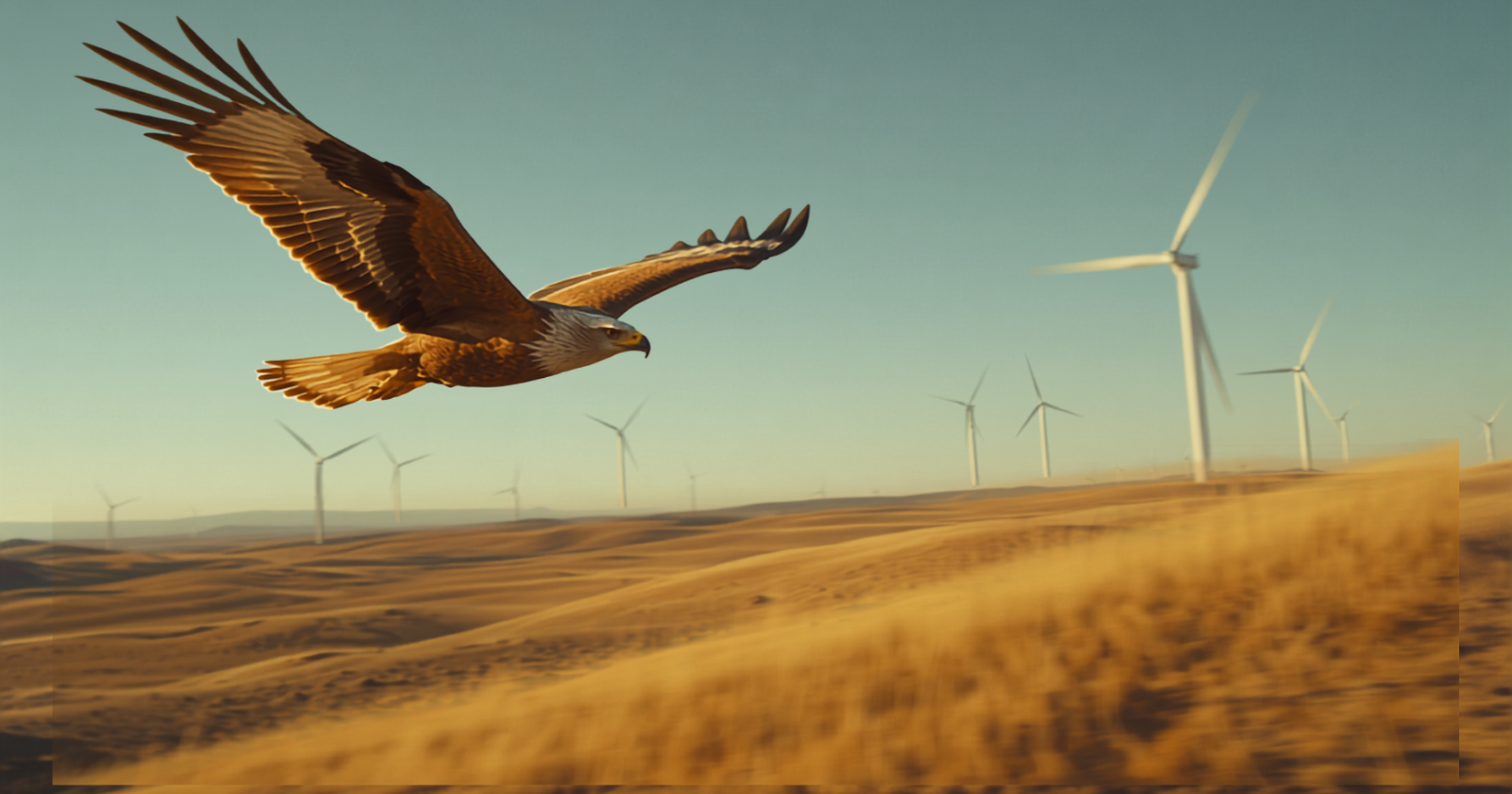
Drive east out of San Francisco and the grass arrives before the turbines do. Altamont Pass is a low saddle in the northern Diablo Range, where valley heat pulls cool Bay air through the hills and the wind comes already organised. Golden eagles have used that lift for as long as anyone has watched the ridge. The first machines went up in the 1980s on a private ranch, before anyone counted the birds already living there.
The two uses of the air never came apart. About 60 golden eagles are still killed each year in Alameda County, most of them on this farm. More than 200 of the birds live in the Altamont country. And a seven-year U.S. Geological Survey study kept finding as many as 21 pairs defending territory inside the wind resource area itself — not on some neighbouring hill, but on the same ground the rotors sweep.
That is the part the ridge does not advertise from the freeway. The eagles do not only die here. They nest here.
The same wind
The pass sits roughly 90 kilometres east of the city, grazed grassland between Livermore and Tracy. Hot valley air and cooler Bay air push some 25 to 45 kilometres an hour across the saddle. That is why the farm is here, and why the eagles are here: large, dark birds with gold on the nape and wings that stretch more than two metres, hunting ground squirrels on the same updrafts a turbine is built to catch.
The early farm was a forest of short towers. A California Energy Commission study led by Shawn Smallwood and Carl Thelander found those low rotors sat at the height golden eagles use when they hunt. Later estimates from the same programme put those years’ eagle deaths around 67 a year, with a wide band of uncertainty. An older all-bird figure from that era, still quoted as a live count, is neither a current census nor an eagle number.
Radio-tag work begun in the 1990s found turbine blades accounted for about two in five of the deaths the transmitters could explain, most of them young and unpaired birds rather than the ones sitting on nests. A later Energy Commission report put the harder puzzle this way: territories around the pass have looked stable, even as the death rate should have been pulling the local population down. Something has been filling the map.
Twenty-one pairs inside the farm
Between 2014 and 2021, USGS crews walked 5,185 square kilometres of the Diablo Range, the pass included. In the wider country they mapped as many as 230 territorial pairs. Inside a 3.2-kilometre ring around the turbines — the distance the U.S. Fish and Wildlife Service treats as a working risk radius — they kept finding up to 21 pairs in a given year.
Those pairs were not just loitering. The survey documented nesting, or nest-building, at 18 of the 21 territories. Several pairs put sticks down less than 1.5 kilometres from blades that were turning. In 2020 and 2021 more than a quarter of the pairs watched on the farm fledged at least one young. An earlier USGS pass, in 2014–16, had already shown many of these territories had been missed. Young birds raised among the towers, if they live, tend to look for a territory near Altamont when they are about four.
The age of the birds on the ridge
Age was the thing that would not look ordinary. Twenty-nine per cent of farm pairs whose age was known included at least one subadult. Outside the farm that figure was 3 per cent. The simplest USGS reading is that adults on the farm die or are pushed out more often, and younger birds step in. Crews also saw more than four times as many unpaired subadults on farm sites. The pass is a place young eagles come to, and a place they die.
The radio-tag study had already sketched the cost of the older death rates: supporting some 55 to 65 blade-strike fatalities a year would have taken the yearly output of more than 200 breeding pairs. Occupancy still held. The map can look full and still be a sink. Golden eagles are protected under the Bald and Golden Eagle Protection Act. Killing one, even by accident, is a federal offence unless the Service has authorised the take.
A camera that can stop a blade
The old short towers are coming down, slowly. A recent agreement on the pass required a company running many of the older, smaller turbines to replace them with fewer, taller machines and to fit IdentiFlight — cameras that try to recognise a raptor and stop the blades. The operator has to walk the ground for carcasses. If the farm kills more than an average of four golden eagles a year, it owes money for each extra bird.
The cameras are not a rumour from a brochure. At a Wyoming farm, a USGS-linked study of automated curtailment found roughly 80 per cent fewer eagle deaths where the system ran than at a nearby farm without it. At Golden Hills, three years of follow-up monitoring found the cameras did not cut the golden eagle death rate in the first year. Once tuned and expanded, years two and three fell below the project’s own threshold — one farm, not the whole pass. About 60 a year is still the number the ridge is living with.
A nest in the machine
Stand on Patterson Pass Road on a wind day: gold grass, white towers, a dark bird on a thermal the blades are also using. This is not wilderness with a power plant next door. It is a nesting population that has decided the farm is home, and machines that still take about 60 birds a year. The cameras can stop a blade. The nest is still inside the farm. The eagles have treated the machine as country. That is the unfinished story of the ridge.
