
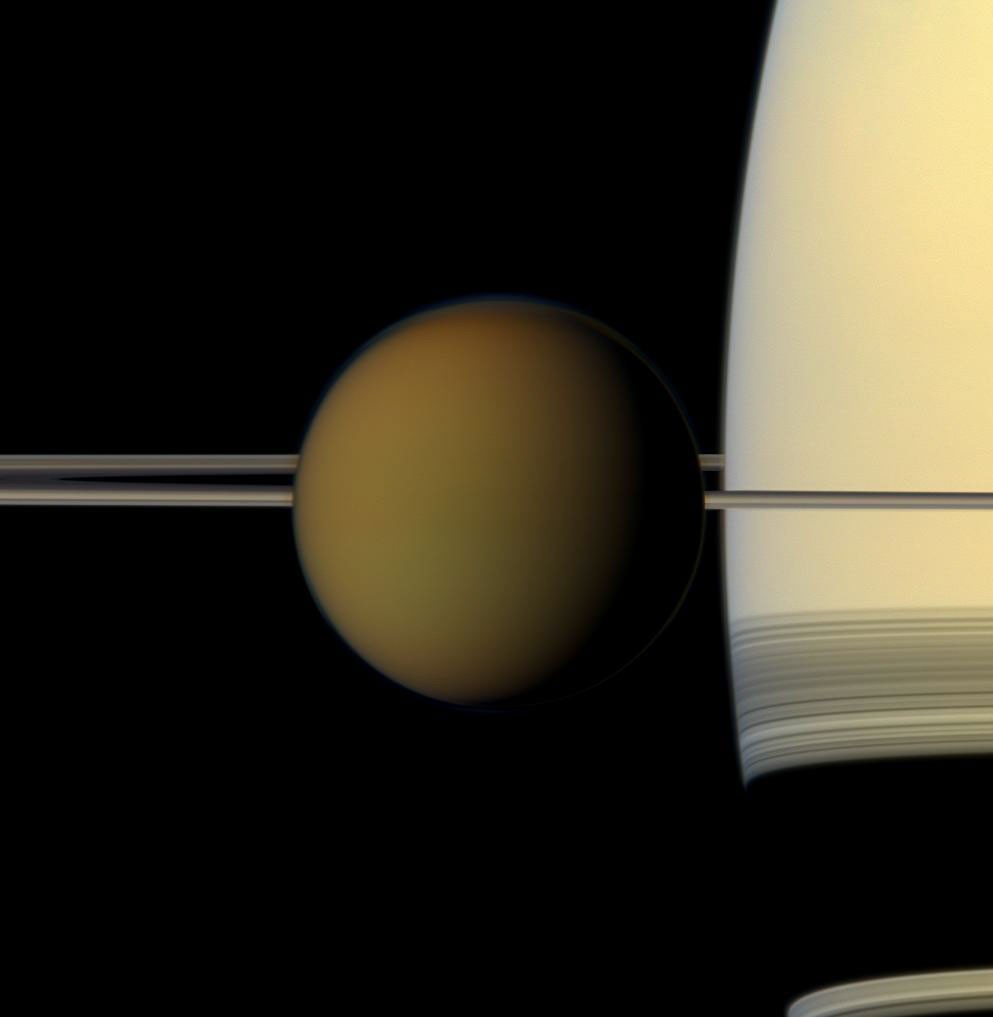
Titan offers a strange thought experiment. If a person could somehow be placed on the surface of Saturn’s largest moon, the surrounding air would not make their saliva boil or force their lungs against a near-vacuum. For once beyond Earth, nature would already be supplying enough pressure.
That narrow fact is often compressed into the wonderfully misleading claim that a person could walk on Titan without a spacesuit. It is true only if “pressure suit” means the inflated garment needed to keep a body alive in vacuum or extremely thin air. The visitor would still need oxygen, carbon-dioxide removal, a sealed environmental layer and extraordinary protection from cold.
Titan’s atmosphere does something else no suit could do nearly as efficiently. It puts a deep column of nitrogen above the ground, forcing incoming galactic cosmic rays to surrender their energy in the atmosphere rather than carrying it undiminished to the surface. That makes the comparison with Mars revealing, but it does not make Titan warm, breathable or ready for settlement.
Edited by Lachlan Brown
Titan supplies the pressure a suit normally has to create
A full-pressure suit is, at heart, a small artificial atmosphere wrapped around a body. When outside pressure falls too low, the suit keeps gases dissolved in body fluids, allows the chest and lungs to function, and prevents the rapid expansion of trapped gas.
NASA’s history of pressure suits describes the Armstrong limit, about 19 kilometres above Earth, where ambient pressure is low enough for exposed water to boil at body temperature. Vacuum is not required for an unprotected human to be in mortal trouble.
Titan sits comfortably on the other side of that threshold. NASA puts its surface pressure at about 60 per cent above Earth’s sea-level value. It is also commonly rounded to 1.5 atmospheres, which gives the headline’s “50 per cent thicker” comparison. The wording refers to pressure. Because Titan’s air is bitterly cold, its density near the ground is roughly four times that of air at Earth’s surface.
This is why Titan can reasonably be called the only known place beyond Earth where a person could stand on solid ground without a pressure suit. Mars has a surface, but its pressure is less than one per cent of Earth’s sea-level value. Venus has solid ground beneath a thick atmosphere, but pressure there is about 90 times Earth’s. Jupiter, Saturn, Uranus and Neptune have no accessible solid surface on which to stand.
Pressure is not the same thing as breathable air
Titan’s atmosphere is about 95 per cent nitrogen and 5 per cent methane, with small quantities of hydrogen and more complex carbon-rich compounds. There is essentially no free oxygen to support a human. Breathing the air would cause hypoxia even while the body experienced entirely tolerable ambient pressure.
A visitor could, in principle, breathe an oxygen-rich mixture through a sealed mask or helmet while leaving the rest of the body close to Titan’s pressure. The system would need to remove exhaled carbon dioxide, control humidity and prevent methane-rich outside air from mixing with concentrated oxygen. None of those are small matters, particularly in an environment where repair is impossibly far away.
So “no pressure suit” does not mean “no life-support suit”. It means designers would not need the garment to hold a large pressure difference between its interior and the moon’s air. Removing that difference could make movement easier and reduce the balloon-like stiffness that complicates work in conventional spacesuits. It would not turn the equipment into ordinary winter clothing.
The cold may be the harder suit problem
Titan’s surface temperature is about 94 kelvins, or minus 179 degrees Celsius. Water ice serves as rock. Methane and ethane can exist as liquids, moving through clouds, rain, channels, lakes and seas in a weather cycle that resembles Earth’s only from a great distance.
The dense air is a mixed blessing. Vacuum is an excellent insulator because there is almost no matter available to move heat by convection. Titan’s atmosphere continually touches a suit and can carry heat away. An explorer would need serious insulation and active heating, as well as seals, bearings, lubricants and electronics designed for cryogenic service.
Cold also changes the consequences of a leak. On Mars, a suit breach is primarily a pressure and oxygen emergency. On Titan, a breathable system might operate near the outside pressure, but a tear could still admit frigid methane and nitrogen, destroy the thermal balance and contaminate the breathing circuit. The suit would be less like a balloon and more like a heated, chemically sealed survival capsule shaped around a person.
Terra Daily recently examined why Titan alone among the Solar System’s moons has a genuine barometer reading. The human question exposes both sides of that result. The air supplies pressure for free, then imposes a formidable thermal load.
Cosmic rays stop in the atmosphere, not at its top
Galactic cosmic rays are mostly atomic nuclei accelerated to enormous energies by events elsewhere in the galaxy. Some carry so much energy that a planetary magnetic field cannot simply turn them aside. An atmosphere protects a surface differently, using its accumulated mass.
When a cosmic-ray particle strikes an atmospheric molecule, it can produce a shower of secondary particles. Repeated collisions spread and deposit the original particle’s energy. The atmosphere is not a wall at a particular altitude. It is a deep absorber through which the particle cascade gradually changes.
A comprehensive review in the Journal of Geophysical Research: Planets states that galactic cosmic rays do not penetrate all the way to Titan’s surface. Models had predicted that their energy deposition would form a lower ionosphere. Instruments carried by the Huygens probe then detected ionisation between about 50 and 80 kilometres altitude, peaking near 65 kilometres.
The word “blocks” therefore needs one qualification. The primary cosmic rays do not pass intact to the ground, but their energy does not vanish. Collisions, secondary particles and ionisation occur in the atmosphere, while rare, extremely energetic events can still leave products at the surface. A NASA-hosted modelling study, for example, examines energy deposited in Titan’s atmosphere and surface by the most energetic particle showers. The defensible claim is strong shielding, not zero radiation.
Mars has too little air to do the same job
Mars provides the revealing comparison. Its atmosphere can slow spacecraft and support winds, but there is far too little of it to absorb the full cosmic-ray environment before particles reach the ground. Mars also lacks a global magnetic field like Earth’s.
Curiosity’s Radiation Assessment Detector measured an average dose equivalent of about 0.67 millisieverts per day at Gale Crater from August 2012 to June 2013. NASA reports that galactic cosmic rays accounted for a slowly varying absorbed dose of about 210 micrograys per day, with the surface measurements dominated by cosmic radiation.
When NASA combined the surface data with measurements taken during Curiosity’s flight, it projected a dose of roughly 1,000 millisieverts for one representative round-trip human mission profile. That is not an automatic death sentence, and it does not mean a person stepping onto Mars would immediately receive a lethal dose. It is a cumulative exposure associated with higher long-term risks, including cancer, and it is large enough to drive the design of spacecraft, storm shelters and surface habitats.
That is the careful meaning of “the galactic cosmic rays that would make Mars lethal over time”. An unshielded long stay would be an unacceptable gamble, but risk depends on duration, solar conditions, shielding and individual biology. Engineers are not planning to send crews to live in the open.
The dangerous leg would begin before arrival
Titan’s shielding helps only after a spacecraft descends into the atmosphere. Reaching Saturn requires years in interplanetary space, where no convenient column of gas stands between a crew and galactic radiation.
NASA’s robotic Dragonfly mission is targeting launch no earlier than July 2028 and arrival in late 2034. Its planned cruise lasts about six and a half years. A hypothetical crewed vehicle would not necessarily follow the same trajectory, but the schedule shows the scale of the distance. Radiation shielding, closed-loop life support, medical care, power and reliability during the journey would all be harder problems than taking advantage of Titan’s pressure after landing.
There is no approved human mission to Titan. Dragonfly is a nuclear-powered robotic rotorcraft designed to exploit the moon’s low gravity and dense atmosphere, flying between scientifically interesting locations. It will test no human suit and provide no direct demonstration that a person could survive there.
Titan solves two problems and leaves nearly everything else
Titan gives a surface explorer two valuable things at planetary scale: ambient pressure that a human body can tolerate and an atmospheric column deep enough to absorb primary galactic cosmic rays before they reach the ground. The Moon supplies neither. Mars supplies only a thin fraction of the second.
Yet a person exposed to Titan’s air would still lose consciousness without oxygen and freeze without aggressive thermal protection. Methane would have to be kept out of oxygen-rich equipment. Machines would need heat, specialised materials and a power source that works almost ten times farther from the Sun than Earth.
The fascination of Titan is not that it is secretly hospitable. It is that habitability breaks into separate physical problems, and this distant moon unexpectedly solves two of them while leaving most of the others brutally intact. A person might not need a pressure suit there. They would still need almost everything that makes a spacesuit a life-support system.
