
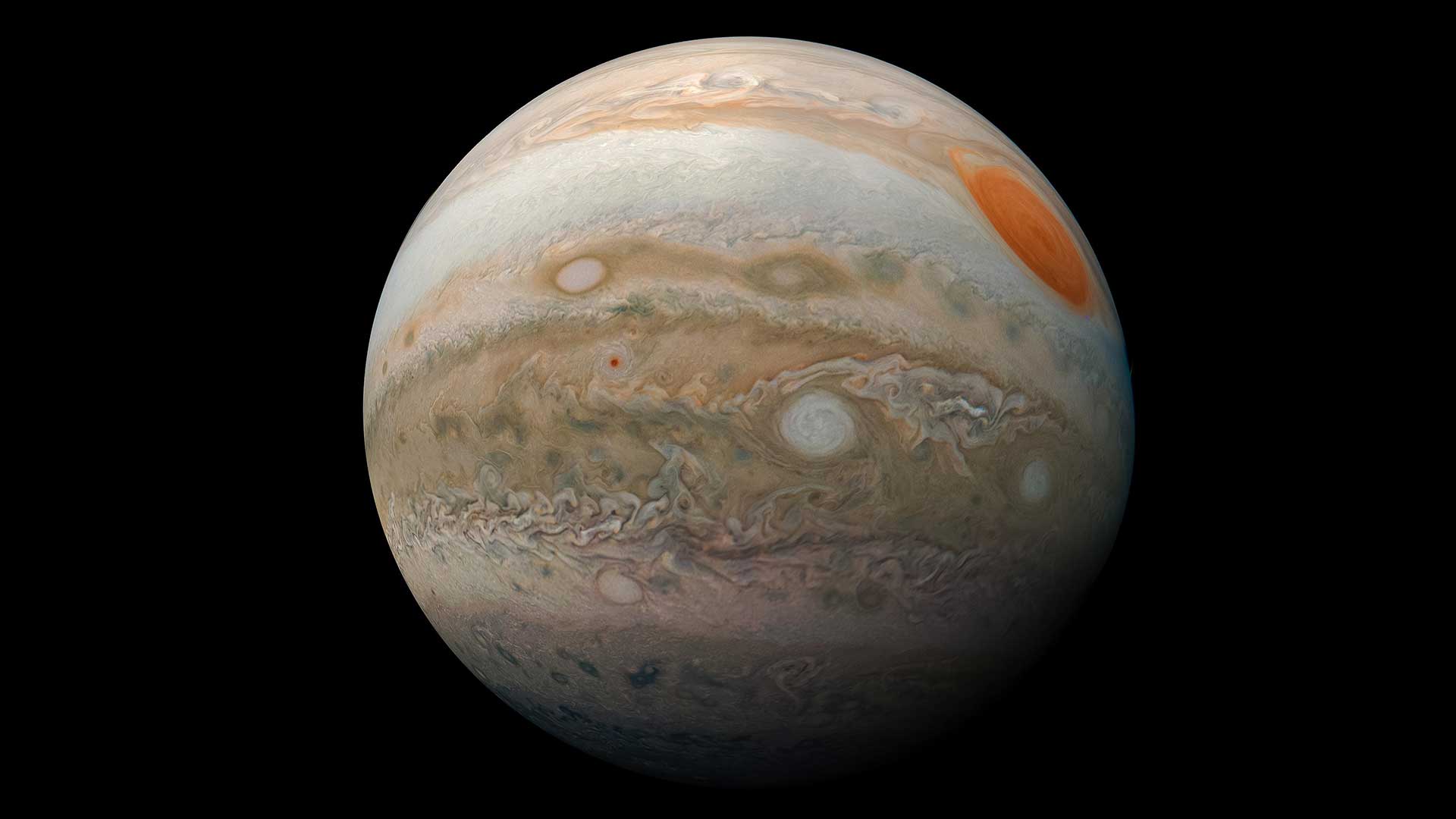
A planet does not orbit a perfectly stationary star. Both bodies respond to gravity, and both move around their shared centre of mass. For Earth and the Sun, that point sits so deep inside the Sun that the familiar shorthand of a planet circling a fixed star works well. Jupiter pushes the geometry over a striking boundary.
At Jupiter’s average orbital separation, the shared Sun-Jupiter barycentre lies about 742,000 kilometres from the Sun’s centre. The International Astronomical Union’s nominal solar radius is 695,700 kilometres, placing the two-body barycentre roughly 47,000 kilometres above the reference photosphere. Jupiter is the only planet for which this individual Sun-planet balance point lies beyond the Sun.
This does not mean the Sun orbits a fixed dot hanging over one patch of its surface. The actual Solar System contains eight planets, their moons and countless smaller bodies. Its combined barycentre changes position relative to the Sun as those bodies move. Jupiter supplies the largest single planetary contribution to that motion, while Saturn and the other planets continually reshape it.
What a barycentre measures
A barycentre is the centre of mass of two or more bodies. NASA’s barycentre explanation uses a balance point as the analogy: the more massive object sits closer to the fulcrum, while the less massive object must be farther away. In space, there is no rigid beam, but the same mass-weighted geometry applies.
For two bodies separated by a distance d, the Sun’s distance from the balance point is d multiplied by Jupiter’s mass and divided by the combined mass of Jupiter and the Sun. The companion formula puts Jupiter on the opposite side, much farther from the balance point because the planet is so much lighter.
Jupiter is only about one-thousandth as massive as the Sun, so the Sun’s share of the total separation is also roughly one-thousandth. That sounds negligible until distance enters the calculation. Jupiter travels hundreds of millions of kilometres from the Sun. One-thousandth of that enormous lever arm is enough to exceed the radius of the star.
The phrase “centre of gravity” is common and intuitive, but centre of mass is more exact here. A barycentre is a geometrical property of the distribution of mass. It is not a place where gravity disappears. A spacecraft positioned there would still experience powerful solar and planetary gravity, and the point itself moves as the separation and direction of the bodies change.
Putting numbers into the balance
JPL’s DE440 astrodynamic parameters give a gravitational parameter of about 132.712 trillion cubic kilometres per second squared for the Sun and 126.713 million for the Jupiter system. A gravitational parameter is mass multiplied by the gravitational constant. Using the ratio is convenient because that constant cancels, allowing the balance to be calculated without converting the figures into kilograms.
Precision ephemerides use the Jupiter system value, which includes the planet and its moons. Jupiter itself supplies almost all of it, so using the planet alone would barely change the result. At the level of this explainer, the system value provides the cleaner match to the JPL ephemeris framework.
Jupiter’s mean orbital scale is about 5.203 astronomical units, close to 778 million kilometres. Multiplying that separation by the Jovian fraction of the combined mass gives a solar reflex radius near 742,000 kilometres. Compared with the IAU’s 695,700-kilometre nominal solar radius, the barycentre sits about 46,700 kilometres beyond the reference photosphere at the mean separation.
Jupiter’s orbit is mildly eccentric, so that distance is not fixed. Near perihelion, the two-body barycentre is about 706,500 kilometres from the Sun’s centre, only around 10,800 kilometres outside the nominal photosphere. Near aphelion it is roughly 778,400 kilometres out, or about 82,700 kilometres beyond that reference surface. The precise figures depend slightly on the orbital elements and solar radius adopted, but the conclusion survives the full orbit: the point remains just outside.
Why no other planet crosses the surface
Jupiter is neither the farthest planet nor remotely comparable to the Sun in mass. Its distinction comes from the product of two advantages: it is by far the most massive planet, and it orbits at a large distance.
Saturn provides the closest comparison. It is farther from the Sun than Jupiter, but it has less than one-third of Jupiter’s mass. Using its mean orbital scale and JPL mass parameter puts the Sun-Saturn two-body barycentre about 408,000 kilometres from the Sun’s centre. That is only about 59 per cent of the nominal solar radius. Even Saturn’s aphelion does not push the point through the photosphere.
Neptune’s greater distance cannot compensate for its much lower mass. Its mean pairwise barycentric distance is roughly 232,000 kilometres. Uranus produces about 125,000 kilometres. Earth and the Moon together shift their shared solar balance point by only about 455 kilometres from the Sun’s centre, while Venus produces roughly 265 kilometres.
A close planet can accelerate its star relatively rapidly yet give it a small spatial orbit. A distant planet can create a wider reflex path, but only if the planet is massive enough. Jupiter has the Solar System’s unmatched combination of planetary mass and orbital lever arm, so its individual displacement term is more than 80 per cent larger than Saturn’s.
The real Sun follows a more complicated path
The Sun-Jupiter barycentre is a useful two-body quantity, not the same thing as the Solar System barycentre. JPL’s Horizons documentation treats the Sun, planetary-system barycentres and the combined Solar System barycentre as distinct reference points for exactly this reason.
In an ideal two-body calculation, the Sun and Jupiter circle their shared point on opposite sides. In the real system, Jupiter does not get an empty stage. Its contribution repeats over an 11.86-year orbit, Saturn takes about 29.5 years, and the remaining planets add their own directions and periods. Sometimes the giant planets’ contributions broadly reinforce each other. At other times they partly cancel.
The Solar System barycentre can consequently lie within the Sun or outside its visible surface. The Sun traces a changing, looped path around that collective centre rather than a clean circle of radius 742,000 kilometres. Calling Jupiter the largest contributor means it supplies the biggest individual planetary term, not that it alone determines the Sun’s position at every instant.
There is also no contradiction in saying the Sun contains almost all the Solar System’s mass while acknowledging that its centre moves. A massive object can have a small reflex orbit around a centre of mass located close to it. The surprise in Jupiter’s case is that “close” is still marginally farther than the photospheric radius.
How large is the wobble?
There are two useful ways to describe stellar wobble. One is displacement: how far the star’s centre travels from a chosen barycentre. Jupiter’s characteristic two-body contribution is about 1.07 nominal solar radii at the mean separation. The other is speed: how quickly the star moves along that reflex path.
A NASA technical report gives the Sun’s average motion around the Sun-Jupiter barycentre as about 12.3 metres per second. A direct calculation from the reflex radius and Jupiter’s orbital period gives a similar value. That is modest road-cycling speed attached to an object containing almost all the mass in the Solar System.
The number is not larger because the circuit takes nearly 12 years. A wide displacement can unfold slowly. Earth, by comparison, induces a solar radial-velocity scale of only about nine centimetres per second. Jupiter is therefore easier to notice around another Sun-like star, although its long period demands patience.
Neither number describes the speed of Jupiter, which travels around its much larger orbit at roughly 13 kilometres per second. The planet and star share an orbital period around their pairwise balance point, but the smaller orbit assigned to the heavier Sun gives it the much lower speed.
The same physics reveals planets around other stars
Astronomers cannot normally resolve a distant Sun-like star tracing a path only about a solar radius wide. They can, however, measure the component of its velocity toward and away from Earth. The radial-velocity method detects alternating red and blue shifts in the star’s absorption lines as it moves around the system barycentre.
The period of that repeating signal helps determine the orbit. Its amplitude, combined with the star’s mass and an allowance for orbital geometry, constrains the companion’s minimum mass. A planet is not seen directly in this method; its gravitational effect is read from the star.
Terra Daily described the same logic in its earlier report Fourteen Times The Earth. There, the amplitude of Mu Arae’s measured velocity variations helped astronomers infer the mass of a planet that was then among the lightest found around a Sun-like star. Jupiter provides the nearby, physically familiar version of the principle.
A Jupiter analogue around another Sun-like star would create a relatively strong radial-velocity signal, but observers would need years of measurements to map its full orbit. Short-period hot Jupiters were found earlier in large numbers partly because their signals repeat in days rather than more than a decade.
A precise statement hiding inside familiar shorthand
Saying Jupiter orbits the Sun remains useful and is not wrong in ordinary conversation. The Sun outweighs Jupiter by more than a thousand to one, and a Sun-centred diagram is often the clearest way to show planetary motion. The more complete statement is that the Sun and Jupiter orbit their shared centre of mass while the whole planetary system moves around its collective barycentre.
The point just outside the Sun is not a second object, a gravitational doorway or a location that stays fixed over one patch of solar surface. It is the instantaneous mass-weighted balance point for a selected pair. Its location changes from roughly 706,500 to 778,400 kilometres from the solar centre as Jupiter moves between perihelion and aphelion.
Within the eight-planet Solar System, Jupiter alone puts its individual Sun-planet barycentre beyond the photosphere. That same combination of great mass and a broad orbit makes it the largest planetary contributor to the Sun’s reflex displacement and velocity. The star does not sit still at the middle of the system. It moves, and Jupiter supplies the largest part of the reason why.
Edited by Lachlan Brown
