
A single beaver felling alder and willow across a first-order stream can lift the surrounding water table by more than a metre within a few seasons, and the wet sediment that piles up behind its dams stores measurably more carbon than the biomass of the trees it cut down. The mechanism is not magic — it is hydraulics, chemistry, and a rodent that will not stop chewing.
The physical logic runs like this: a beaver drags branches into a channel until flow slows, sediment drops out, the water spreads sideways into the floodplain, and the local groundwater table rises to meet the ponded surface. Once the sediment behind the dam stays wet year-round, oxygen can no longer reach the buried leaves, roots, and silt, and decomposition slows to a crawl. Carbon that would have respired back to the atmosphere in a free-flowing stream stays locked in the mud.
The rodent as hydraulic engineer
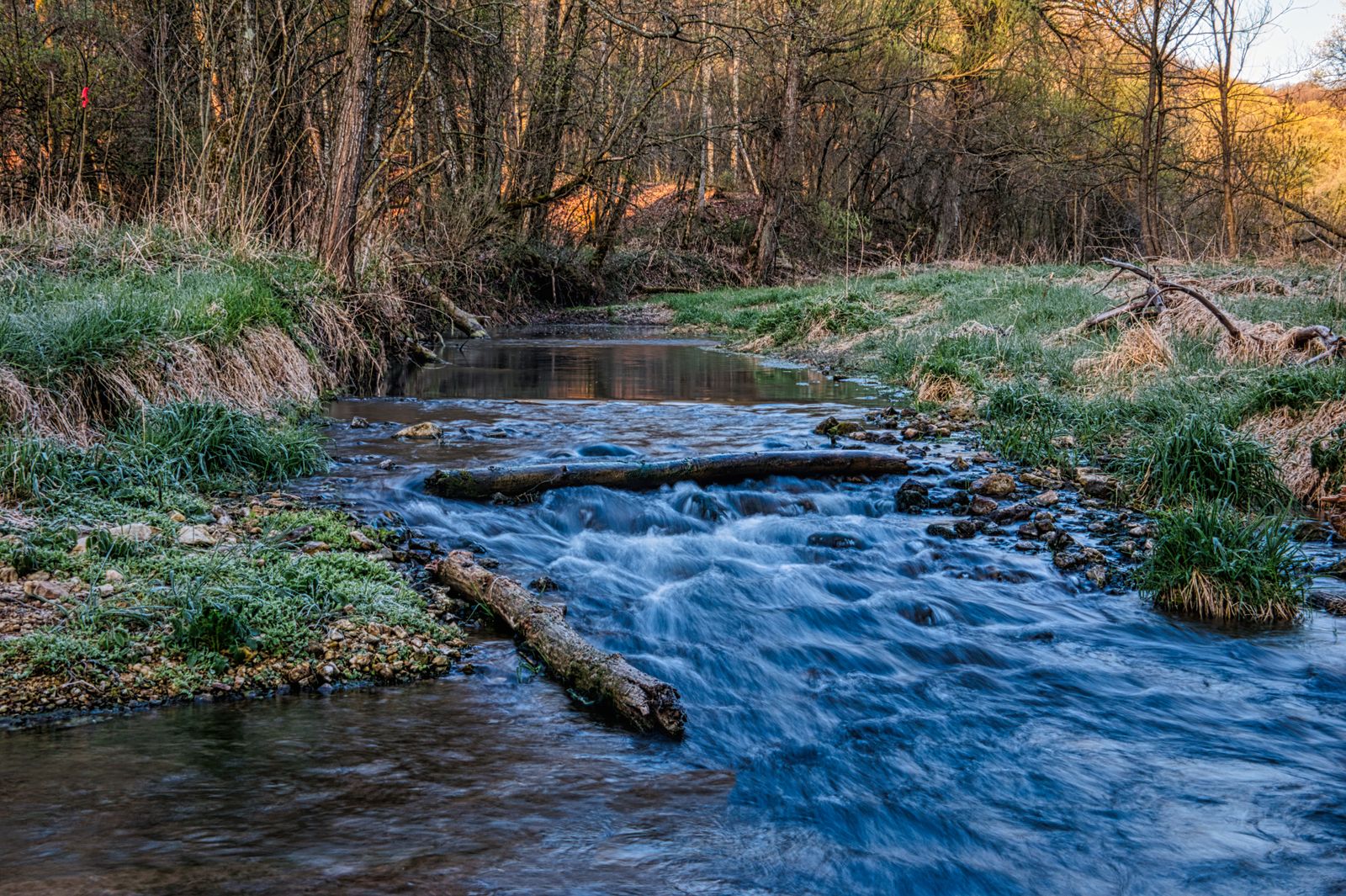
North American beavers (Castor canadensis) and their Eurasian cousins (Castor fiber) build in headwater streams — the narrow, low-order channels where a valley first collects its water. A researcher writing in The Conversation notes that the animals are now widely recognised as ecosystem engineers, reshaping the physical structure of rivers and streams through nothing more sophisticated than felled saplings and mud.
A single dam is rarely tall. Two metres is a big one. That is not a reservoir. It is a puddle with ambition. And yet the effect on the valley around it is disproportionate to the volume held back.
Groundwater in a valley bottom sits in equilibrium with the stream that drains it. Lower the stream, and the water table drops toward the channel. Raise the stream — by ponding it behind a dam — and the water table rises to meet the new surface, spreading laterally into the floodplain sediments on either side. Field measurements on a beaver-dammed reach of the Colorado River in Rocky Mountain National Park recorded a dam raising the river’s stage by 1.7 metres and lifting the adjacent water table to within 40 centimetres of the surface across large stretches of the study valley, with similar metre-scale gains recorded at other western dam sites.
A 2022 field and modelling study in Nature Communications found that, in a mountainous Colorado watershed, the hydraulic gradient a single beaver dam imposes on the surrounding riparian zone is ten to thirteen times larger than the gradient produced by the difference between a wet year and a dry one — meaning the presence or absence of the dam matters more, year to year, than the climate does.
The effect compounds. One dam raises the local grade. Sediment drops behind it. The stream bed builds upward. The next dam upstream now sits on a higher base level, and the beaver adds height to keep pace. Within a few years, a stepped staircase of ponds runs up the valley, each one wetting the ground beside it.
The wet meadow and the carbon ledger
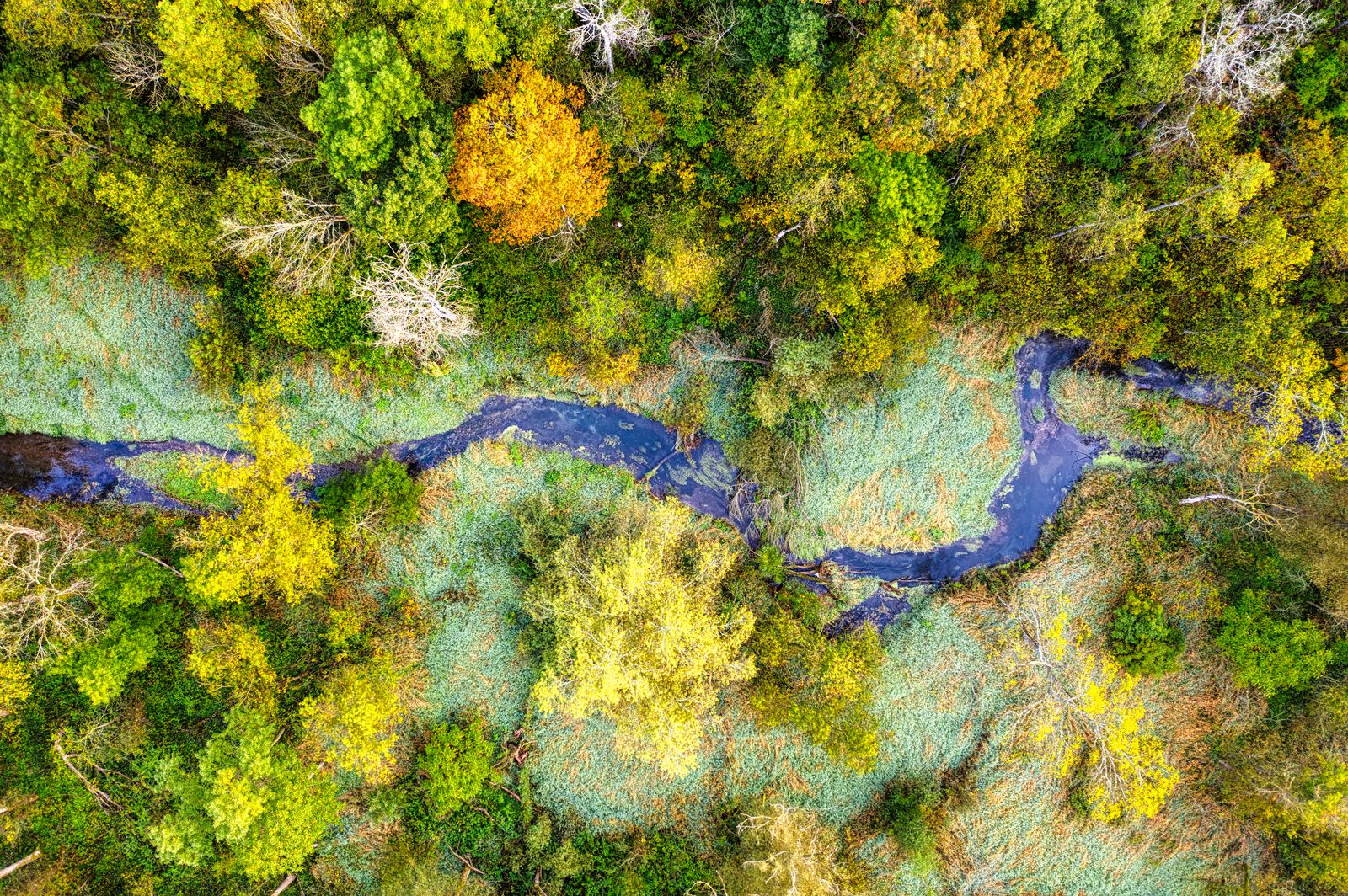
What appears above ground is a wet meadow — sedge, rush, willow scrub, cottonwood — where a dry gully used to be. Researchers writing in Frontiers in Water describe beavers as critical zone engineers, animals that operate in the thin skin of the Earth where rock, water, air, and life meet. They reshape not just the channel but the whole cross-section of the valley floor.
The saplings the beaver cuts — willow, aspen, alder, birch — hold carbon in above-ground biomass. A busy family might fell a few hundred over a season. That carbon does not disappear. Much of it becomes dam structure and lodge, some is eaten, some rots on the bank.
Meanwhile, behind the dam, something else is happening. Slow water drops its load. Every spring flush, every summer thunderstorm, carries fine sediment and organic debris — leaves, needles, twigs, algae — into the pond, where it settles to the bottom. Once buried under saturated silt, that organic matter enters an environment starved of oxygen. Microbes that would normally break it down to CO₂ operate far more slowly, and much of the carbon persists for centuries.
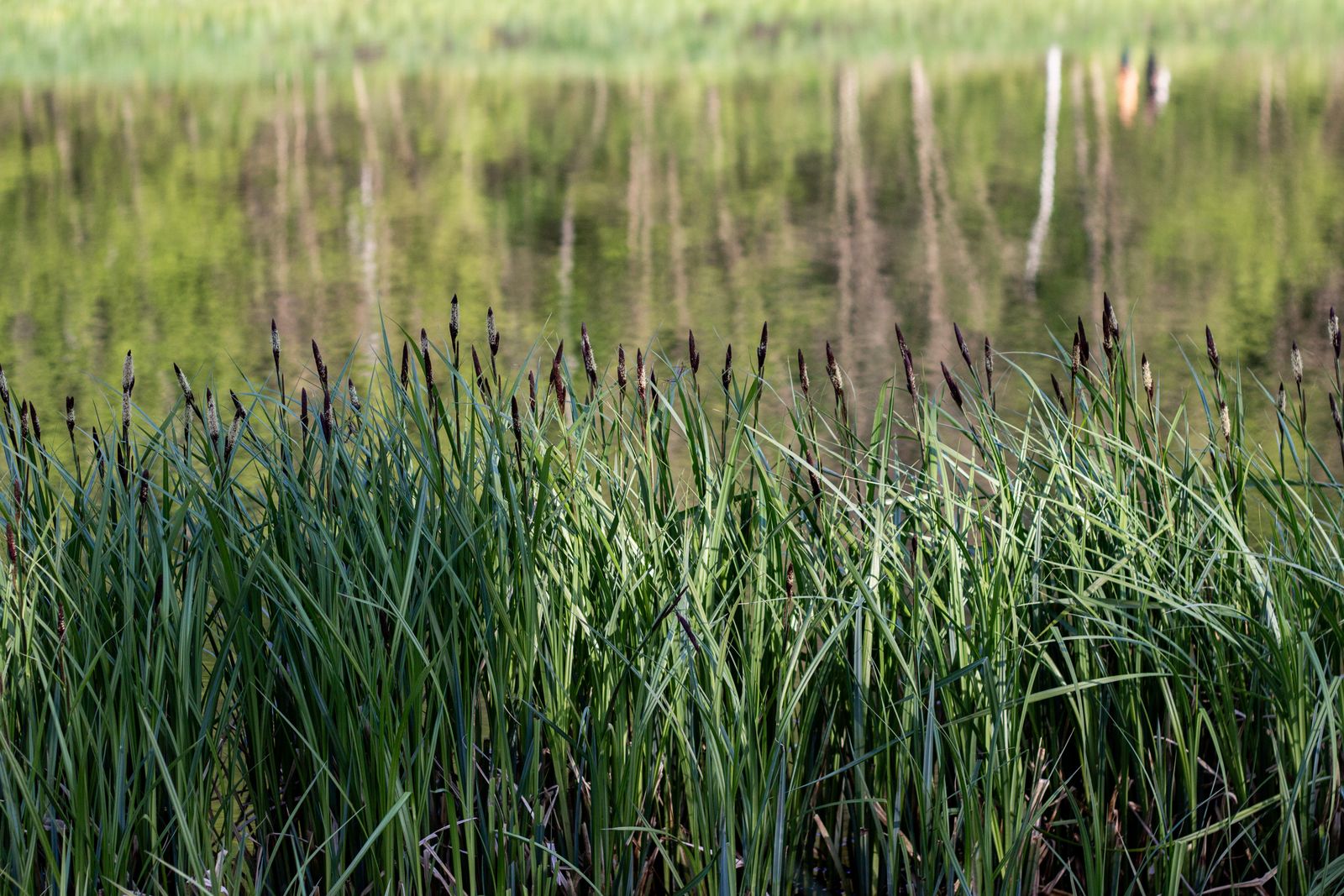
Beaver-dammed reaches accumulate organic-rich sediment at rates that turn stream corridors into persistent carbon sinks. The stored carbon per hectare of pond complex can exceed the carbon in the standing forest the beaver removed to build the dam in the first place. That storage is not unconditional, though: the same anoxic conditions that preserve carbon also favour methane-producing microbes, and researchers treating beaver ponds as critical-zone features note that the gas escaping a pond partially offsets what the mud locks away — a full gains-versus-losses accounting has yet to be done for most beaver-dominated watersheds.
The persistence of the wet sediment is the whole game. If the pond drains — dam abandoned, breach unrepaired, drought — the buried organic matter meets oxygen again and begins to respire. The carbon sink becomes a carbon source.
Beavers prevent this by simply being there. Adults patrol, patch, extend. When one dam fails, another is built upstream or downstream. A pond complex is not a single structure but a living infrastructure maintained by a resident family that will drag a fresh sapling into a breach within hours of noticing it.
A 2025 mapping study of 87 beaver pond complexes across Colorado, Wyoming, Montana and Oregon, published in Communications Earth & Environment, found that dam length was the single strongest predictor of how much surface water a complex held, with the height of nearby woody vegetation and the stream’s own power close behind — together explaining three-quarters of the variation the researchers measured. Dam length, in turn, tracks upkeep: a family still in residence keeps building and lengthening its dams, while an abandoned complex stops growing and starts to shrink.
The Nevada experiment
Where beavers are absent, humans have started copying them. In the sagebrush country around Elko, Nevada, the Eastern Nevada Landscape Coalition has been installing beaver dam analogs — low woody structures built from sagebrush and nearby brush — to restore streams scorched by wildfire. John Haddock, a natural resource specialist with the coalition, told the Las Vegas Sun in January 2026 that the structures are meant to mimic the effects of natural beaver dams on rangeland streams.
The sequence Haddock described is the same one that plays out under a real beaver: spring runoff carries sediment, the sediment fills in behind the analog, the stream bed rises, and the channel reconnects to its floodplain. The process restores the stream’s natural meandering pattern, raises the water table and slows water movement.
The payoff in Nevada is not only ecological. Many streams in the state are ephemeral, running only after storms and snowmelt. Some of them have the potential to become perennial if water movement is slowed enough — a headwater that used to run dry by midsummer instead holding water into autumn. Following wildfires such as the Wildcat Fire that burned Elko County rangeland, the coalition has used the analogs to help the scorched land recover, monitoring the sites for natural beaver activity and often finding beavers moving in to maintain the structures themselves.
The wet ribbon along a restored stream also does something firefighters have started to notice. A green, saturated riparian corridor is a lousy fuel bed.
The politics of a chewed sapling
The ecological ledger is one thing. The social ledger is another. Beaver dams flood pasture. They back water into culverts. They fell orchard trees. Dams have been blamed for downstream flooding after hurricanes, and farmers have pushed back hard against wild beaver reintroduction, arguing that the animals waterlog productive fields and block drainage.
The flooding case is worth examining. The same re-analysis of beaver dam breaches described above found that even when retained water volume is deliberately overestimated, the effect on downstream water levels can be very small. Landslides, bank erosion, and narrow bridge openings often do the damage. The dam takes the blame.
What a metre of water table actually means
The wet meadow that spreads out behind a dam complex is not just carbon storage. It is habitat. Sedges and rushes shelter amphibians. Willows feed moose and songbirds. The ponds themselves become nursery water for juvenile fish — coho salmon in the Pacific Northwest, brook trout in the Appalachians, native cutthroat in the Rockies. Work on wet meadow regeneration through restoration of biophysical feedbacks has traced how quickly the biological community reassembles once the hydrology is fixed.
The story bears comparison to other cases where a single actor reshapes a landscape’s water and carbon. Terra Daily has looked at how coastal mangroves store three to five times more carbon per hectare than tropical rainforest by keeping their soils permanently waterlogged — the same mechanism, in a saltier setting. Anoxic mud is a very good filing cabinet.
The beaver’s version works in cold headwater valleys where mangroves cannot grow, and the comparison is not perfect. But the principle is identical: slow the water, waterlog the sediment, and the carbon stays put.
A one-metre rise in the water table sounds abstract. On the ground it looks like this: a dry gully with a trickle at the bottom becomes a corridor of shining pools, the banks slump into gentle slopes covered in sedge, willow shoots crowd the wet margins, and the ground stays soft underfoot in August. The frogs return. The mosquitoes, too.
For a rancher whose cattle drink from that stream, the change is the difference between hauling water in July and not. For a hydrologist, it is a measurable rise in late-summer base flow — the water that keeps a stream alive between rainstorms. For a fire crew arriving at a burn edge, it is a green line the flames have trouble crossing.
None of this required a dam engineer, a permit, or a budget. It required a rodent with orange teeth and an obsession with the sound of running water, dragging saplings across a channel until the sound stopped.
A beaver family can build and maintain several dams in a season. Across a valley, a dozen dams become a staircase. Across a region, thousands of staircases add up to something the continent has not seen at scale since the fur trade — wet valleys, high water tables, and a lot of carbon quietly sinking into the mud, one chewed sapling at a time.
