

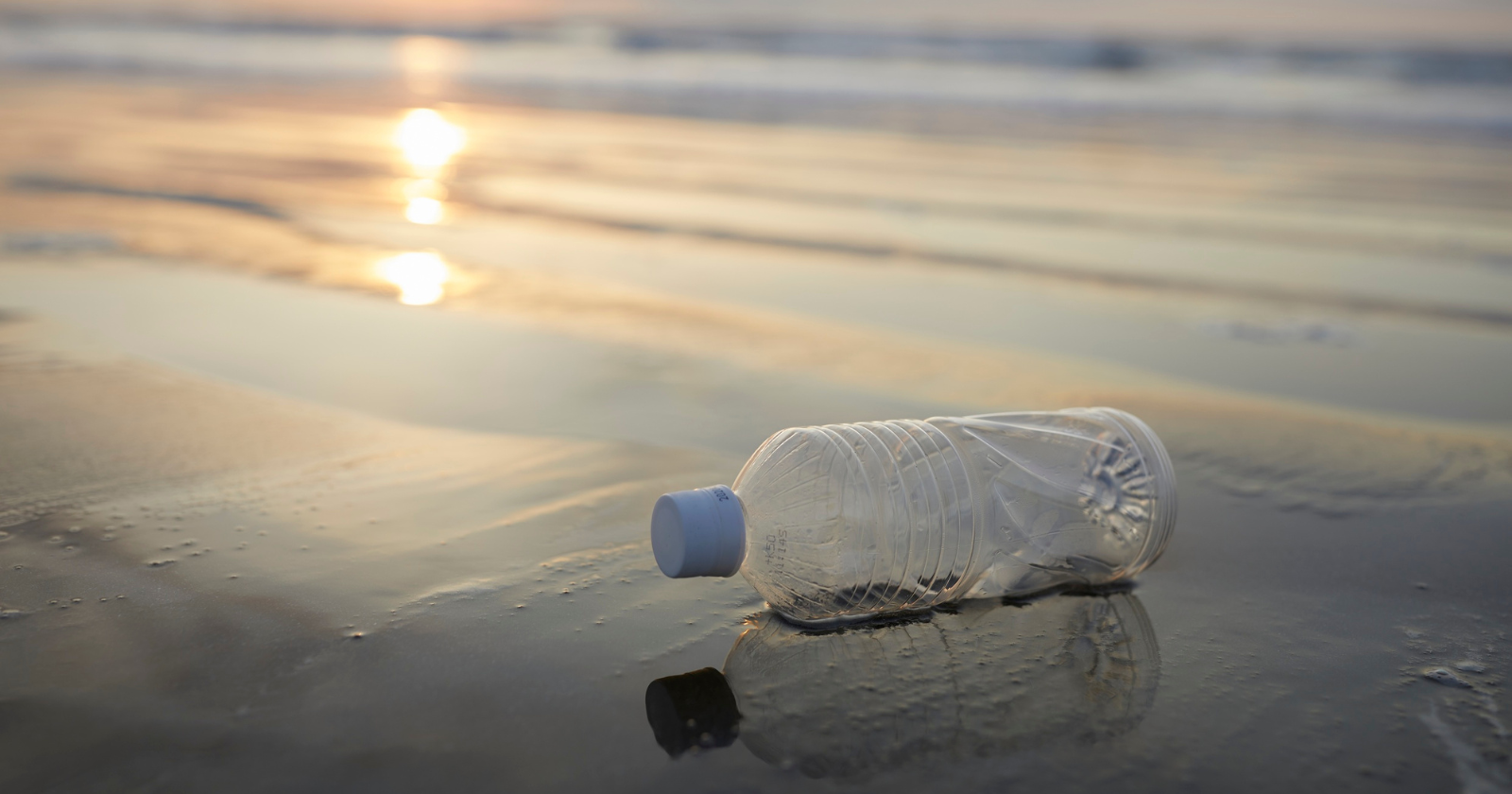
The figure that gets repeated in almost every article about plastic pollution is 450 years.
A single-use polyethylene terephthalate water bottle — a PET bottle, the standard clear plastic container that most of the world drinks from — takes approximately 450 years to break down after being discarded. The number comes from decomposition studies conducted by environmental scientists at various points across the last several decades, and the National Geographic figure of 450 years is the version that has entered general public awareness.
What is less often mentioned is what the number actually means.
It does not mean that the plastic disappears at the end of the 450 years. It does not mean the bottle is gone. What the figure describes is the amount of time required for a single bottle to fully break apart into fragments too small to see — down to what environmental scientists call microplastics, and eventually into even smaller pieces called nanoplastics. At the end of the 450 years, the material has not decomposed. It has just become invisible.
This distinction is one of the most important and least appreciated facts about plastic pollution. Plastic does not biodegrade in any meaningful sense. There are essentially no organisms on Earth that can metabolise polyethylene, polypropylene, or PET into simpler compounds and return their constituent atoms to the natural nutrient cycle. The material just fragments, over centuries, into progressively smaller versions of itself — and once it becomes small enough, it enters everything.
Where the fragments have been found
The specific reach of microplastic contamination, as revealed over the past decade of atmospheric and oceanographic research, is genuinely startling.
In 2019, a team led by Steve Allen and Deonie Allen published a study in Nature Geoscience documenting microplastic fallout in a remote French Pyrenees mountain catchment. The site was chosen specifically because it sits five kilometres from the nearest village, at high altitude, surrounded by protected land. What the team found was that microplastic particles were falling from the sky in significant quantities — on the order of 365 particles per square metre per day, comparable to rates measured in central Paris.
The particles were dominated by fragments of single-use packaging — the same material as PET water bottles. Computer modelling of wind patterns suggested the fragments had been transported through the atmosphere for at least 95 kilometres before landing at the remote mountain site.
Subsequent work has found similar microplastic precipitation on Mount Everest, in the Rocky Mountains, in the Alps, on the Tibetan Plateau, and — most strikingly — across the surface ice of the Arctic. A 2018 study by Ilka Peeken and colleagues at the Alfred Wegener Institute analysed Arctic sea ice samples and found microplastics in every single one. The specific polymers detected included polyester fibres from clothing, polyethylene from packaging, and nylon and bottle-cap plastics — a chemical fingerprint of everyday synthetic materials, embedded in ice thousands of kilometres from any city.
In the other direction, the Mariana Trench — the deepest known point in the world’s oceans, at 10,935 metres below sea level — has become one of the most surprising sinks for plastic on Earth. Bottom-water samples have contained up to 13.5 microplastic particles per litre. Sediment concentrations are 15 to 160 times higher than the overlying water. A 2019 study of amphipods (small shrimp-like crustaceans) collected from six deep-ocean trenches found microplastic fragments in 72 percent of specimens overall, and in 100 percent of the amphipods collected from the Mariana Trench itself.
There is essentially nowhere on the surface or in the oceans of the Earth that plastic has not reached.
What “still intact” actually means
Now consider what this implies for a single water bottle produced in the 1970s.
If PET decomposition takes approximately 450 years, then every plastic water bottle produced since the 1970s is currently, right now, somewhere between roughly 10 percent and 15 percent of the way through its decomposition process. Most of them are still recognisable as bottles or as large fragments. The oldest are showing significant surface degradation. But essentially none of them have disappeared. Every plastic water bottle that entered the environment during the disposable-plastic revolution of the 1970s and 1980s is, in some form, still present.
Cumulative global plastic production since the material was invented is estimated at 8.3 billion tonnes. Approximately 6.3 billion tonnes of this has become waste. Of that waste, only about 9 percent has been recycled and 12 percent incinerated. The remaining 79 percent — nearly 5 billion tonnes — has either been buried in landfills or released directly into the environment.
Nearly all of that material is still on Earth. Some of it is still in its original form. The rest has been progressively fragmented into microplastics that now saturate air, water, ice, and sediment on every continent, at every altitude, in every ocean.
The 450-year figure is not really a decomposition timeline. It is a fragmentation timeline. And even at the end of it, the material has not decomposed. It has just become too small to see.
Why this matters more than the numbers alone
The consequences of this ubiquity are still being worked out.
Microplastics have been detected in human blood, in human lungs, in human placentas, in breast milk, in male testes, and in essentially every organ system that has been carefully examined. Recent research estimates that the average person ingests and inhales the equivalent of a credit card’s worth of plastic per week. The long-term health effects of this exposure are not fully understood, and the research field is genuinely still in early stages.
What is known is that plastic in the environment does not exit the environment. The material humanity has produced since the 1950s — 8.3 billion tonnes and counting — is essentially all still here. It will still be here in 100 years. It will still be here in 500. The particles found in Arctic ice and Mariana Trench sediment today will still be present, in some form, when the last person alive on Earth today has been dead for centuries.
The alternative framings of the situation — that plastic waste is being “managed” through recycling and incineration, that biodegradable plastics will solve the problem, that the fragmentation of large plastic items into microplastics represents a form of dispersal that reduces the impact — are all, on close examination, misleading. Only 9 percent of plastic waste has ever been recycled globally. “Biodegradable” plastics generally still fragment into microplastics rather than mineralising. And the dispersal of large plastic into microplastics does not reduce the material’s presence. It only makes the material harder to remove.
The plastic is not going away. It has never been going to go away. That is the specific structural fact about this material that the 450-year figure, taken casually, actually conceals.
Every plastic bottle you have ever used is still on Earth. Every plastic bag. Every plastic straw. Every plastic bottle cap. They are all here, right now, in some form. And they will remain here, in progressively smaller particles, for as long as there is a here for them to be.
