
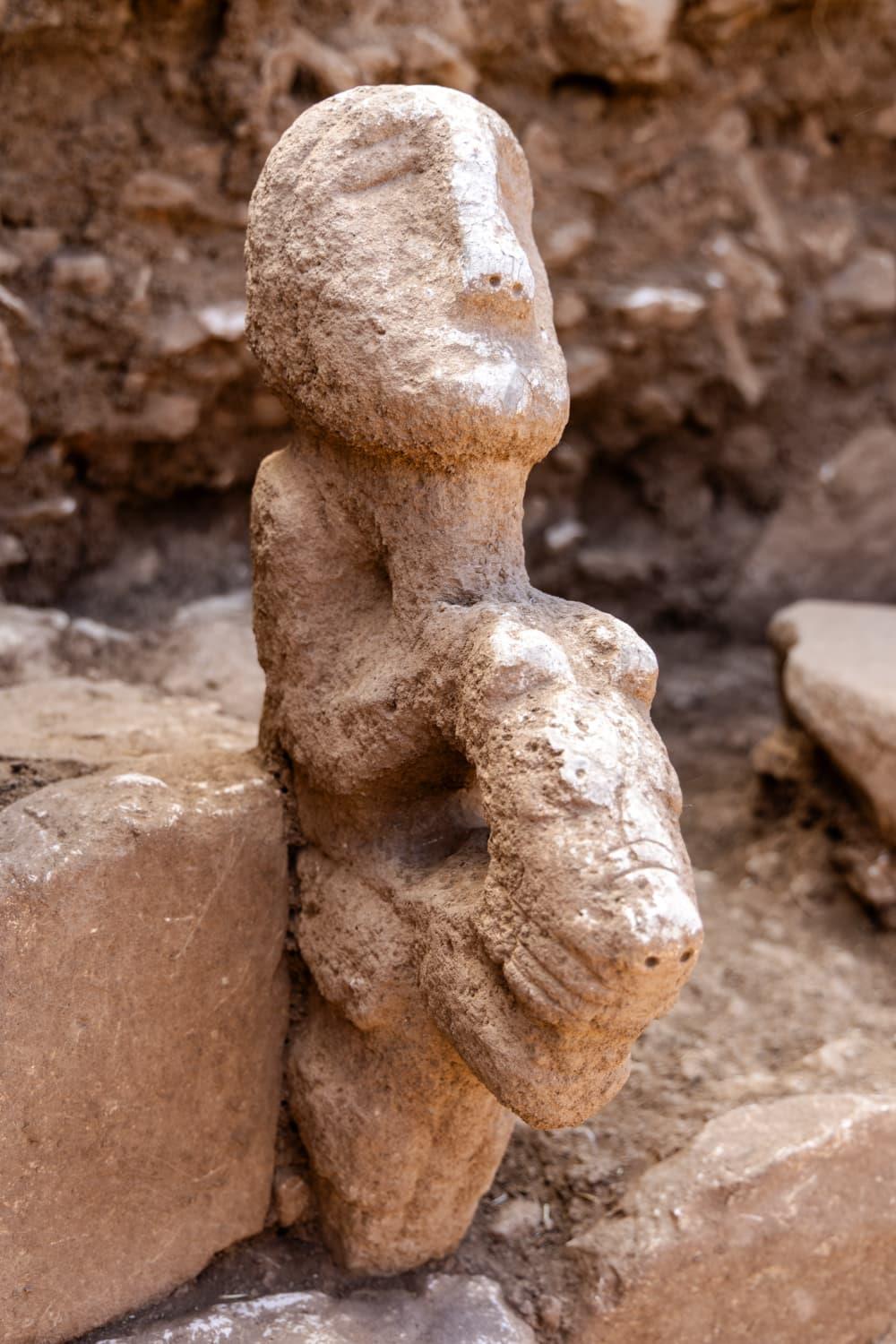
A 70-centimetre stone figure of a human seated on a leopard was found this month on a bench inside a roughly three-metre-wide room at Karahan Tepe, near Şanlıurfa in southeastern Turkey. Turkey’s culture ministry says the 11,000-year-old composite statue had been left where it was placed, in a structure whose floor is paved with flat stones. The Bulgarian News Agency, which ran the ministry’s excavation photographs, reported that the figure itself was found covered by those slabs.
Minister of Culture and Tourism Mehmet Nuri Ersoy announced the find on 25 August 2026, during the 2026 excavation season of the national Heritage for the Future programme. In the ministry’s press notice that day, the team had brought to light “a composite statue featuring a style unlike any previously encountered” at the site. The object is 70 centimetres high, in a room about three metres across, at Karahan Tepe near Şanlıurfa.
Found on the bench, under the stones
Ersoy’s statement is exact about the furniture of the room and silent about a building code. The statue was found on a bench that runs along the wall of the three-metre structure. The floor is covered in flat stones. The ministry says the piece was identified in the place it had been left some 11,000 years earlier. No trench number, enclosure name or structure label appears in the official account, and none is supplied here.
BTA’s Ankara dispatch, based on the statement sent to the agency, is the source for the covering: archaeologists found the 70-centimetre figure under flat stones, still in position. The ministry’s own text dwells on the paved floor and the bench; the wire adds that slabs also lay over the statue.
“We have brought to light an 11,000-year-old statue with no known parallel,” Ersoy said. “During the 2026 archaeological excavations, carried out as part of the national Heritage for the Future programme, we discovered a composite figure unlike anything we have encountered before.” He said he believed the discovery would “open the door to new questions about the earliest periods of human history” and would “resonate widely in the scientific world,” and he thanked the General Directorate of Cultural Heritage and Museums, the excavation committee, the scientists, and the crew on site.
Karahan Tepe — Karahantepe in the ministry’s Turkish spelling — has been under excavation since 2019. BTA reports that the work is directed by Prof. Necmi Karul. That detail comes from the wire, not from the sentences Ersoy put his name to. The 25 August notice itself says the 2026 season opened new structures and objects, and that this human-on-leopard composite is the piece the ministry chose to announce.
A human astride an animal
What the ministry means by composite is a human and a leopard in one carving. That pairing, and the claim that the style had not been seen at the site before, is the official news. What it meant to the people who set it on the bench is not in the announcement.
Elizabeth Carter, professor emerita of Near Eastern archaeology at UCLA, speaking to The Art Newspaper, put the statue in the Taş Tepeler group of Pre-Pottery Neolithic sites around Şanlıurfa. “Göbeklitepe is more famous than the Karahan site where this sculpture was discovered,” she said. “To my knowledge, the human figure mounted on an animal is unique. Although animal sculptures have been identified before on benches within the buildings at Göbeklitepe, I don’t know of a human astride an animal.”
That comparison is Carter’s, not the ministry’s. Göbekli Tepe’s bench animals are a different arrangement: animals as part of a building’s fittings, not a person riding one. Carter is describing what she has not seen in that corpus, not assigning the Karahan Tepe figure a ritual job.
Ergun Lafli, professor of archaeology at Dokuz Eylül University in Izmir, speaking to the same paper, set the new piece against an earlier composite from Karahan Tepe. He said this is “a second composite statue depicting a combination of abstracted iconography of a human and a leopard,” and that the first, found in 2021, showed a large cat on a man’s shoulders. The 2026 object reverses that pairing. Lafli also said the new statue is carved in local limestone native to Şanlıurfa. That material call is his. The ministry’s 25 August notice does not name the stone.
Lafli told the paper that more work on dating is “crucial,” because “calibrated and uncalibrated dating attempts are not entirely presented in scholarly publications yet and not sufficiently discussed.” He described the find-spot as an area that “seems to be a votive deposit.” The hedging is in the original. The ministry does not use the word votive, and the official account does not say what the seated figure was for.
An 11,000-year claim, and what is still open
The ministry dates the statue to about 11,000 years. That is the figure Ersoy used on 25 August, and the figure BTA and The Art Newspaper repeated. It is a site-level age for a Pre-Pottery Neolithic settlement, not a laboratory date published for this object.
Karahan Tepe sits in the Şanlıurfa hinterland, in the same uplands as Göbekli Tepe. Excavation there has, since 2019, produced a run of stone figures and special buildings. This month’s object is not a T-shaped pillar and not a twenty-tonne monolith. It is a 70-centimetre composite statue, found on a bench in a room about three metres across, in a stone-floored structure at Karahan Tepe near Şanlıurfa.
The ministry has a statue, a bench, a stone floor, a height, a place, and a claim that the piece was left where it was put. It has not issued a building designation, a function for the room, or a petrographic report. The 2026 Heritage for the Future season at Karahan Tepe has produced a human seated on a leopard. What that figure meant to the people who set it on the bench, under the stones, is not a fact the announcement contains.
