
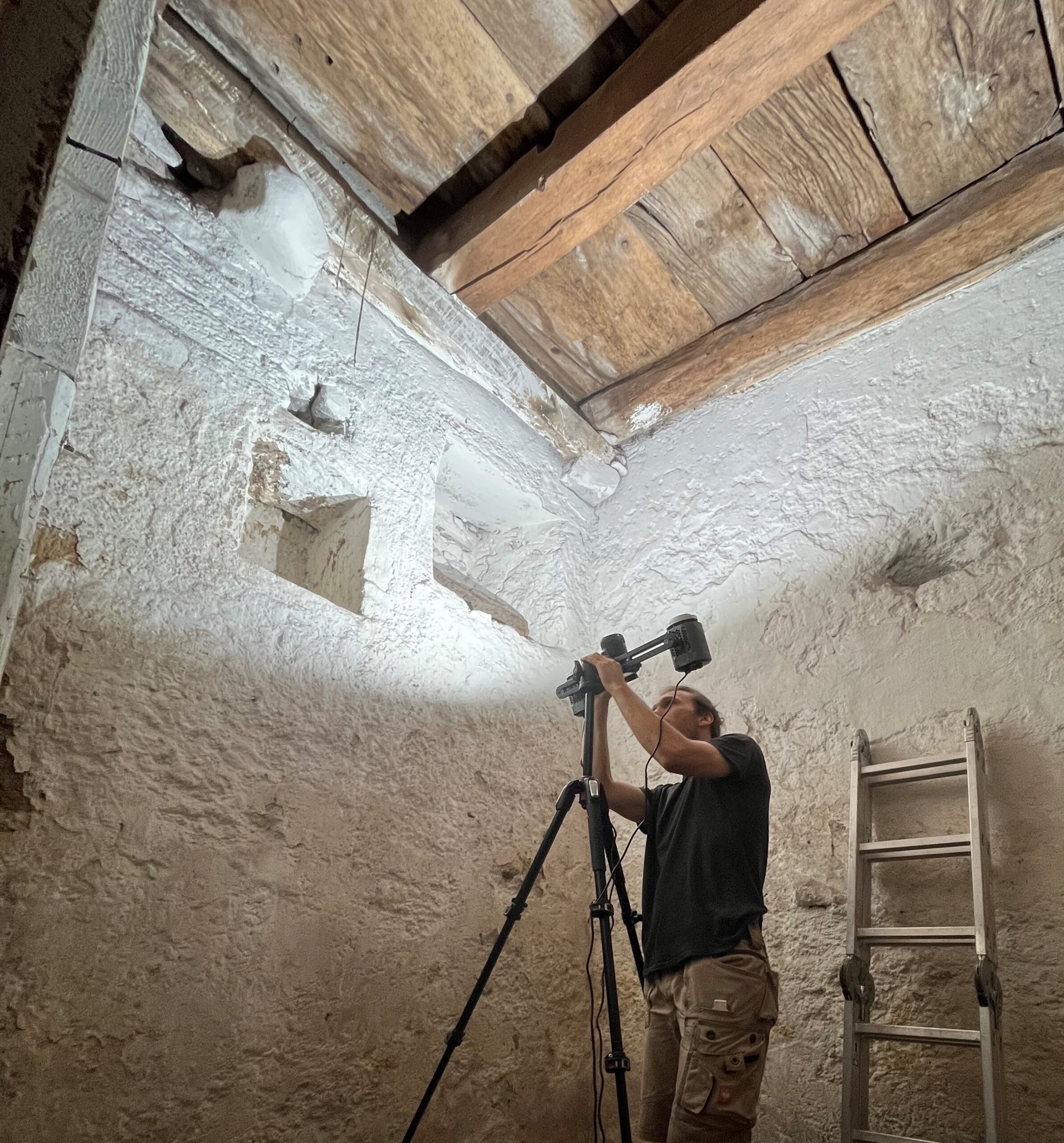
At least 19 planks from a medieval cargo hull now form more than 25 square metres of ceiling in a cellar dated 1244 on Konradigasse in Konstanz. Baden-Württemberg’s monument office said on 12 August 2026 that the boards are not scrap timber hammered into a house, but an almost completely connected ship’s hull given a second life as architecture.
The finding comes from an interdisciplinary team of building researchers and archaeologists at the Landesamt für Denkmalpflege (LAD) in the Regierungspräsidium Stuttgart, set out in the office’s 12 August press release and issued the same day by Denkmalpflege Baden-Württemberg. The cellar is dated to 1244. The hull inside it is older than that roof. How much older the office will not yet say: dendrochronology samples are in the laboratory.
The boards were reused. The surprise was the ship
Dr Aline Kottmann, the LAD’s specialist for medieval archaeology, was blunt about the first reading. “At first it was only clear that the boards had been reused. That they had originally been part of a ship was the surprise of surprises,” she said in the 12 August release.
Reuse of old ships as house timber is not, on Lake Constance, a novelty. Alexandra Ulisch, who works on the LAD’s Wracks und Tiefsee (Wrecks and Deep Water) project, said as much. What is special in Konstanz, she reported, is the completeness: not isolated fragments, but “an almost completely connected ship’s hull” built into the ceiling. Wooden pegs, rows of nails, and the characteristic shapes of the planks are what allowed the team to name those boards as a hull rather than convenient scrap.
First analyses point to a flat-bottomed cargo sailing vessel of a type already known from the Bodensee. The comparison the office names is the wreck at Kippenhorn, near Immenstaad, dated to the fourteenth century. The Konradigasse hull is not claimed as the same ship, nor as the same decade. It is claimed as the same family of workboat: a load-carrier built to sit on a shallow lake.
Whether any of the side planking survives in the ceiling remains an open question in the release. Ulisch put it in the conditional: if side planking is still there, the join between bottom and side would be newly readable. The office has not confirmed that those parts remain. Until it does, the locked fact is the connected bottom — the cargo floor — now serving as a roof.
Pegs in the seams, and a dovetail the lake has not shown before
The identification rests on details scrap timber would not keep. Characteristic wooden pegs and nail rows run with the planks. Some of those planks, Ulisch said, are “cut to fit one another and fastened to the ceiling in the same assembly as they were in the ship.” Because they still sit in that original order, caulking — the sealing compound driven into the seams — has survived in places and has already been analysed. For ship archaeology, caulking is the stuff that kept a lake cargo from becoming the lake.
Damaged stretches of plank were cut out and replaced with tightly fitted wooden inserts. At least four such repairs are already visible. One of them is a dovetail-shaped inlay. The LAD says that form has, so far, no direct parallel in medieval shipbuilding on Lake Constance: a yard decision, sometime before 1244, to lock a failing board back into a hull that still had to float.
Pegs, surviving caulk, matched edges, and those four repairs are why the office will not call this salvage. A scrap pile does not arrive with its seams still packed and its patches still in register. A hull does. That completeness is also why the cellar is, for now, more useful than the wrecks still on the lakebed. Medieval Bodensee wrecks are few, and they lie underwater. “The timbers of Konradigasse are preserved in a markedly more accessible setting,” Kottmann said. “They therefore offer ideal conditions for further analyses.” She called the ceiling more than a chance secondary find: a testimony to medieval shipbuilding, and of particular importance for the ship archaeology of the Lake Constance region.
Hundreds of photographs in mid-August, dates still in the lab
In mid-August 2026 the team went back. They documented the ceiling again and captured it in three dimensions with structure-from-motion photogrammetry — SfM — shooting hundreds of stills that a computer will now assemble into a single model. That is the mapping in the title: not a survey from a boat, but a dense photographic record of dry timber overhead in a dated cellar.
Wood samples came out at the same time. “The evaluation of the samples will take place in the coming weeks. We are already very curious to see what comes of it,” Kottmann said. The office has not published a felling date. The 1244 figure belongs to the cellar, not yet to the trees that became the hull.
The 12 August notice is explicit about its own limits. It is based on preliminary findings. Further detail, the office says, will follow once the analyses in train are finished — the 3D model, the dendrochronology, and the work on the caulking. None of those results are in the release.
Look up in that Konradigasse cellar and the ceiling is still a ceiling: more than 25 square metres of boards, at least 19 of them, carrying the house as they have since 1244. Look with the monument office’s notes in hand and the same boards are a Lake Constance cargo sailer that was not discarded. It was reused as house timber, almost whole, pegs and patches and seams included, and this month it was photographed, plank by plank, so the hull can be read again without being taken apart.
Edited by Justin Brown
