

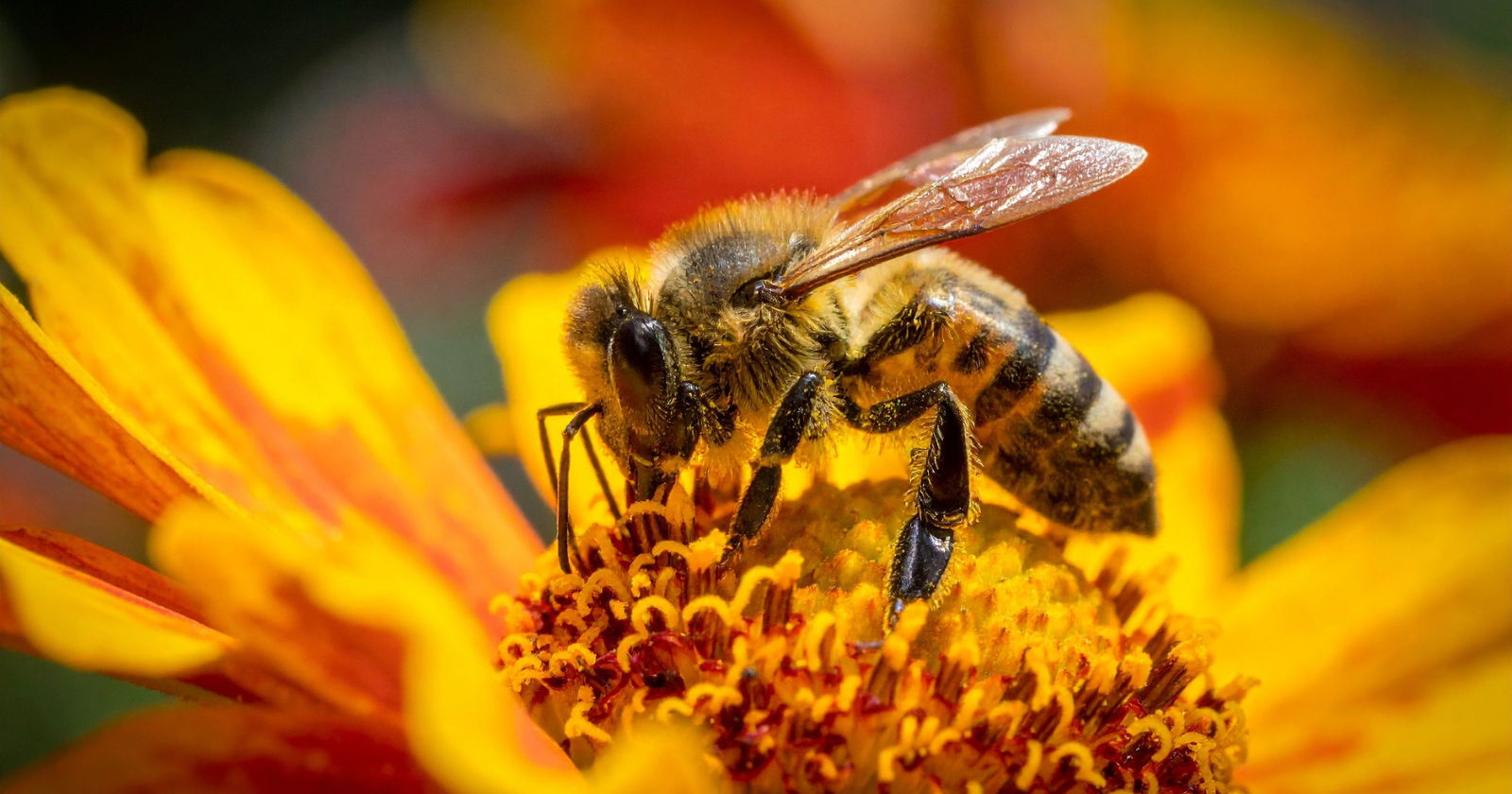
Here is a number that might make you next time you are pouring honey over your toast: one worker honeybee, across her entire life, makes only about a twelfth of a teaspoon. Not a jar. Not a spoonful. A twelfth of one teaspoon.
Of course, that figure is an educated average, not a measurement. As beekeeper Charlotte Anderson notes, “There is no way to measure the amount of honey made by any single bee.” You can’t tag one insect and total her personal contribution to the hive’s stored honey.
The number is a rule-of-thumb estimate, and it shifts with weather, nectar, season and colony conditions. I’d treat it as a useful ballpark, not a stopwatch reading.
A life measured in nectar flights
Part of what makes the figure so small is how little time a worker has. In the warm months, they burn through life fast. Norman Gary, an emeritus professor of entomology at UC Davis, writes that “worker bees live for approximately five to six weeks in the spring and summer.” Those reared in the fall can live for several months, long enough to carry the colony through winter.
So the summer worker gets roughly a month and a half and she doesn’t even spend all of it foraging. A worker starts on jobs inside the hive, cleaning, feeding young and building comb, before moving to field work in her final two or three weeks.
Only then does she fly out for nectar. Each trip brings back a tiny haul. Depending on the flowers available, she may have to visit several hundred flowers to obtain a full load. That nectar still has to be thickened and cured into honey.
What’s left, spread over a short working life, is that twelfth of a teaspoon.
What a jar costs in bees
Now the arithmetic gets uncomfortable. If twelve bees’ lifetime output makes one teaspoon, and a standard one-pound jar holds about 64 teaspoons, that jar represents the lifetime honey output of roughly 768 bees.
Take that as a back-of-envelope figure, not a headcount. It’s built from an average, and the total changes with the size and weight of the jar.
An 8-ounce jar represents roughly 384 bee-lifetimes of honey production. For a one-pound jar, the answer is closer to eight hundred. Whichever number you use, the scale is the point: a jar on a shelf is the pooled output of a small town of insects.
Why the hive works anyway
How does anything get filled at that rate? Sheer numbers, all working at once, that’s how.
A single colony’s worker population can climb to 50,000 to 60,000 workers by midsummer. Thousands of twelfth-of-a-teaspoon contributions, running in parallel, add up fast. The tiny individual output stops being a limit once you multiply it by a crowd.
What keeps that crowd from wasting its effort is coordination. A forager who finds good nectar comes home and dances. The waggle dance communicates the direction, distance and quality of the food source, so nestmates can fly towards it instead of searching blind. Researchers led by James Nieh found that the dance is sharpened by learning and can be culturally transmitted, with young bees performing more accurately after following experienced dancers. The point is that the hive isn’t just a pile of workers. It’s a system that spreads good information fast, so all that parallel effort doesn’t get wasted on bad directions.
The next time a jar sits open on the counter, remember that the contents represent the output of hundreds of short lives, each one adding barely a trace, pulled together by a colony that knew how to point them all the same way.