
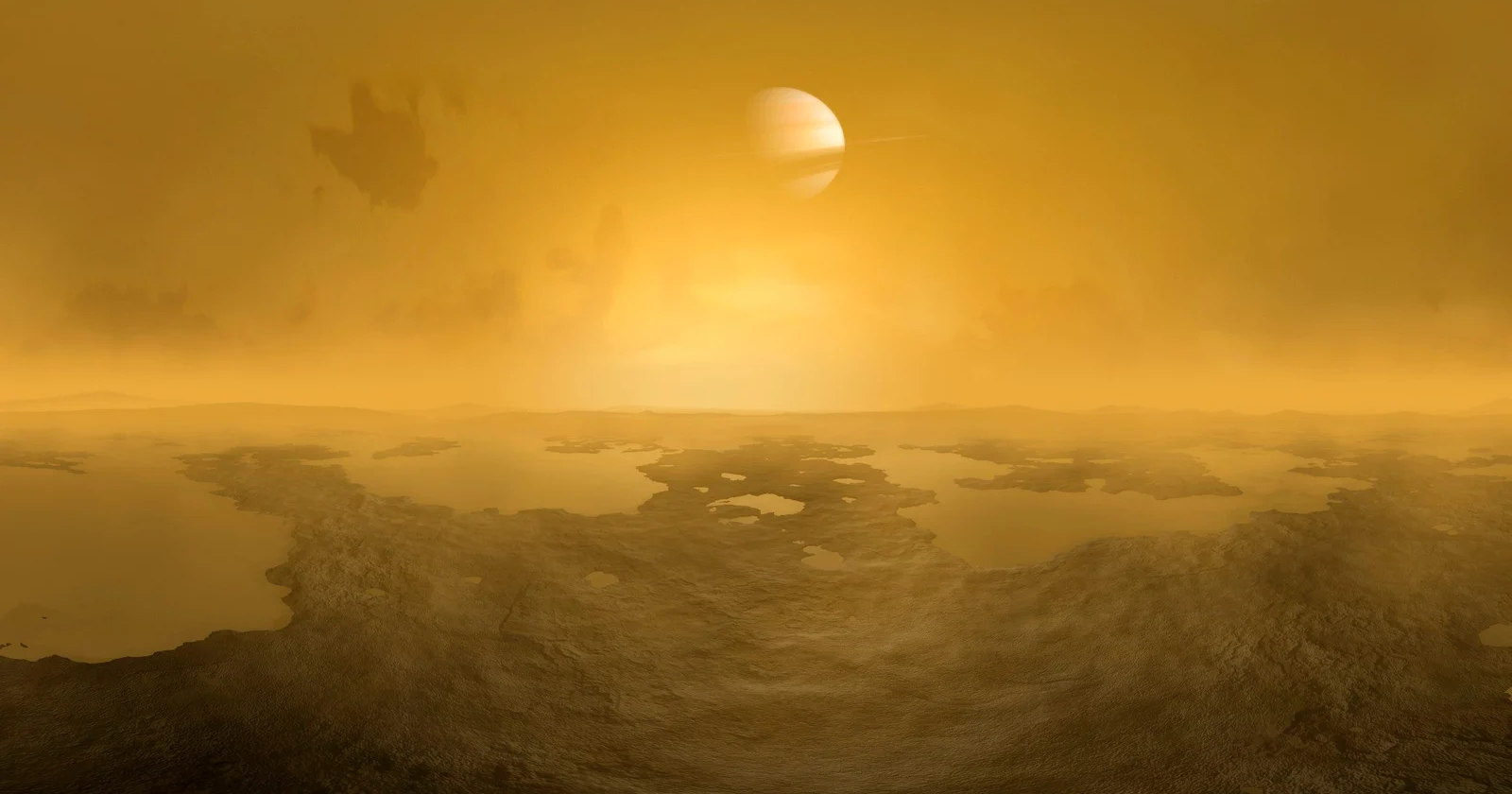
For almost twenty years, Saturn’s biggest moon has been on the short list of worlds that might hide an ocean.
The reason is that Titan flexes. As it swings around Saturn on a slightly stretched orbit, the planet’s changing pull kneads the moon up and down. Cassini measured how much it gives, and the answer was too much for a solid ball of rock and ice. Something inside had to be soft. The obvious explanation was a global sea of liquid water sloshing beneath the crust, letting the whole moon bend.
Then a group at NASA’s Jet Propulsion Laboratory went back to the same old data and got a different answer. Their reanalysis, published in Nature on December 17, 2025, keeps the softness but throws out the sea. In its place: a slab of warm, near-melting ice hundreds of kilometres thick, dotted with isolated pockets of liquid rather than one connected ocean.
We are not planetary scientists, and nothing here is settled. This is our reading of a single new study that reinterprets old spacecraft data. The picture it paints is an inference, not a photograph of Titan’s insides, and other analyses of the same data reach different answers.
What the reanalysis pulled out of the data
Cassini studied the Saturn system from 2004 to 2017 and made more than 100 close flybys of Titan, tracking the moon by radio to see how its gravity shifted as it deformed.
That data has been sitting in the archive for years. What the JPL team did was clean it up with a new noise-removal technique and look for something earlier work had mostly ignored: not just how much Titan flexes, but when.
Timing turned out to be the key. The team found that Titan’s flexing doesn’t peak at the same moment Saturn’s pull does. It lags behind by roughly 15 hours. A delay like that means the interior is dragging its feet, soaking up energy as it bends. In everyday terms, the inside behaves less like something runny and more like something syrupy.
That energy loss is what surprised the team. “Nobody was expecting very strong energy dissipation inside Titan,” lead author Flavio Petricca told Discover. “That was the smoking gun indicating that Titan’s interior is different from what was inferred from previous analyses.”
The logic is clear: a global ocean flexes easily and wastes little energy. A thick layer of warm, bendable ice wastes a lot. The lag points to the ice.
The stranger picture underneath
Swap the ocean for that syrupy interior and you get a layered moon. The team’s preferred model puts a roughly 170-kilometre outer ice shell on top, then a band of warmer, near-melting ice hundreds of kilometres thick beneath it. All told, the water-rich zone runs to about 600 kilometres deep, kept warm and moving by heat from all that flexing.
The physics here isn’t intuitive, and it leans on a strange property of water. Pile enough of it up and the immense pressure changes how it freezes. “The watery layer on Titan is so thick, the pressure is so immense, that the physics of water changes,” co-author Baptiste Journaux told Live Science. “Water and ice behave in a different way than sea water here on Earth.” Down there, ice can be dense enough to sink, and liquid doesn’t simply pool into a single sea.
Petricca’s team suggests “there should be pockets of liquid water, possibly as warm as 20 degrees Celsius (68 degrees Fahrenheit), cycling nutrients from the moon’s rocky core through slushy layers of high-pressure ice to a solid icy shell at the surface.” The qualifiers matter. That 20-degree figure comes from a model, not an instrument, and “possibly” is carrying real weight in that sentence.
How solid the case is
Not solid enough to close, because this single Cassini dataset keeps producing different moons depending on who reanalyses it.
An earlier round of work ran the numbers on the same gravity data and came out the other way, favouring a low-density global ocean. It focused on how big Titan’s tidal response is and got Love number of 0.375 ± 0.06; it didn’t chase the timing-and-energy signal the 2025 team built its slush argument around. Same data, two interiors.
What could actually settle it is going there. NASA’s Dragonfly, a rotorcraft bound for Titan and set to launch no earlier than 2028, carries a seismometer specifically intended to study the depth of Titan’s interior liquid-water layer. Seismic waves travel differently through liquid than through slush, so a real answer is plausibly on the way, even if it’s a long way off.
What slush instead of a sea would mean for life
The reframe matters more than it might first seem. An open ocean and a network of isolated melt pockets are very different places to look for the chemistry of life. “Instead of an open ocean like we have here on Earth, we’re probably looking at something more like Arctic sea ice or aquifers, which has implications for what type of life we might find, but also the availability of nutrients, energy and so on,” Journaux said.
That’s not necessarily a downgrade. Co-author Ula Jones framed the slush as an opening rather than a loss, telling EarthSky that “the discovery of a slushy layer on Titan also has exciting implications for the search for life beyond our solar system. It expands the range of environments we might consider habitable.” If pockets of warm water can cycle nutrients up through the ice, they may be small, scattered laboratories rather than one big sea, and that’s an environment worth taking seriously in its own right.
So Titan loses its ocean, maybe, and gains a stranger interior that we can’t yet see and can only model from a decade of old radio signals. The next real word on it probably comes from a drone with a seismometer, sometime after 2028. Until then the moon’s inside stays an open question that the same data keeps answering differently.
