

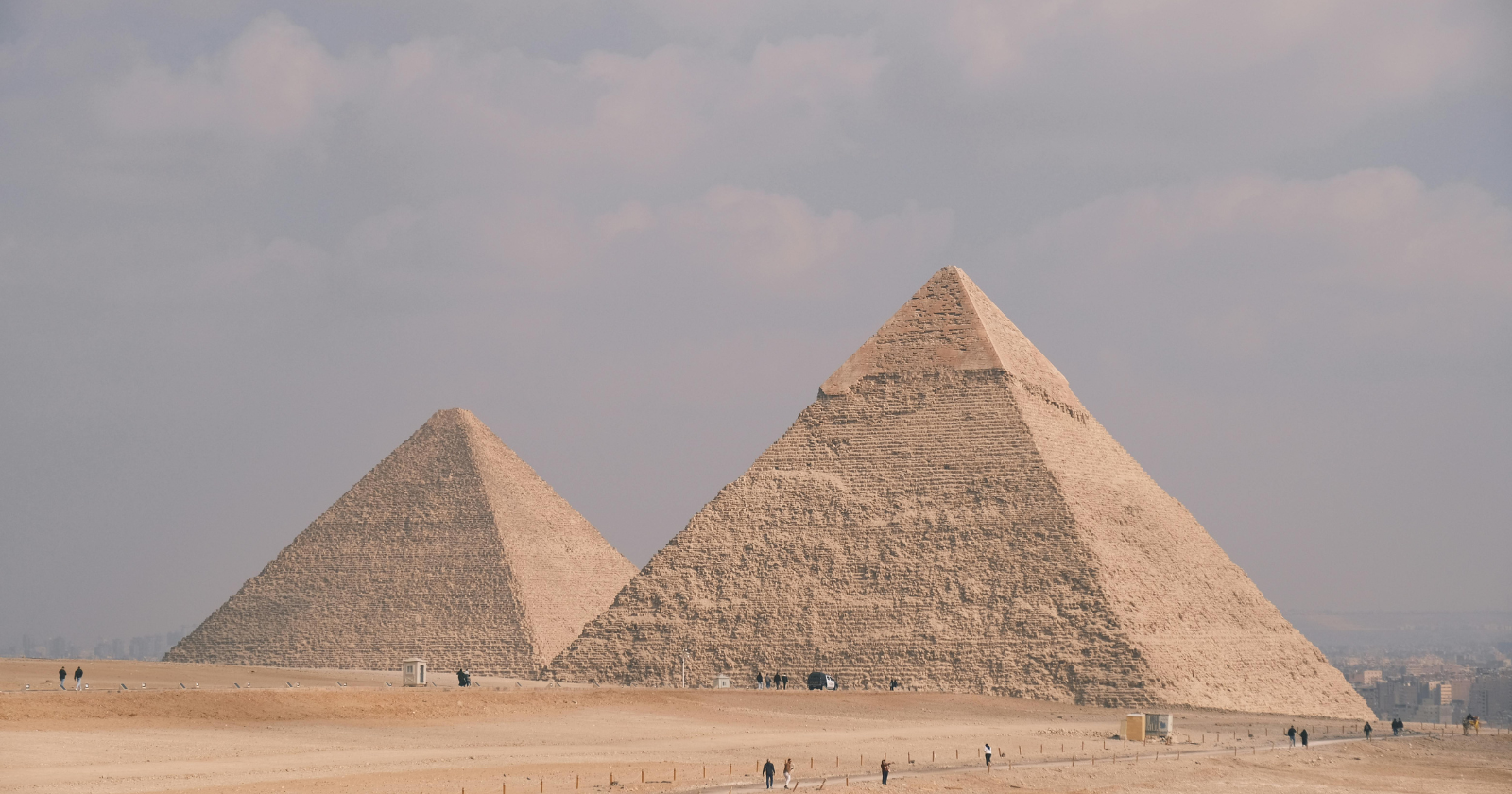
The rough, brown, stepped pyramid you’ve seen is not the pyramid Khufu’s builders actually finished. Around 2550 BC, the Great Pyramid had four flat, unbroken faces covered in fine white limestone, smoothed and polished. It probably looked less like stacked stone than like something poured.
What everyone photographs today is what was left after that white skin came off.
The stepped stone you see now is mainly the rougher backing masonry beneath the casing, not the finished exterior. As Egyptologist Garry Shaw puts it, “when you visit the Great Pyramid today, you aren’t seeing the monument as it originally appeared; the pyramid may look unchanged by time, but it was once even more striking.”
What the casing actually was
The outer layer came from quarries at Tura, across the Nile from Giza, hauled over and cut to a precise slope. Scholars estimate the casing alone used around 67,390 cubic metres of fine limestone that turned a stepped pile of blocks into a smooth, geometric solid.
What that finish was meant to signify is where interpretation begins. Shaw reads the casing as something that “concealed the pyramid’s core and gave its surface a perfect, sloping smooth finish, gleaming white in the sunlight: a rampway to heaven, rather than a stairway.” That last line is his own read on the design, not something the builders wrote down. But the physical description underneath it is solid: flat, white, bright.
How bright is genuinely uncertain. National Museums Scotland, which holds a surviving casing stone, says: “It was polished until it shone so that the pyramid would have gleamed in the sun.”
Donald Jennings argues in a 2021 arXiv preprint that “the great pyramids of Egypt at Giza were once encased in polished white limestone that shone brightly in reflected sunlight,” and that the surface may even have thrown mirror-like flashes as the sun moved. Keep in mind, that this is a single-author preprint rather than a peer-reviewed study.
The safe claim is the modest one. It was white, smooth, and bright. Just how dazzling is a reconstruction, not a measurement.
How it came apart
The skin didn’t simply erode as you might think. Much of it was deliberately taken.
Archaeological research states that most of the fine Tura casing stones were “stripped off the Great Pyramid and recycled to build Cairo during the medieval period,” while conservation research records their reuse in Coptic and Islamic monuments.
The Sultan Hassan Mosque, built between 1356 and 1363, has long been linked to stone removed from the Giza pyramids, although the evidence does not identify particular blocks with certainty.
The pyramid became, in effect, a quarry with a head start, its stone already shaped and dressed.
What survives, and what it tells us
A few casing stones still sit in place at the base of the Great Pyramid, and one traveled a long way: the block now in Edinburgh was brought from Egypt by astronomer Charles Piazzi Smyth in 1872. But the clearest surviving evidence isn’t on Khufu’s monument at all. As Shaw points out, “if you look at the peak of the Pyramid of Khafre, just beside the Great Pyramid, you can still see some of its original fine white limestone.” That smooth cap near the top of Khafre’s pyramid is a preview of the smooth outer finish Khufu’s pyramid once carried from base to summit.
The stripped pyramid isn’t a ruin in the usual sense, a building fallen in on itself. It’s an inside that got exposed, a skeleton whose skin was carried off one block at a time to become the walls of a city downstream. The gleaming original hasn’t so much vanished as scattered. It’s still faintly readable if you know where to look: in the handful of white stones left at the base, in the cap on Khafre next door, and quite possibly in a limestone lintel somewhere in old Cairo that no one thinks to look at twice.