

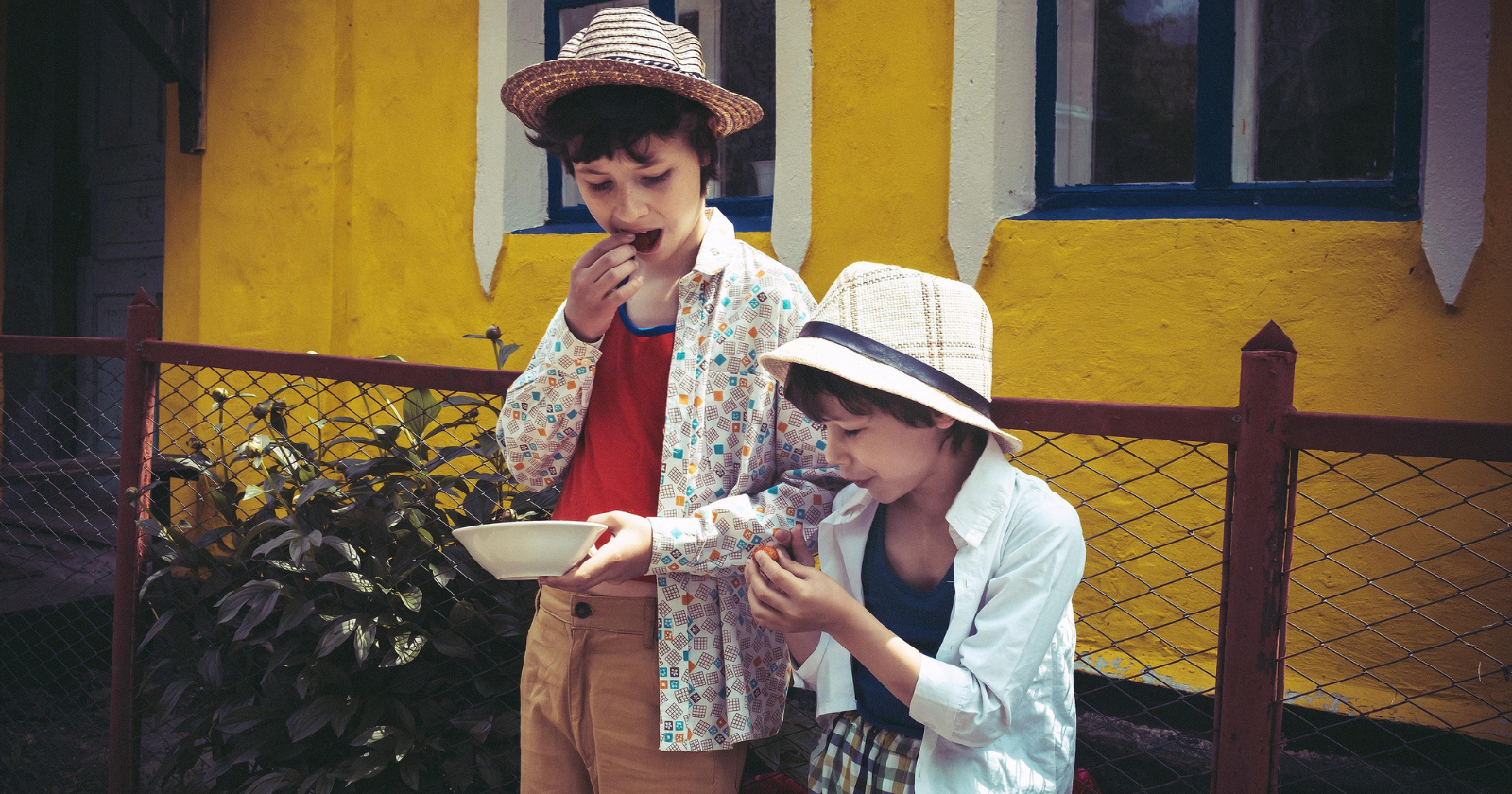
Picture an American childhood, somewhere around 1974.
You leave the house after breakfast on a summer Saturday. Nobody asks where you’re going, because nobody expects an itinerary. You’re eight. The rules are: be back when the streetlights come on, and don’t make anyone call the house.
Between breakfast and streetlights, you will negotiate with older kids over baseball rules, get genuinely lost, get unlost, wreck your bike, assess your own knee, decide it’s fine, resolve a fight without a single adult learning it happened, and get bored so thoroughly that you invent something to do out of sticks and spite.
No parent designed any of that as a curriculum. And that’s exactly the point — because according to a growing body of psychology, that unsupervised, undesigned, benignly neglected childhood was quietly running one of the most effective emotional training programs ever assembled. By accident.
The accidental experiment
Let’s be clear about what 60s and 70s parenting actually was, because nostalgia tends to airbrush it.
It wasn’t wiser. Parents of that era weren’t reading attachment research or validating feelings — most of them would have found the phrase “validating feelings” hilarious. Kids were loved, but the emotional weather of children was, to put it gently, not the household’s central preoccupation. Adults had adult lives, and children were expected to go have childhoods somewhere out of earshot.
That indifference created something no parenting philosophy has managed to engineer since: thousands of hours of childhood in which no adult was available to solve anything.
Psychologist Peter Gray, who has spent decades studying children’s play, calls this vanished resource free play — play that’s genuinely free of adult direction and control. And his central, uncomfortable finding is that free play wasn’t the fun that happened around childhood development. It was childhood development.
What the streetlight hours were actually building
In his landmark research, Gray lays out what free play does that nothing else replicates: it’s how children learn to make decisions, solve problems, exert self-control, regulate their emotions, and get along with others as equals.
Read that list again slowly, because it’s basically the spec sheet for emotional durability.
Consider what a pickup baseball game actually demands when no adult is present. The kids must recruit players, negotiate teams, argue rules, handle cheaters, manage blowouts, and keep the game alive — because the alternative to self-regulation isn’t a timeout from a referee. It’s that the game ends and everyone goes home. The stakes are real and the enforcement is social. Every disputed call is a masterclass in emotional regulation with no instructor.
Or consider boredom — the great, despised abundance of that era. A bored kid in 1974 with no adult entertainment options had to sit inside the discomfort until they manufactured their own way out. That’s not wasted time. That’s a child learning, rep after rep, that unpleasant internal states are survivable and solvable by them. There’s a name for what accumulates from those reps: an internal locus of control — the deep, load-bearing belief that you are the one who handles your life.
The graph that should worry everyone
Here’s where this stops being nostalgia and becomes data.
Gray documents that over the past half century-plus, children’s freedom to play without adult direction has declined continuously — and over the exact same period, anxiety, depression, feelings of helplessness, and suicide among young people have climbed. By some estimates, five to eight times as many students meet criteria for major depression or anxiety disorder as did half a century ago — and that holds even when the diagnostic yardstick is kept constant.
Correlation isn’t causation, and Gray says so himself. But the mechanism is hard to ignore, and one supporting datapoint is especially damning: over those same decades, young people’s locus of control shifted measurably outward — from “I handle my problems” toward “my problems are handled by forces outside me.” Which is precisely what you’d predict from childhoods in which, increasingly, they were.
The kids of the 60s and 70s weren’t tougher because they were made of different material. They were tougher because their environment ran them through ten thousand small, unsupervised difficulties — and difficulty, in doses a kid can handle, is how emotional calluses form.
Why comfort can’t grow a callus
Here’s the cruel irony at the center of all this: the callus-destroying force wasn’t neglect’s opposite — it was love, optimized.
Modern parenting is more attentive, more informed, and more emotionally fluent than anything the 1970s could imagine. And that’s the trap. A callus only forms where friction is repeatedly applied and survived alone. The moment a caring adult absorbs the friction — mediates the dispute, cures the boredom, pre-solves the problem, smooths the disappointment before it fully lands — the skin stays soft. Not because anyone failed, but because everyone succeeded at the wrong goal.
You cannot supervise a child into self-reliance. It’s a contradiction in terms, like teaching someone to swim by holding them out of the water. The 70s kid learned they could handle things by handling things, hundreds of times, with no witness. The modern kid, tracked and scheduled and rescued in real time, is denied the evidence — and a child without evidence of their own durability has every reason to feel fragile, no matter how many times they’re told they’re resilient.
To be clear: nobody sane wants actual neglect back, and the era had genuine costs this article’s word count can’t do justice to. The point isn’t that indifference is a virtue. It’s that indifference accidentally delivered something essential — unrescued difficulty — and we threw it out with the indifference.
The inheritance that’s still claimable
If you grew up in those decades, this explains something you may have never had words for: why your baseline assumption is that you’ll cope. That assumption isn’t a personality trait. It’s a conclusion — drawn from a mountain of small childhood evidence that today’s kids are rarely allowed to gather.
And if you’re raising children now, the lesson isn’t to love them less. It’s to rescue them slower. Boredom left unfixed. Arguments left unrefereed. Problems left, for one uncomfortable beat longer than instinct wants, in the small hands that own them.
The streetlights still come on every night. The question is whether anyone’s coming home from far enough away to see them.
