
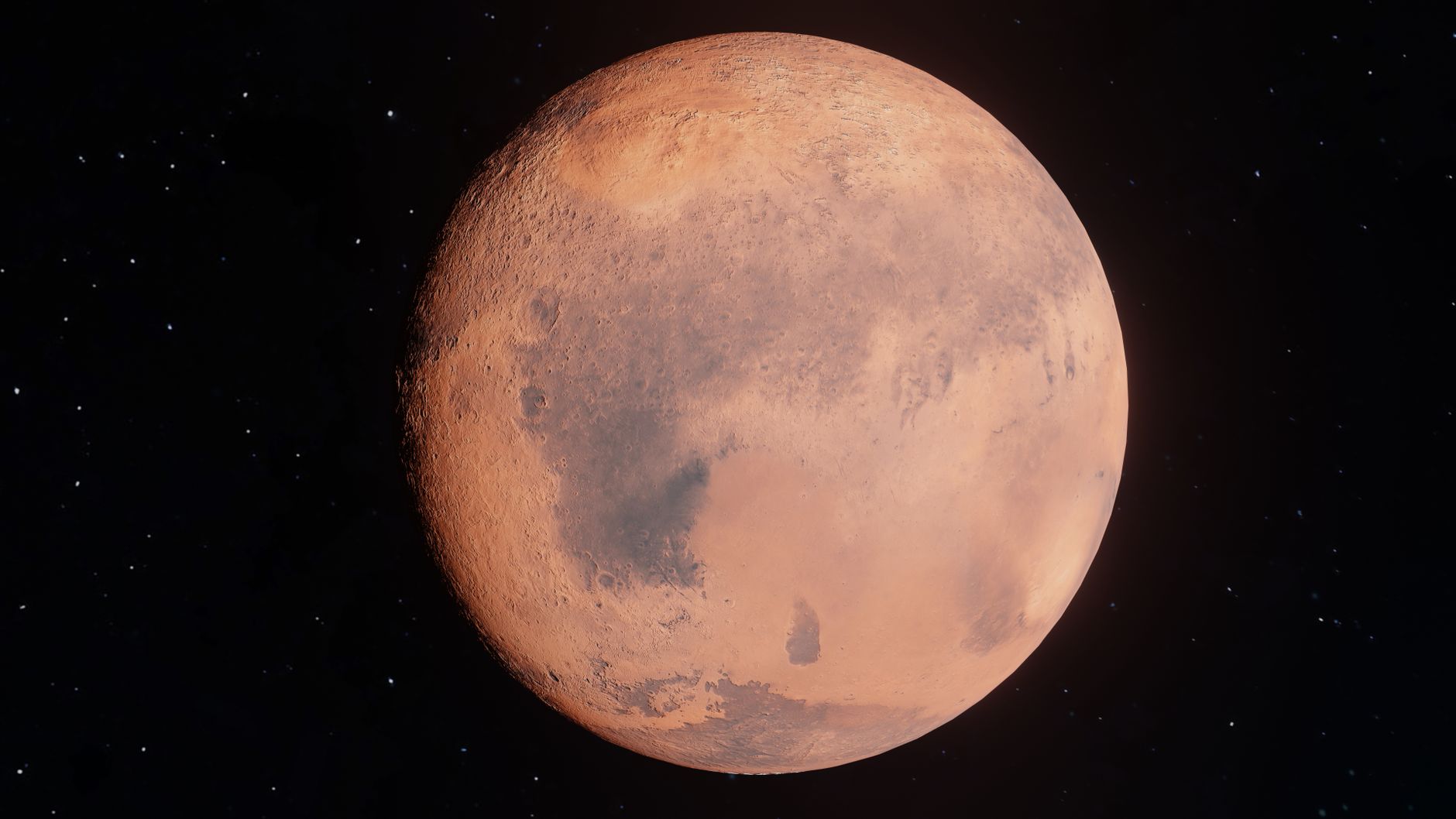
Mars is a planet with two faces. One is the world telescopes and rovers see today: cold, dry, dusty and wrapped in an atmosphere less than one percent as thick as Earth’s at the surface. The other is preserved in stone. Ancient channels branch across old terrain, deltas pour into empty basins, and layered mudstones record lakes that once held water long enough for sediment to settle.
The short version is familiar. Mars was once wetter and probably warmer, with a thicker atmosphere that made surface water easier to sustain. Then the planet lost its global magnetic field, leaving the upper atmosphere more exposed to the solar wind. Over billions of years, the Sun helped strip away gases that had once made Mars a very different place.
That version is broadly right, but it needs care. Mars did not become a desert because a single switch flipped. A magnetic field is not a perfect lid. The solar wind was not the only escape route. The story also involves planetary cooling, ultraviolet radiation, atmospheric chemistry, carbon dioxide trapped in rocks, water frozen underground and Mars’s weaker gravity.
The old climate is written into the ground
The evidence for ancient Martian water does not rest on one suggestive channel. NASA describes Mars as a world whose surface records river valleys, deltas, lakebeds and minerals that form in liquid water. Taken together, those features point to a climate in which water could flow, pool and chemically alter the ground.
Curiosity gave scientists one of the clearest records inside Gale Crater. The rover found rounded gravel that had been transported by flowing water, then fine layered rocks formed as mud settled to the floor of ancient lakes. In 2015, NASA’s Jet Propulsion Laboratory reported that the Curiosity team had confirmed evidence for a succession of streams and lakes between roughly 3.8 and 3.3 billion years ago.
Perseverance later landed at Jezero Crater beside another piece of the same planetary memory: an ancient river delta built into a lake. Across Mars, the pattern repeats. The present atmosphere is too cold and thin to support long-lived liquid water at the surface, yet the geology keeps insisting that liquid water once mattered.
“Warmer” does not have to mean Mars was always mild by Earth standards. The young Sun was fainter, and climate models still struggle to keep ancient Mars continuously warm for long periods using carbon dioxide alone. Some researchers argue for a mostly cold planet punctuated by wetter episodes driven by snowmelt, impacts, volcanism, rainfall or changing orbital conditions. The rocks nevertheless require a Mars where liquid water was far easier to sustain than it is today.
Mars once made a global magnetic field
Earth’s magnetic field is generated by motion in its electrically conducting liquid outer core. That motion acts as a dynamo, producing a planetary-scale magnetic shield. Mars appears to have had its own dynamo early in its history, but it did not last.
The evidence is locked into crustal magnetism. Some of Mars’s oldest southern highland rocks still carry strong remanent magnetic signatures. That is difficult to explain unless those rocks cooled while a global magnetic field existed and preserved a record of it. Younger volcanic plains and some large impact basins show weaker or absent magnetisation, suggesting the dynamo had faded before those surfaces formed.
A 2021 analysis by planetary scientist D. J. Hemingway in the Journal of Geophysical Research: Planets examined how the cooling history of the Martian core could explain the shutdown. The exact timing remains debated because different rocks and basins preserve different parts of the magnetic record.
Mars is not magnetically empty today. Local crustal fields remain, and the interaction between the solar wind and the ionosphere creates an induced magnetic environment around the planet. What Mars lacks is Earth’s kind of internally generated global field enclosing the whole planet.
MAVEN watched atmospheric escape happening
The solar wind is a stream of charged particles blowing from the Sun. At Earth, a strong global magnetic field diverts much of that flow around the planet. At Mars, the solar wind can interact more directly with the upper atmosphere, energising ions and helping carry them into space.
NASA sent the Mars Atmosphere and Volatile Evolution mission, or MAVEN, to study that process. MAVEN entered orbit in 2014 as the first mission devoted to understanding the Martian upper atmosphere, ionosphere and interactions with the Sun and solar wind. NASA’s MAVEN mission page says the spacecraft operated for more than 11 years before the agency declared the mission over in 2026 after an unrecoverable loss of signal.
One of MAVEN’s early results was direct measurement of present-day atmospheric loss. In 2015, NASA reported that MAVEN had identified a process that appeared to play a key role in Mars’s transition from an early warm and wet environment to the cold, arid planet seen today. The spacecraft showed that atmospheric gas is still being lost to space and that the rate increases significantly during solar storms.
That result did not mean the entire ancient atmosphere vanished in one kind of escape. It showed that the stripping process is active now, measurable now and sensitive to solar activity. From there, scientists could ask how much stronger the same processes may have been billions of years ago, when the young Sun emitted stronger extreme ultraviolet radiation and Mars had already lost its global shield.
Argon gave scientists a long-term clock
To estimate ancient loss, MAVEN scientists used argon. The reason is elegantly practical: argon is a noble gas, so it does not readily react with rocks or disappear into minerals. If its isotopes are fractionated in the atmosphere, the pattern can preserve evidence of escape to space.
In 2017, NASA announced that MAVEN measurements showed most of the gas ever present in the Martian atmosphere had been lost to space. The team found that about 65 percent of the argon that was ever in the atmosphere had escaped, a result used to infer broader atmospheric loss over time. NASA’s release says solar wind and radiation were responsible for stripping the Martian atmosphere and transforming Mars from a potentially habitable world into a frigid desert.
Argon is not the main greenhouse gas that would have warmed ancient Mars. Carbon dioxide and water vapour matter much more for climate. But argon is a useful witness because it is chemically stubborn. Its isotopes preserve the fingerprint of physical escape, showing that Mars did not merely hide its atmosphere in the ground.
MAVEN also strengthened the case for sputtering, one of the mechanisms that can remove neutral atoms from the upper atmosphere. In sputtering, energetic ions accelerated by the solar wind slam into atmospheric particles, knocking some of them into space. In 2025, NASA reported the first direct observation of this process at Mars, based on measurements combining several MAVEN instruments. The measured sputtering rate was higher than earlier predictions and rose during solar storms.
The magnetic shield story is true, but not simple
It is tempting to make the explanation tidy: Mars had a magnetic field, then lost it, then the solar wind blew away the air. That is the shape of the story, but not all of its physics.
Venus has no Earth-like internal magnetic field and still has a massive atmosphere. Earth has a strong field and still loses some atmospheric particles. A global dipole can protect parts of an atmosphere, but it can also channel escape along magnetic field lines under some conditions. The outcome depends on the planet’s gravity, atmospheric supply, solar radiation, chemistry and magnetic structure.
For Mars, the loss of the internal dynamo mattered because Mars is small, relatively weak in gravity and was exposed to a more active young Sun. Without a global magnetic field, the upper atmosphere interacted differently with solar wind energy. Over enormous spans of time, small escape rates became planetary change.
Some atmospheric material also went elsewhere. Carbon dioxide can become locked in carbonate minerals. Water can freeze into polar deposits and the subsurface, or become bound in hydrated minerals. Impacts can both strip gases and deliver volatile material. Mars’s atmospheric loss was not one drain, but many drains operating through deep time.
The cold desert we see today is therefore not a contradiction of Mars’s wet past. It is the endpoint of a long transition. The rivers and lakes were written into rock. The air that helped sustain them was vulnerable, leaking atom by atom into space while the planet cooled, its magnetic engine faded and the Sun kept blowing across an increasingly exposed world.
