
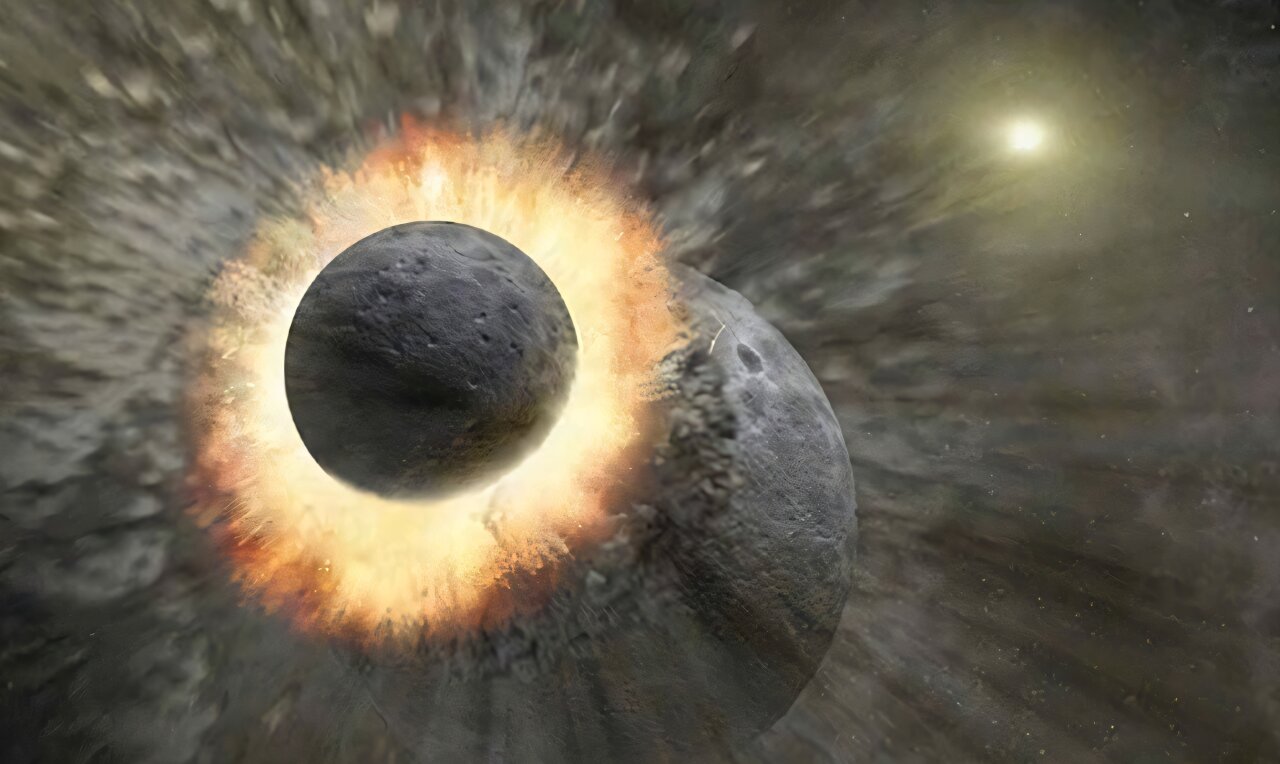
For decades, the standard computer version of the Moon’s origin began with a useful simplification. A body about the size of Mars, commonly called Theia, struck the young Earth roughly 4.5 billion years ago. The calculation treated both worlds largely as strengthless fluids and left a disk of hot debris in orbit. The Moon then assembled from that material over months or years.
A study published on 1 September 2026 in The Astrophysical Journal Letters asked what happens when solid rock is allowed to resist deformation. In one otherwise canonical calculation, temperature-dependent strength changed the outcome from a disk into a coherent satellite whose initial separation occurred within roughly five hours.
This is one simulation study, not a settled reconstruction of lunar history. The five-hour result describes the early dynamical appearance of a connected satellite in one family of modelled impacts. It does not describe the completion of cooling, crust formation or the Moon’s long orbital evolution.
Why a planet-sized collision was modelled as fluid
Calling a rocky planet a strengthless fluid sounds like an obvious mistake. At giant-impact energies, however, it can be a defensible first approximation. Pressures deep inside a planet are far greater than the stress ordinary rock can withstand. The collision also melts and vaporises immense volumes of material, so gravity, pressure and shock heating dominate much of the motion.
The classic 2001 calculation by Robin Canup and Erik Asphaug, published in Nature, reproduced several broad properties of the Earth-Moon system. A differentiated, Mars-sized impactor struck at an oblique angle near the end of Earth’s growth. Mantle material entered orbit as an iron-poor debris disk while most of the metal joined Earth.
Follow-on models then dealt with the disk as a separate stage. Particles and melt outside Earth’s Roche limit, the distance within which tidal forces resist assembly, could gather into larger bodies. Material closer to Earth could spread outward and join them. Depending on the model, building the Moon took months or years rather than hours.
The technique used for the impact is smoothed-particle hydrodynamics, or SPH. Instead of treating each world as a rigid ball, the method represents it with many computational particles carrying properties such as mass, density, temperature and velocity. The 2026 study used the SPHLATCH code and added friction, plastic yielding and thermal softening to the material behaviour.
The difference lay in Theia’s outer layers
The new resistance did not make Theia an unbreakable sphere. Stresses in its deep interior still dwarfed the mechanical strength of rock. The important change appeared in the outer hundreds of kilometres, where partly solid material could resist shearing long enough to alter how the impactor stretched, rebounded and exchanged momentum.
The nominal comparison used an impact angle of 45 degrees and a speed close to mutual escape velocity, about nine kilometres per second. The proto-Earth began with 0.877 Earth masses and Theia with 0.133 Earth masses. Both were differentiated into rocky mantles and iron cores.
With material strength switched off, the hot canonical run added about 91 per cent of Theia to Earth and produced a melt-dominated debris disk. With identical temperature structures but a strength model switched on, about 84 per cent accreted immediately. The rebounding part of Theia deformed and split into large components instead of flowing back as one diffuse stream.
As the inner component fell back, it transferred angular momentum to the outer remnant. The outer body survived as a captured satellite. A University of Arizona account of the study describes the central contrast: matching impact geometry can produce either a disk or a coherent Moon depending on how geological strength is represented.
What “a Moon in five hours” actually means
In the successful nominal case, the bodies began with surface temperatures near 2,000 K but their interiors remained mostly below the solidus. In other words, Theia was extremely hot and weak, but not treated as entirely molten. The initial satellite separated during the first five hours as the inner remnant recollided with the proto-Earth.
Five hours was not the end of the calculation. The outer remnant passed close to Earth, lost material through tidal stripping and received additional torque that moved its orbit outward. The team followed intact-satellite runs for up to 36 hours to make sure the body survived several early orbital passages.
The nominal satellite also was not an exact copy of the present Moon. It finished with about 1.78 lunar masses and an iron core equal to about 5 per cent of its mass. Other nearby choices of impact speed produced coherent bodies between about 1.46 and 1.71 lunar masses. “Moon-sized” is a useful scale description, not a statement that the model reproduced every observed lunar property.
The cooler cases show why the result is not simply “more strength makes a Moon”. At a surface temperature near 400 K, Theia remained so cohesive that most of the rebounding body hit Earth again, leaving a debris disk. At 800 K, a remnant of about 0.63 lunar masses entered orbit temporarily but was disrupted near 25 hours.
The hot, weak solid could deform enough to split into two substantial components. Accretion of the inner one supplied the torque that captured the outer one. The colder body resisted that useful deformation and recollided more completely.
Rapid lunar formation was not invented in 2026
The new paper is not the first calculation to produce a satellite within hours. A 2022 study, Immediate Origin of the Moon as a Post-impact Satellite, found that sufficiently high-resolution SPH impacts could place a body with roughly lunar mass and iron content directly into orbit. Some of its satellites survived passage within the Roche limit through partial stripping and gravitational torques.
The 2026 work identifies a different control. It compares otherwise matching calculations with and without material strength, then varies the temperature that determines how much resistance the rock retains. Its result suggests a connection between timing and outcome: a relatively early collision involving a hot but solid Theia could favour direct capture, while a later, cooler Theia could favour disk formation.
NASA’s overview of lunar formation now presents immediate formation as one live possibility among several. Any successful origin model must still account for the Moon’s mass, small core, angular momentum, early orbit, volatile inventory and close isotopic similarity to Earth. Producing one plausible satellite quickly does not make those other constraints disappear.
The limits are part of the result
The September study explored a deliberately narrow region around the canonical impact. Angles ranged from 43 to 47 degrees, speeds stayed close to escape velocity and three starting temperature profiles were tested. The authors found strong sensitivity within that space. A small change in angle or speed could turn an intact satellite into a short-lived remnant or a disk.
Resolution mattered too. At 100,000 particles, the nominal calculation did not produce the intact satellite. Runs using 500,000 and one million particles did, with the resulting masses differing by only about 0.23 per cent. The authors describe that as evidence that this result is approaching convergence, while stopping short of claiming every relevant parameter has been explored.
The captured body remained mostly material from Theia’s mantle. Adding strength therefore did not solve the long-standing isotopic problem by itself: samples show Earth and Moon are compositionally much more alike than a simple impact between separately formed worlds might suggest.
TerraDaily previously covered isotopic evidence that supported a more energetic collision and thorough mixing. The new strength-based result does not erase that line of work. It adds temperature-dependent geology to impact angle, speed, composition and numerical resolution as a variable that can redirect the outcome.
Five hours is therefore not a new measured age for the Moon. It is the timescale on which one physically richer simulation separated a large, coherent satellite from the collision. Cooling, differentiation, crust formation and the gradual reshaping of the orbit still required far longer chapters of lunar history.
Edited by Lachlan Brown
