
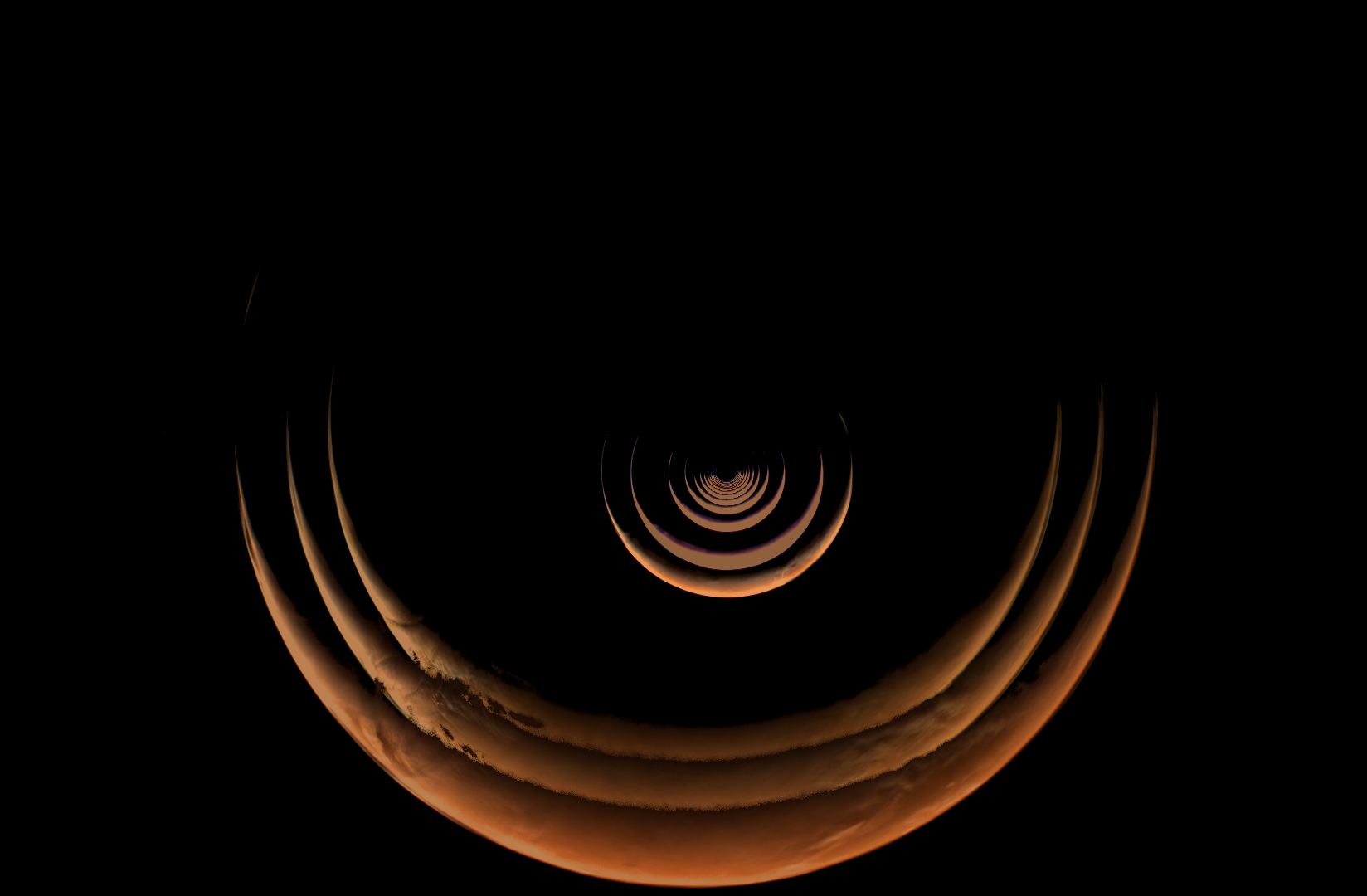
NASA’s Psyche spacecraft passed 2,864 miles (4,609 kilometres) above Mars on 15 May 2026 and emerged from the encounter moving about 1,000 miles per hour faster relative to the Sun. Mars also shifted the plane of the spacecraft’s orbit by roughly one degree, a small angle with a large consequence after years of travel. The manoeuvre put Psyche on the course it needs to reach a metal-rich asteroid in 2029, without using any onboard propellant to create the boost.
Edited by Lachlan Brown
That last detail can sound like a loophole in physics. It is not. Psyche borrowed an almost imperceptible amount of orbital momentum from a moving planet, while a carefully chosen path turned Mars’s gravity into a steering system. The encounter shows why gravity assists remain among the most valuable tools in planetary exploration: they can deliver changes in speed and direction that would otherwise demand more propellant, more spacecraft mass or a different launch.
A close pass with a large payoff
Psyche reached its closest point above Mars on 15 May, then continued towards the main asteroid belt between Mars and Jupiter. Flight controllers did not simply assume the manoeuvre had worked. They examined Doppler shifts in radio signals exchanged with NASA’s Deep Space Network, the global collection of antennas that tracks distant missions.
According to NASA’s post-flyby account, those data confirmed that Mars had added 1,000 mph to the spacecraft’s speed and changed its orbital plane by about one degree relative to the Sun. Navigators then confirmed that Psyche was on track for arrival in the summer of 2029.
The distance of 2,864 miles was measured above the Martian surface, not from the planet’s centre. It was far above the atmosphere and involved no contact with Mars. Yet on the scale of interplanetary navigation it was an intimate pass, close enough for Mars’s gravity to bend the spacecraft’s path by exactly the useful amount.
A gravity assist changes direction before it changes speed
The simplest description of a gravity assist is that a spacecraft falls towards a planet, accelerates as it approaches, and then loses that temporary speed as it climbs away. If Mars were stationary and only the spacecraft and planet mattered, Psyche’s distant approach and departure speeds relative to Mars would be nearly equal. What changes permanently is the direction of the spacecraft’s velocity.
But Mars is not stationary. It is travelling around the Sun, carrying an enormous reserve of orbital momentum. By arriving from the correct direction and leaving along a carefully selected path, Psyche departed with a velocity that included a small contribution from the planet’s solar orbit. NASA’s gravity-assist primer explains the same event in two reference frames: almost the same speed in and out relative to the planet, but a useful change in speed relative to the Sun.
Nothing is created for free. Psyche tugged gravitationally on Mars just as Mars tugged on Psyche. The planet lost the amount of orbital momentum that the spacecraft gained. Mars is so vastly more massive that its resulting change is too small to measure, while the effect on a comparatively tiny probe is mission-changing. It is the orbital equivalent of transferring a vanishingly small fraction of a freight train’s momentum to a ball.
“No fuel” applies to the flyby, not the whole mission
The 1,000 mph boost and orbital-plane change required no onboard propellant during the close encounter. That is the precise meaning of the claim. Psyche did not burn fuel to manufacture the gain while it passed Mars; gravity and the planet’s motion supplied it.
The spacecraft is not otherwise propulsion-free. It launched on a SpaceX Falcon Heavy on 13 October 2023 and uses solar-electric Hall thrusters during cruise. Those thrusters use electricity from the spacecraft’s solar arrays to ionise xenon and accelerate it out of the engines. The thrust is gentle, but it can operate efficiently over long periods. NASA’s preview of the encounter described the flyby as a way to save propellant by letting Mars do work that propulsion would otherwise have had to provide.
Nor was the manoeuvre free in the broader engineering sense. Mission designers had to choose a launch window and build a trajectory that would meet Mars at the right place, time, speed and angle. Navigators tracked Psyche for years and prepared correction opportunities in case its aim drifted. The distinction matters because “burning no fuel” is an accurate description of the gravitational exchange, not a claim that the spacecraft reached Mars without rockets, xenon or sustained human effort.
Mars also became a full-scale instrument rehearsal
A known planet offered the team a rare chance to practise before the unfamiliar asteroid filled Psyche’s instruments. The multispectral imager collected thousands of observations. It recorded a narrow crescent on approach, when sunlight scattered through dust in the Martian atmosphere, and a nearly full Mars after closest passage. NASA’s visualisation collection preserves the approach sequence and shows how rapidly the geometry changed.
The other instruments were active too. Psyche’s magnetometer detected the Martian bow shock, the boundary where the solar wind meets the magnetic environment surrounding Mars. Its gamma-ray and neutron spectrometer detected an increase in neutron counts, although the spacecraft was too high for the team to expect a useful gamma-ray signal. These were not the measurements the mission was built to make at Mars, but they gave engineers real data with which to refine calibration and operating procedures.
A NASA Jet Propulsion Laboratory report issued after the flyby describes the encounter as both a navigation success and an opportunity to check the payload. That rehearsal has special value because there will be no comparable planet waiting beside the destination. Once Psyche arrives, its instruments must be ready to characterise a body no spacecraft has visited before.
The “dead planet core” remains a compelling hypothesis
The title’s description of asteroid Psyche as the exposed metal core of a dead planet captures the most vivid reason for the mission, but it should not be mistaken for a confirmed identity. Scientists think the asteroid may contain material from the partial core of a planetesimal, one of the smaller building blocks that assembled into planets early in solar system history. Repeated violent collisions may have stripped away much of its outer rock before it could become a full-sized world.
There are other possibilities. Remote observations increasingly suggest a mixture rather than a solid block of nickel and iron. NASA estimates that metal accounts for roughly 30 to 60 per cent of the asteroid’s volume, with silicate rock also present. Its unusual composition could reflect impact mixing, volcanic processes involving metallic material, or another history that current data cannot distinguish.
The agency’s profile of asteroid Psyche is deliberately cautious: the body may hold significant metal from a planetesimal’s core, but scientists will not know what it looks like until the spacecraft arrives. Terra Daily previously reported how NASA’s updated mission plan retained the Mars assist and a 2029 arrival after the original launch period was missed.
The last long leg leads to 2029
With the flyby complete and the trajectory checked, controllers prepared Psyche to resume sustained solar-electric propulsion. Arrival is expected in the summer of 2029, with NASA mission material commonly placing the start of exploration around August. The spacecraft will then enter a sequence of progressively lower orbits and spend about two years mapping the asteroid.
Its cameras will study geology and composition. The gamma-ray and neutron spectrometer will look for elemental signatures. The magnetometer will search for remanent magnetism that could support a core origin, while radio tracking will help reconstruct the body’s gravity and internal mass distribution. Together, those measurements can test whether Psyche is exposed deep-interior material, a thoroughly mixed object or something that current categories fail to describe.
The 15 May encounter was therefore more than a photogenic waypoint. It was a precisely engineered exchange of momentum across millions of kilometres, a full-system rehearsal and the last planetary turn before the target. Mars changed by an amount no instrument could notice. The spacecraft walked away 1,000 mph faster, on a new orbital plane, carrying a suite of calibrated instruments towards one of the solar system’s most enigmatic worlds.
