
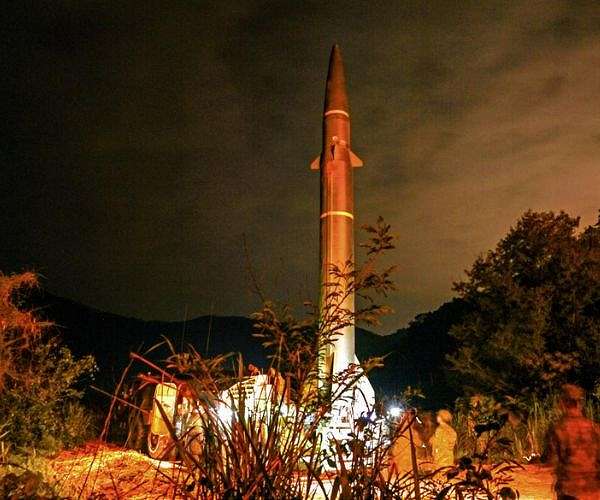
Taiwan issued a national emergency alert on Tuesday as China launched a satellite, days before the self-ruled island holds a crucial presidential election that has heightened security worries.
The alert came hours after election front-runner Lai Ching-te, Taiwan's current vice president, accused Beijing of using "all means" to influence this weekend's poll, which will set the course of cross-strait ties for the next four years.
Phones across Taiwan blared with a "presidential alert" at about 3:15 pm (0715 GMT), around the time Beijing announced the successful launch of its Einstein Probe satellite, which it says will gather astronomical data.
"China launched (a) satellite which flew over the southern airspace," said the Taiwanese alert in Chinese. "Public, please beware of your safety."
The English part of the message described it as an "air raid alert", warning of a "missile flyover Taiwan airspace", but officials said this was a mistranslation.
Foreign Minister Joseph Wu assured reporters that it was a satellite, explaining that the alert was issued because of possible "debris".
"When a rocket is openly flying in our sky, some of their tubes or debris will fall in this region," Wu told reporters at a news conference interrupted by the alert.
"That's the reason why our national alert centre will issue this kind of alert. It has happened before."
– 'No illusions' –
Earlier Lai warned voters to have no illusions about China maintaining peace, but said that he would keep the door open for exchanges with Beijing if he takes power.
Saturday's election will be closely watched from Beijing to Washington as voters choose a new leader to steer the island in the face of an increasingly assertive Beijing.
China claims Taiwan as part of its territory, rejecting the ruling Democratic Progressive Party (DPP) government's stance that the island is "already independent".
Beijing has maintained a near-daily military presence around Taiwan — with four Chinese balloons moving across the sensitive median line on Monday, the latest in a series of incursions that Taiwan and conflict experts say is a form of "grey zone" harassment.
Lai said that while China interferes in "every election in Taiwan", the latest efforts are the "most serious".
"In addition to political and military intimidation, (it is using) economic means, cognitive warfare, disinformation, threats and incentives," he told reporters.
"It has resorted to all means to interfere with this election."
– Hong Kong warning –
President Tsai Ing-wen, who is leaving office after reaching the two-term limit, won a landslide in the last election in 2020.
She was carried to victory by the Taiwan public's fears of becoming like Hong Kong, which had seen Beijing crack down on dissent by implementing a national security law after city-wide protests for greater freedoms.
Under her administration, Beijing has refused all high-level communications with Tsai and ramped up political and military pressures against Taiwan.
Lai said Tuesday that "as long as there is parity and dignity, Taiwan's door will always be open" for exchanges and cooperation with China under his leadership.
"But we cannot have illusions about peace. Accepting China's 'one-China' principle is not true peace," he said, referring to a Beijing doctrine that Taiwan is a part of China.
"Peace without sovereignty is just like Hong Kong. It is a false peace."
Touting deterrence as a main defence policy, Lai said the DPP's "pursuit of peace relies on strength, not on the goodwill of the aggressor".
"The goodwill of invaders cannot be relied on — if you look at Tibet and Xinjiang in the past, or Hong Kong today, these are all good examples," Lai said.
His opponents on Saturday include Hou Yu-ih, a former police officer and mayor with the Kuomintang (KMT), a party which has long encouraged closer cooperation and compromise with China.
Hou has said that Lai — who has previously dubbed himself a "pragmatic worker for Taiwan's independence" — represents a danger to cross-strait relations.
'We are a democracy': Taiwan's voters raise their voice
Taipei (AFP) Jan 9, 2024 –
Taiwan's voters go to the polls on January 13 to elect a new president.
Their choices are frontrunner Lai Ching-te from the ruling Democratic Progressive Party, major opposition Kuomintang candidate Hou Yu-ih, and Taiwan People's Party leader Ko Wen-je.
Here is a look at three of their supporters:
– Hsu Yu-chia, 20 –
University student Hsu Yu-chia said his political coming-of-age happened in 2019, when a pro-democracy movement in Hong Kong brought hundreds of thousands to the streets calling for more autonomy from Beijing.
From democratic Taiwan, he watched the protests on the news with rapt attention.
"I started paying attention to political issues relating to Hong Kong and China," the 20-year-old law student told AFP.
"It was also during that time that I began to see we are separate from China and that Taiwan should not return to the old 'one China'."
China claims the island as part of its territory and has stepped up pressures on Taiwan in recent years, angered by the current DPP-led administration for its independence-leaning stance.
Come January 13, Hsu will be among an estimated one million new voters participating in Taiwan's election.
A staunch DPP supporter, Hsu spends his free time outside of his studies campaigning for them.
"I feel afraid about war breaking out to some degree. But for me the way to avoid war is to prepare ourselves for war — no way we are kneeling down," he says.
"From Tibet to Hong Kong, there have been so many previous lessons."
– Huang Min-sheng, 66 –
Bed-and-breakfast owner Huang Min-sheng said the streets of Kinmen, an outlying island located just a short ferry ride from China's shores, used to be packed with tourists.
"There were very open communications between both sides (Taiwan and China) during the Ma Ying-jeou government," said the 66-year-old, referring to the previous presidency led then by opposition KMT.
But China has ramped up tensions with Taiwan since the DPP administration took over, affecting cross-strait tourism.
"Hou Yu-ih said he'll open up (to China) if he wins," Huang said.
His entire family are KMT supporters — much like the majority of the small island — and he proudly flies the party's signature blue flag outside his historic courtyard home that dates back to the Qing dynasty.
China has also increasingly flexed its military might, running massive drills around Taiwan that have Kinmen residents worried.
"As long as there is no war and both sides continue to communicate with each other, this is the best," Huang said.
"I hope for a change of government… Are you more well off compared to eight years ago? If not, let someone else govern because we are a democracy."
– Penny Huang, 44 –
"In the last 30 years of Blue (KMT) and Green (DPP) bi-partisan fighting, the people are the biggest losers," declared Penny Huang.
The resident of Hsinchu — a northern city home to Taiwan's powerhouse semiconductor industry — said most of her family are "deep blue", staunch supporters of the KMT.
But the 44-year-old has long been disillusioned by the party, and says she has chosen to cast her ballot based on policy.
And this year, it is TPP led by Ko Wen-je that will get her vote.
"They have a clean image of honesty and integrity and they strive for the welfare of the people," the homemaker said, adding that "if Ko promises something, he will keep his words."
Her mornings are spent canvassing near a busy Hsinchu street, holding up Ko's poster and distributing flyers.
"It is not easy for a third political party, the TPP, to emerge and to counter blue and green parties," she said.
"We really hope that it can end the vicious fight… and lead us to a future of new politics and new culture."
