
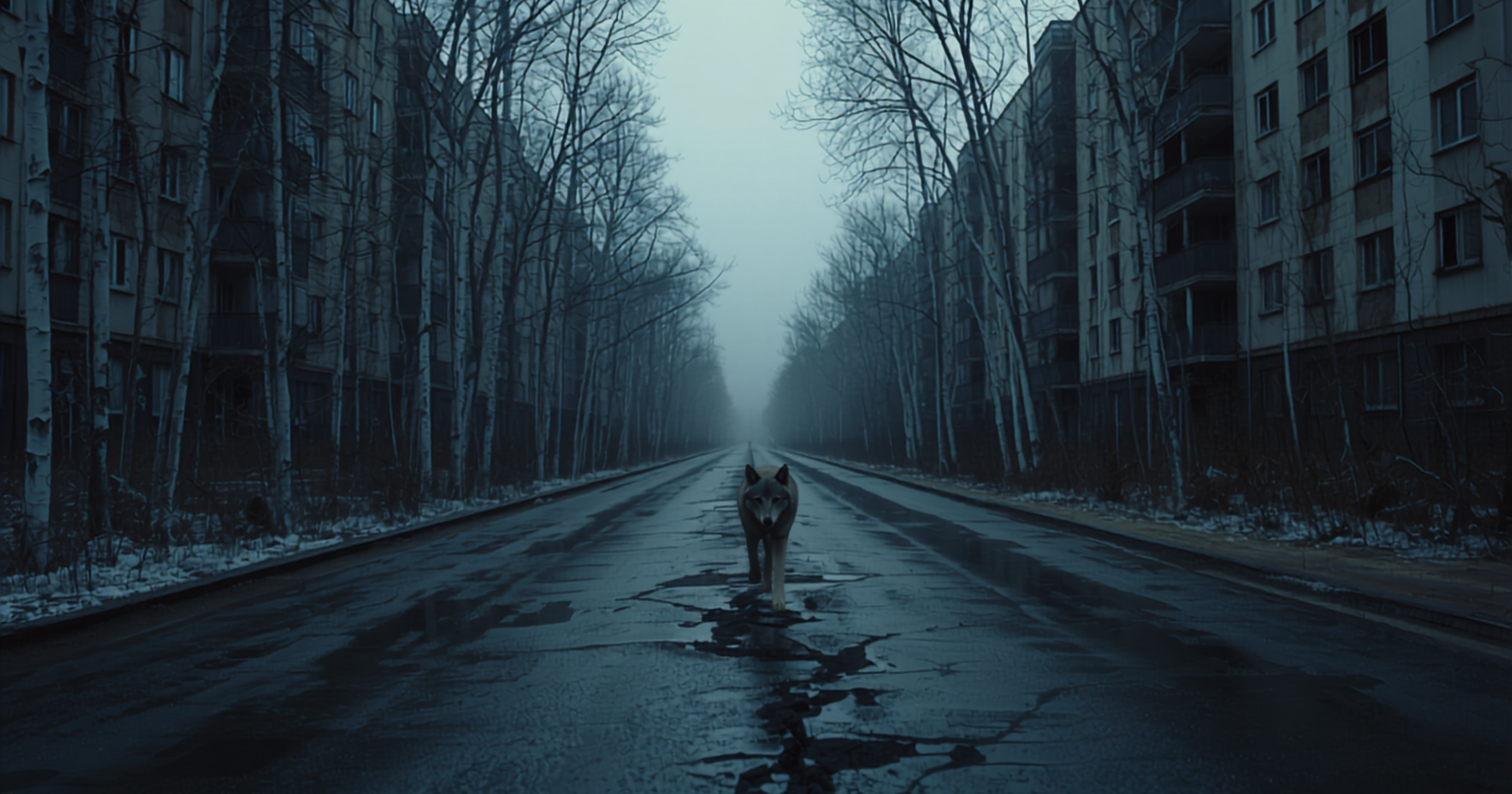
North of Kyiv the pines close over the road and ordinary traffic thins to almost nothing. Pripyat is still printed on the map. The people who filled it were told to leave in 1986, after a reactor at the Chernobyl plant failed and threw its inventory into the sky. What remains is an energy landscape without a workforce: a wrecked machine, a fence, and a lot of empty ground.
The wolves used that vacancy. A winter census on the Belarus side of the same emptied country found grey wolves at about seven times the density of wolves in nearby uncontaminated reserves. Elk, roe deer and wild boar were roughly as common as in those reserves. People were gone. Wildlife was not.
That is the twist the fence does not advertise. Radiation did not wipe the map clean. People leaving it changed the map more.
The machine that emptied the map
The plant sits on the Pripyat River. The first exclusion was a 30-kilometre ring. Ukraine’s zone now covers about 2,600 square kilometres; the Polesie State Radioecological Reserve across the border another roughly 2,160. Papers that treat both as one abandoned country put the combined exclusion at about 4,200 to 4,300 square kilometres. Some 116,000 people were permanently moved out of that first emptied area.
The machine is still there. The reactor that failed is under an arched confinement. The towns are still standing, windows out, trees in the streets. A handful of returnees and a rotating crew keep a thin human presence. Hunting, farming and forestry on the old scale do not. For a wolf, that is the useful fact.
Seven times, counted in snow
The seven-times figure is not a camera tally from last winter, and it is not a 2024 headcount. It comes from a 2015 paper in Current Biology by T.G. Deryabina and colleagues, including Jim Smith at the University of Portsmouth and James Beasley at the University of Georgia. Between 2008 and 2010, crews walked winter routes in the Belarus reserve and counted tracks in the snow — more than 300 kilometres of transect, the same method used in four uncontaminated nature reserves nearby.
Elk, red deer, roe deer and wild boar inside the reserve looked as common as in those cleaner parks. Wolf density was seven times higher. Estimating an absolute population from footprints is messy; comparing reserves counted the same way is sturdier. The more contaminated routes did not hold fewer large mammals than the cleaner ones inside the zone.
Helicopter surveys from the first decade after the accident had already shown elk, roe deer and wild boar increasing. Wolves increased with them. Wild boar later dipped — wolves take boar, and African swine fever moved through as well. The 2015 paper’s line was not that radiation is harmless. It was that, whatever radiation does to an individual animal, the emptied zone still held an abundant mammal community after nearly three decades of chronic exposure.
What the cameras actually saw
A year later the Georgia team put cameras on the same Belarus ground: 30 remote units, 94 scent stations, five weeks. Grey wolf, raccoon dog, wild boar and red fox turned up most often, on hot ground as well as quieter ground. Habitat — food, water, cover — predicted the visits better than the contamination map. The cameras did not produce a new seven-times number. They produced pictures of a predator on ground the reactor had emptied of people. Beasley said the work still could not give a density or a survival rate. It could say the animals were not missing from the worst patches.
A young wolf walks out
When a wolf population fills a place, the young leave. In 2015 the same group fitted GPS collars, with dosimeters, on wolves in the Belarus sector. Thirteen adults kept home ranges inside the zone. One young male did not. Over 21 days in February 2015 he moved about 369 kilometres from the centre of a home range that had been only about 28 square kilometres. Daily travel jumped from a few kilometres to a mean of about 17. The collar failed before anyone could see whether he came back. It was the first documented long walk out of the exclusion zone by a wolf. The authors treated it as a sign the emptied country may feed wolves beyond the fence — and as an open question about whether anything radiation does to genes could travel with them. They did not claim they had watched mutations spread. They had watched one young male leave.
The fence is not a garden wall
Stand on the empty road into Pripyat on a winter afternoon and the postcard writes itself: snow, pines, a wolf, the arch over the wreck. That picture is true and incomplete. The 2015 authors said their census was not a verdict that radiation is good for wildlife. Smith put it more bluntly after the paper landed: it does not mean radiation is good. It means hunting, ploughing and cutting had been worse for these large mammals than the contamination that remained.
A track count of hunted species is not a health survey, and it is not a claim that a wolf living on caesium is the same animal as a wolf on a clean reserve. The papers that found the boom measured density against nearby uncontaminated reserves. They did not measure innocence. The reactor failed and the people were removed. The wolf used the vacancy. Seven times the density of the cleaner parks next door is a real number from a real winter census. It is not a blessing. It is what a predator does with a landscape a machine emptied and left standing.
