
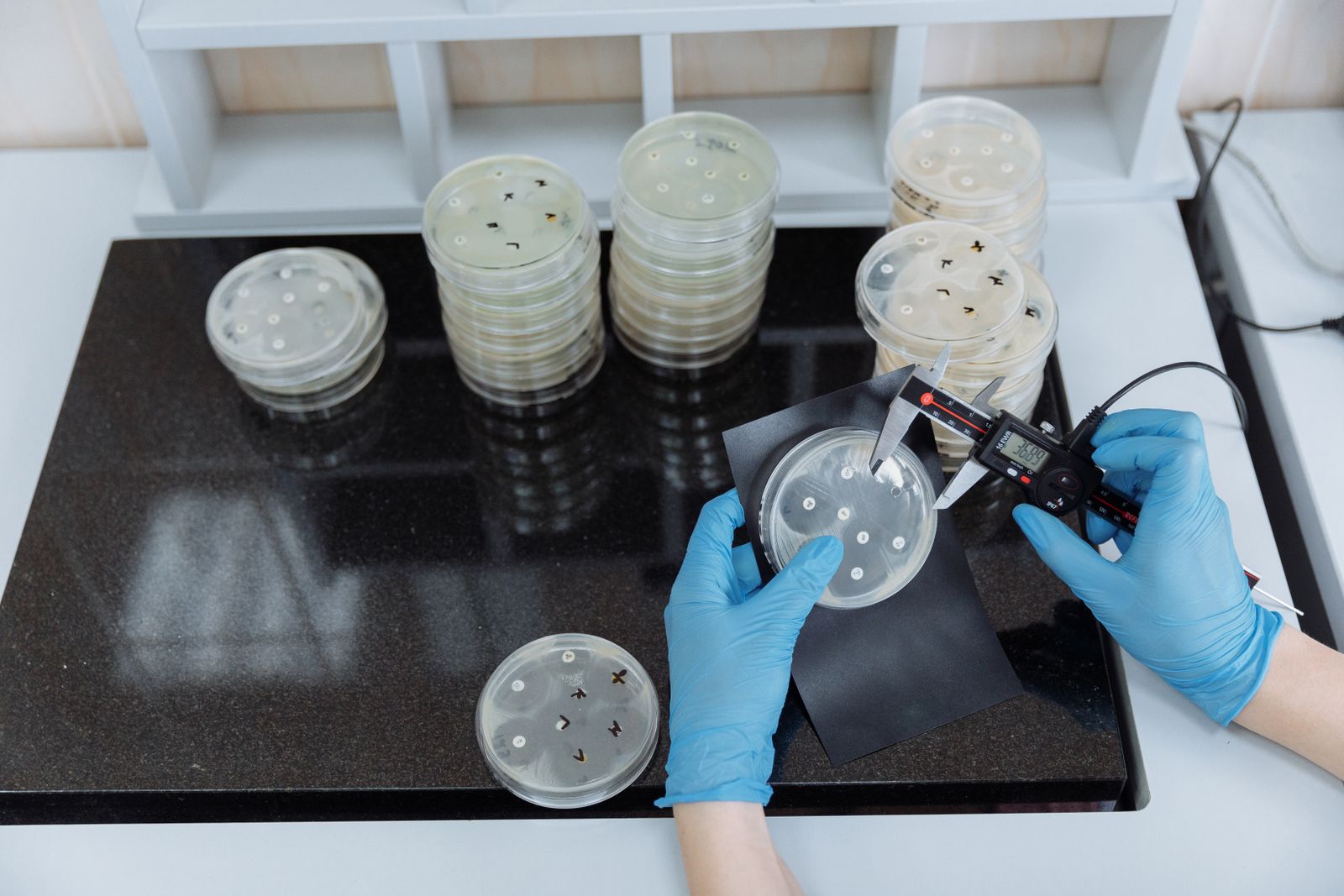
In early September 1928, a Scottish bacteriologist named Alexander Fleming walked back into his cluttered laboratory at St Mary’s Hospital in Paddington, London, after a two-week family holiday and noticed something strange on a petri dish he had left stacked by the sink. A blue-green mould had drifted in from somewhere — possibly from a mycology lab one floor below, according to one theory — and settled on a plate of Staphylococcus bacteria. Around the mould, in a clean halo perhaps a centimetre wide, the bacteria were dead.
That halo is where the antibiotic era begins.
Fleming was 47. His bench was famously messy. He had spent most of the previous decade hunting for substances that could kill bacteria without killing the human host, and had already found one — lysozyme, an enzyme in tears and mucus — but it was too weak against the microbes that actually killed people. The plate by the sink was, by every account of the moment, an accident he almost threw away. He didn’t. According to a Deutsche Welle retrospective, Fleming returned on 3 September 1928 and found the mould had "inadvertently penetrated a Staphylococcus culture and pushed it back."
The plate that shouldn’t have survived
Fleming had been culturing staphylococci for a chapter he was writing on the bacterium. Before leaving for his holiday, he stacked the used plates on a bench rather than in the disinfectant tray. The lab was warm in late August, then cooler when a cold snap passed through London, then warm again. Those temperature swings are believed to have been crucial, according to later historical analysis: the mould germinated in the cool spell, then the bacteria grew in the warmth that followed. Almost any other sequence would have produced a plate that looked normal.
When Fleming lifted the lid, he is said to have muttered, "That’s funny." He showed the dish to a colleague who later recalled the moment in interviews reprinted after Fleming’s death. Fleming photographed the plate, subcultured the mould, and identified it as belonging to the genus Penicillium. He called the substance it exuded "mould juice" before settling, in a 1929 paper in the British Journal of Experimental Pathology, on the name penicillin.
Why the mess mattered
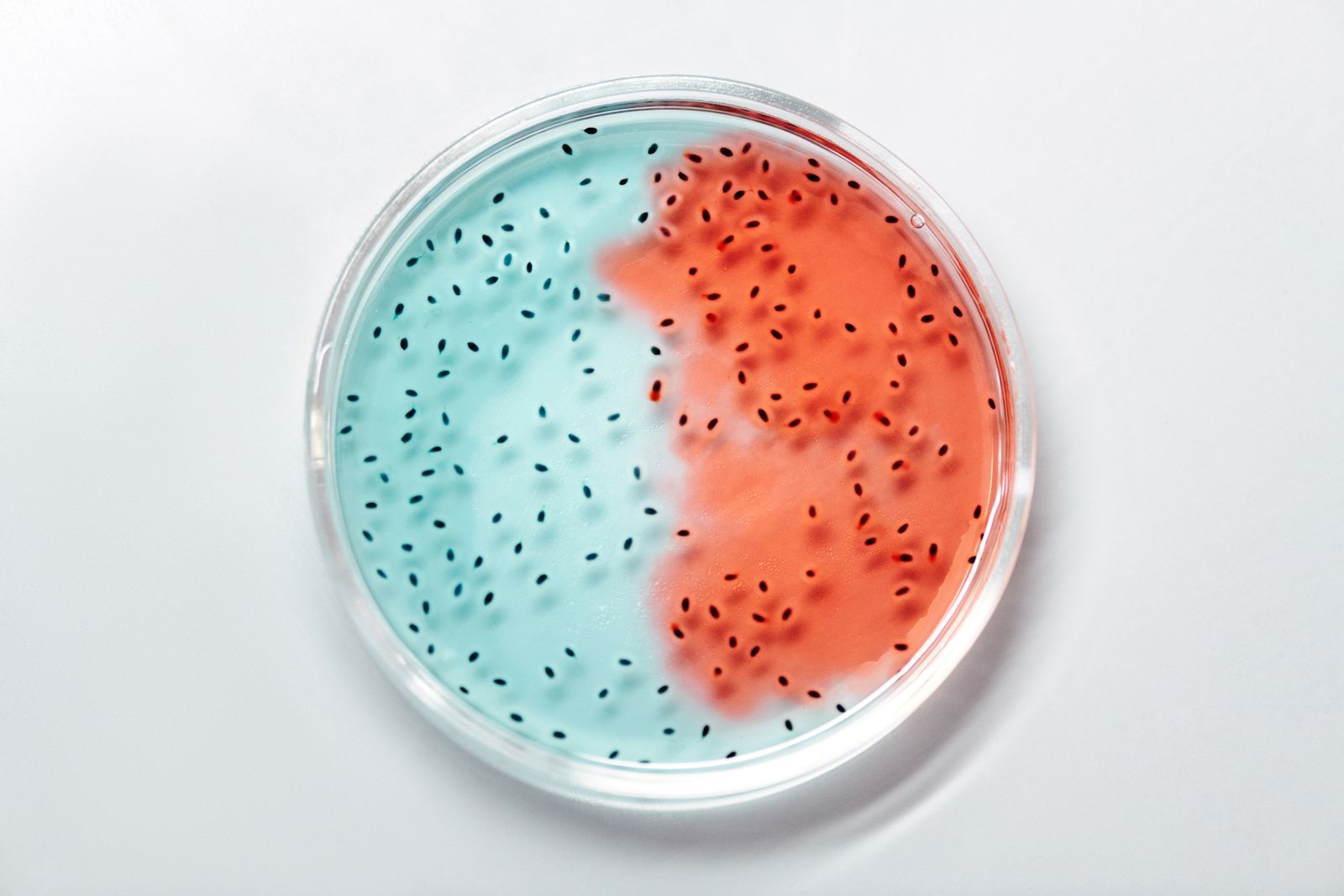
The image of Fleming as a lucky slob is the version most people learn in school, and it isn’t quite right. A Smithsonian profile of Fleming argues that what looked like carelessness was really an unusual attention to the odd and the outlying. Fleming painted with living bacteria in his spare time — ballerinas, houses, stick-figure soldiers, all rendered in cultured microbes of different pigments on agar plates at the Chelsea Arts Club. He had spent years learning what a normal plate looked like, which meant he could see, at a glance, when one wasn’t normal.
Other bacteriologists had almost certainly seen Penicillium contamination before. They had thrown the plates away. Fleming didn’t, because failed experiments were the ones he found most interesting. A piece in The Conversation makes the case that the standard telling — brilliant accident, instant cure — misreads the whole arc of the story. The accident was real. The cure took another sixteen years.
The gap between 1928 and the ward
Fleming published his paper in 1929 and it landed with almost no impact. Penicillin was hard to purify, unstable in solution, and produced in tiny quantities by the mould. Fleming tried to interest chemists in extracting the active compound; the chemistry defeated them. Through the 1930s he kept the original Penicillium notatum strain alive on his bench, sending subcultures to anyone who asked, but he largely moved on to other work.
The drug that actually saved lives came out of Oxford. In 1939 an Australian pathologist, Howard Florey, and a German-Jewish refugee biochemist, Ernst Chain, began working on penicillin in the Sir William Dunn School of Pathology. By 1940 they had purified enough of the compound to test it on mice infected with lethal doses of streptococci. The treated mice lived. The controls died overnight.
The first human trial came in February 1941. A 43-year-old Oxford policeman named Albert Alexander had scratched his face on a rose thorn and developed a systemic infection that was eating through his scalp and jaw. Florey’s team injected him with penicillin and, within days, his fever dropped and his abscesses drained. They ran out of the drug. They tried to recover it from his urine. They ran out again. He died.
From a mouldy dish to industrial fermentation
Wartime need did what peacetime chemistry hadn’t. Florey flew to the United States in the summer of 1941 and, with the U.S. Department of Agriculture’s Northern Regional Research Laboratory in Peoria, Illinois, began screening moulds from around the world for higher-yielding strains. The winner came from a mouldy cantaloupe in a Peoria market: a Penicillium chrysogenum strain that produced roughly 200 times more penicillin than Fleming’s original.
By D-Day in June 1944, American pharmaceutical firms were manufacturing enough penicillin to treat every Allied soldier who needed it. Deaths from bacterial pneumonia, wound sepsis, and gonorrhoea collapsed. A Healio retrospective on the discovery notes that penicillin cut the mortality rate from bacterial pneumonia from around 18 percent before the drug to less than 1 percent after.
Fleming, Florey, and Chain shared the Nobel Prize in Physiology or Medicine in 1945. In his acceptance speech, Fleming used the platform to warn — presciently — about resistance. Bacteria exposed to sub-lethal doses of penicillin, he told the Stockholm audience, would evolve to survive it. Give the drug to enough people at the wrong dose, and it would stop working.
The bill Fleming warned about
He was right within a decade. By the mid-1950s, hospital strains of Staphylococcus aureus had begun producing an enzyme, penicillinase, that cracked the drug’s beta-lactam ring before it could bind to bacterial cell walls. Methicillin was developed in 1959 to get around the enzyme. Methicillin-resistant Staphylococcus aureus — MRSA — was reported two years later.
The resistance clock, it turns out, was already running long before Fleming’s holiday. Microbes have been fighting each other with chemical weapons — and evolving defences against them — for most of the planet’s history. Human medicine simply borrowed one weapon out of an arms race that predates multicellular life.
Fleming died of a heart attack on 11 March 1955, at 73. A UPI dispatch from the day he died quoted Lord Horder, physician to the royal family, calling him "the greatest name in British medicine since Lister." The obituary noted that Fleming had refused to patent penicillin or take any royalties from its manufacture, on the grounds that a drug that could save so many lives ought to belong to everyone.
What the plate started
The clear halo on that 1928 dish set off a chain of consequences that reshaped the twentieth century. Life expectancy in industrialised countries rose significantly between 1940 and 1970, with antibiotics believed to account for a substantial share of that improvement. Surgery became survivable in ways it hadn’t been before — bowel resections, joint replacements, organ transplants all depend on the assumption that post-operative infection can be controlled. Childbirth stopped killing women at the rates it had for centuries. Syphilis, which had shaped European history for 400 years, became a two-week course of injections.
The bill, though, is coming due. Antimicrobial resistance is now directly responsible for more than a million deaths a year and contributes to nearly five million more. New classes of antibiotics have become rare — the last genuinely novel one to reach clinical use was daptomycin, approved in 2003, and it was actually discovered decades earlier. Researchers are pushing into ever stranger corners of the biosphere in the search for replacements, from deep-sea sediments to the microbiomes of insects.
The date Fleming came back
The exact date of Fleming’s return from holiday is often given as 28 September 1928, the anniversary widely marked as the day of discovery. Other sources, including the DW retrospective, place the moment on 3 September. The discrepancy reflects the fact that Fleming himself gave slightly different accounts over the years, and that the "discovery" was really a sequence of observations spread over several days of subculturing and photographing the plate before he was sure of what he had.
The plate itself survives. Fleming preserved it, coated it in resin, and it now sits in the collection of the British Museum, a small circular disc of hardened agar with a faint pale ring still visible where the bacteria died. Every antibiotic prescription written since — an estimated 250 million a year in the United States alone — descends from that pale ring.
Fleming used to tell visitors to his lab, half seriously, that he had not invented penicillin. Nature had. He had simply noticed it, on a warm September morning, on a plate he was supposed to have washed two weeks earlier.
