
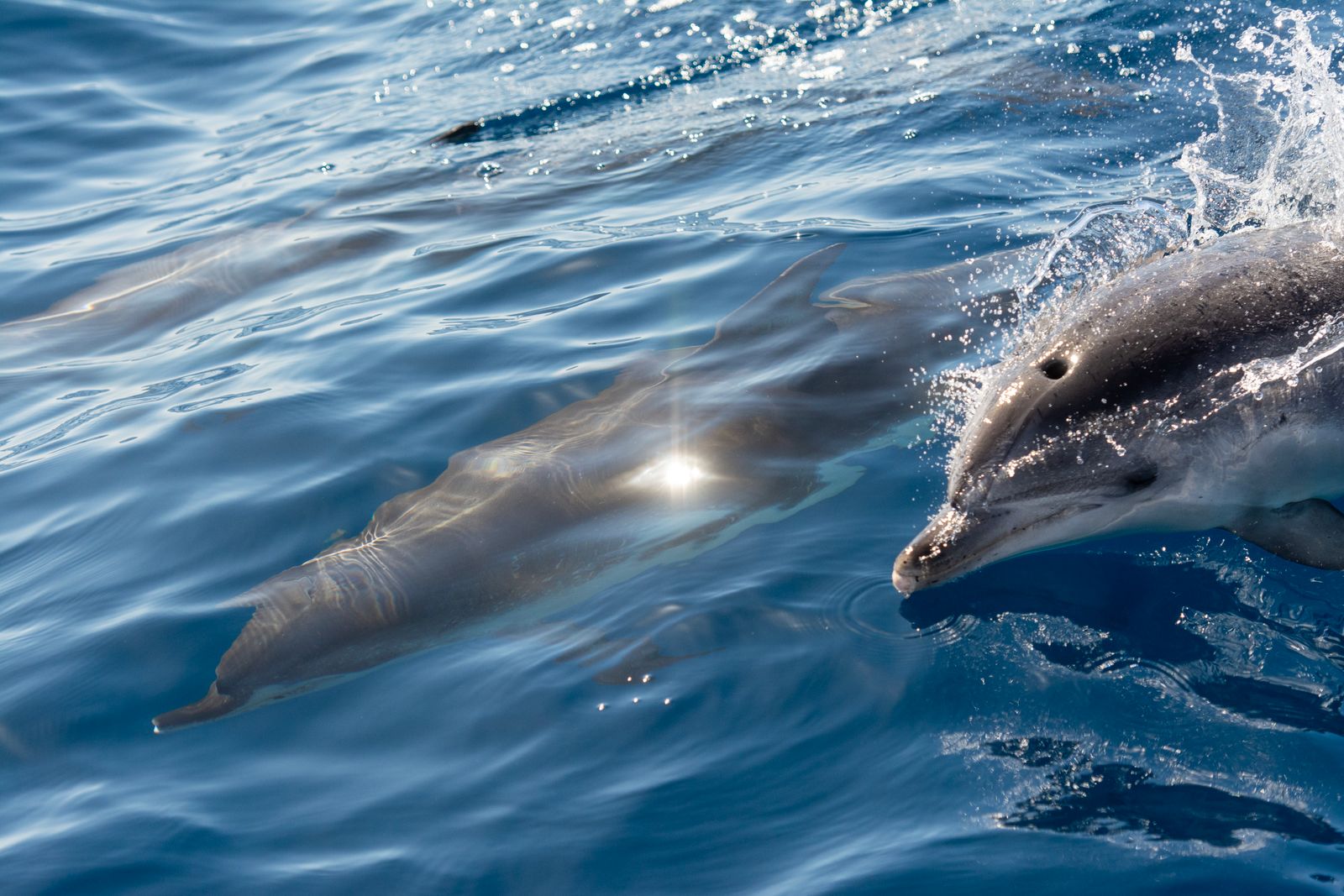
In June 1965, a 23-year-old with no scientific training named Margaret Howe Lovatt moved into a flooded concrete house on the island of St Thomas in the US Virgin Islands, and lived there for roughly ten weeks in ankle-to-waist-deep seawater with a young male bottlenose dolphin named Peter. The work was funded partly by NASA. Her job was to teach him English. By the end of it, Peter could blow air through his blowhole in shaped bursts that sounded, to human ears, like hello, ball, and a strangled attempt at her name.
The building was called the Dolphinarium. It sat above Nazareth Bay at the eastern end of the island, and its upper floor had been waterproofed and flooded with a couple of feet of water so a dolphin and a human could share the same rooms.
A house half-filled with the sea
The lab was the creation of the neuroscientist John C. Lilly, who had spent the previous decade convinced that cetaceans were intelligent enough to hold a conversation with humans, if only someone could work out the interface. He had published Man and Dolphin in 1961, and the book found an unlikely readership among astronomers. Frank Drake, fresh from the first radio search for extraterrestrial signals, helped Lilly secure federal backing, as the Guardian’s account of the project records. NASA and the US Navy were both interested, because the same question — how do you talk to a mind that isn’t shaped like yours? — sat underneath the era’s early thinking about contact.
Lovatt heard about the lab from her brother-in-law at Christmas 1963 and drove out to see it early the following year. The lab’s director, the anthropologist Gregory Bateson, met her at the door, asked why she had come, and, impressed by her nerve, told her to sit and write down what the dolphins did. She was still there months later. Lilly, travelling constantly, eventually handed her the training.
There were three dolphins, all of them former performers acquired from Marine Studios in Florida, where they had worked on the television series Flipper, according to the record of the Dolphinarium experiment. Sissy was the largest and ran the pool. Pamela was timid. Peter was the young male, and Lovatt chose him precisely because he had never been given human-sound training — the other two had.
The setup was simple and strange. The upper floor was sealed with waterproof paint and flooded deep enough for Peter to swim in and shallow enough for Lovatt to wade through. She slept on a makeshift bed on the elevator platform in the middle of the room. Her desk hung from the ceiling on ropes, suspended over the water. She ate standing up.
Twice a day, six days a week
The teaching schedule was rigid. Two formal lessons a day, six days a week, archived on quarter-inch tape as she went. On the seventh day Peter went back down to the sea pool to spend time with Pamela and Sissy, and Lovatt got a night out of the water.
She would speak a word — hello Peter, ball, fish — slowly, exaggerating the vowels, and Peter would try to reproduce the shape of it. The hardest sound was the M in Margaret. He worked at it for weeks and eventually solved it by rolling onto his side and bubbling the sound through the water.
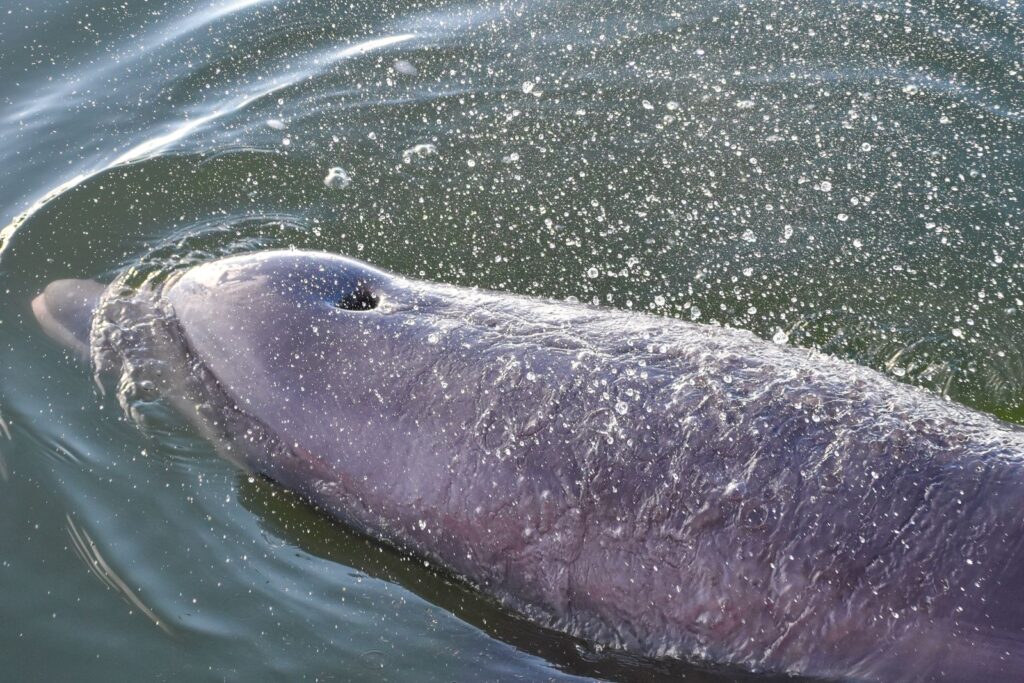
A bottlenose dolphin does not have vocal cords. It makes sound by moving air across tissue in a nasal passage below the blowhole, and it normally uses that apparatus for clicks and whistles at frequencies well above human speech. Getting a dolphin to imitate an English word means asking the animal to slow its air, drop its pitch, and shape a sound its anatomy is not built for.
Peter did it. Lovatt’s own assessment, decades later, was that the formal sessions were not where the progress happened — it was the hours of nothing in particular, the two of them in the same room, that taught her most about the animal.
What Peter was actually doing
Modern acousticians would call what Peter learned vocal production learning — the ability to modify a sound based on hearing another animal make it. Humans do it constantly. Songbirds do it. Most mammals cannot. Bottlenose dolphins, along with a handful of parrots, seals, and other cetaceans, are among the rare groups that can, and Peter’s mimicry is one of the more sustained early cases of a dolphin shaping air to match a human speech target on cue.
Whether he understood any of it is a different question. He would produce ball when she held up a ball, and also when he wanted her attention, and sometimes for no visible reason at all. The imitation was real. The semantics were murky. No novel combinations ever appeared, and no one has claimed since that Peter was using language.
Terra Daily has looked before at how human whistled languages may help decipher dolphin communication — an angle that came out of the same underlying puzzle Lilly was chasing. Cetacean signals do not map onto human words, but they do carry information, and the search for the bridge between the two systems has never fully stopped.
The lab, the funding, and the LSD
Lilly called the operation the Communication Research Institute. Its interest was partly military — the Navy was already training dolphins for underwater work — and partly philosophical. Lilly believed that establishing communication with another intelligent species on Earth would prepare humanity for eventual contact with intelligences off it. Carl Sagan visited the lab to report back to Drake on how it was going.
His methods drifted. Lilly had been licensed to research LSD, and had been injecting it into the dolphins since 1964, hoping the drug would loosen whatever cognitive barrier was preventing conversation. Nothing happened. Lovatt was opposed to the practice and insisted the drug never be given to Peter, which Lilly agreed to, as reporting on Lilly’s dolphin work and the Guardian’s interviews with Lovatt both describe. She had no standing to stop him dosing the other two.
Her focus stayed on Peter and the vocabulary. She kept teaching.
The vocabulary that survived
The point of the flooded house was proximity. Lilly’s theory was that a dolphin would learn human speech faster if it were immersed in it the way a human child is — surrounded, all day, by a caregiver speaking. So Lovatt did not go home at night. Peter followed her through the flooded rooms. He watched her write. He looked, at length and with what she described as real curiosity, at the back of her knee.
He was also a sexually maturing male, and his arousal disrupted the lessons constantly. At first she sent him downstairs to the females, but the trips broke the continuity of the work, so she began relieving him manually instead, as she described decades later in interviews reviewing the experiment. She described it as an itch to be scratched, done openly, not private. It is the part of the story that has since eclipsed almost everything else about the project, and the part a Hustler feature seized on a decade later.
By the end, Peter’s working repertoire, as logged in Lovatt’s notebooks and described in retrospective coverage of the Dolphinarium experiment, included recognisable mimicry of hello, hello Margaret, ball, and a counted one, two, three. The words were pitched high, compressed, and heavily nasal — closer to a tape played at the wrong speed than to human speech — but they were shaped.
What happened to Peter
By autumn 1966, Lilly’s attention had moved on and the funding was gone. Bateson had already been driven out by Lilly’s treatment of the animals. The lab was closed, and Lovatt’s last job there was decommissioning it and shipping the dolphins to Lilly’s other facility in Miami — a disused bank building, small tanks, little or no sunlight.
Peter survived the move by a few weeks. Lovatt got the news in a phone call from Lilly himself, who told her Peter had “committed suicide”. Dolphins are voluntary breathers — each breath is a conscious act, not a reflex — and Ric O’Barry, who knew Lilly at the time, has explained the mechanism plainly: a dolphin that finds life unbearable sinks and simply does not take the next breath. The lab’s vet, Andy Williamson, put the death down to a broken heart, and later coverage of Peter’s fate records both accounts.
Lovatt stayed on St Thomas and married the photographer who had documented the project. They moved back into the Dolphinarium, drained it, and raised three daughters in it. The building has since fallen into disrepair.
The scientific verdict on Lilly’s project is that it produced almost no lasting insight into dolphin cognition. The design was chaotic, the record-keeping uneven, and the entanglements made the data impossible to interpret cleanly. No one has tried to teach a dolphin English since; the research moved instead toward decoding what cetaceans are already saying to each other.
But the recordings remain. If you find the archival audio online today, you can hear a young bottlenose dolphin, sixty years dead, producing something a human ear parses as the word hello. The voice is thin and shaped with air moving through the wrong organ for the job. It is the sound of an animal doing something evolution did not build it to do, because someone in a flooded room asked it to, twice a day, six days a week, through a Caribbean summer.
