
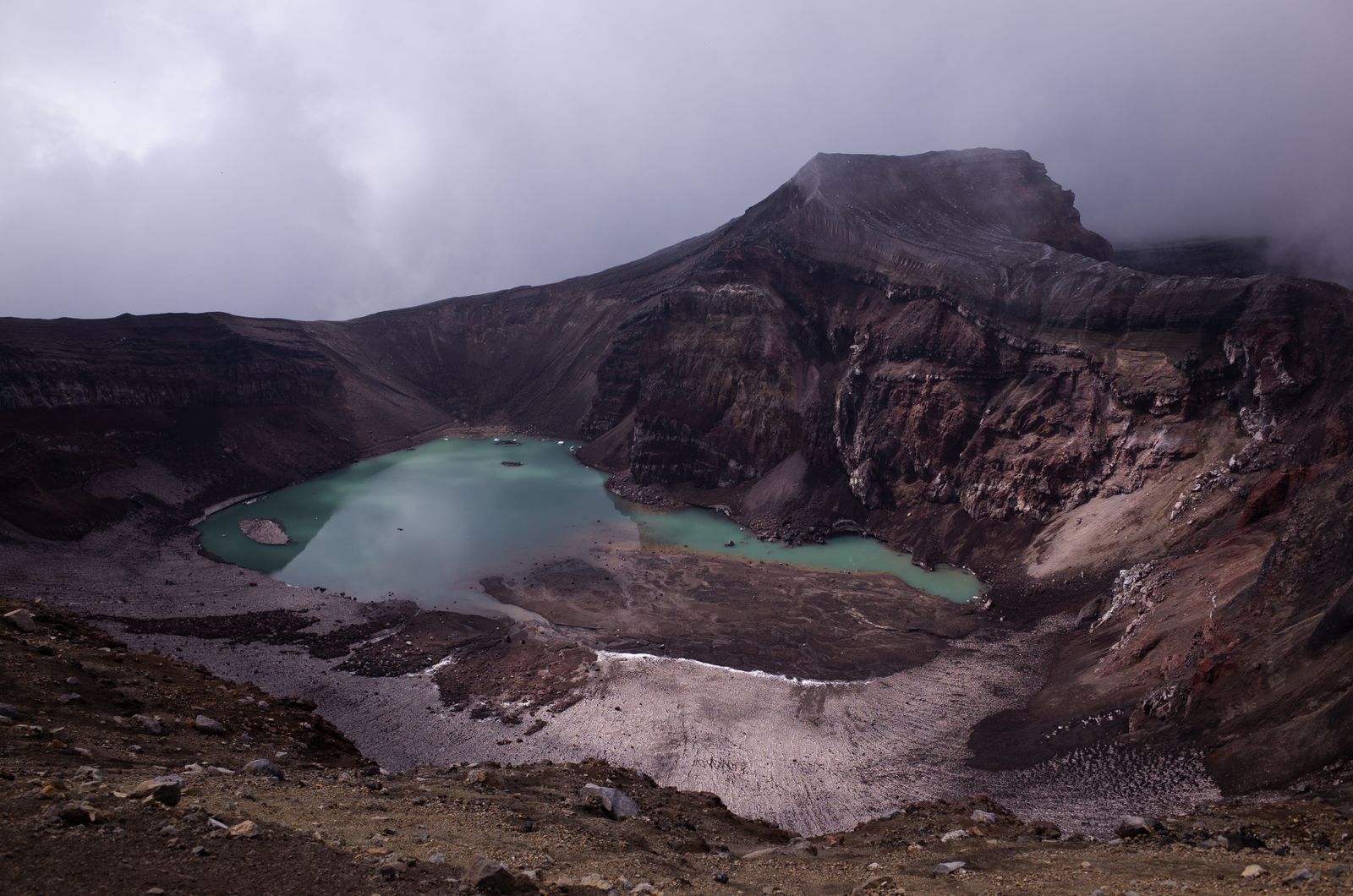
On the night of August 21, 1986, a crater lake in the volcanic highlands of northwest Cameroon exhaled. What came out was invisible, odorless, and heavier than air: a cloud of carbon dioxide hugging the ground as it poured down the valleys around Lake Nyos at roughly the speed of a running man. By sunrise, 1,746 people and more than 3,500 head of livestock were dead, most of them found exactly where they had been at 9 p.m. the night before — beside cooking fires, in doorways, in bed.
There was no flame. No blast wave. No smell. The lake had simply turned over.
The night the air went bad
A subsistence farmer was in his mud-brick house on a cliff above the lake. Around 9 p.m. he heard what sounded like a rockslide, saw a strange white mist rising from the water, and told his children it looked like rain was coming. He went to bed feeling ill. He was lucky — his house sat on high ground.
Down near the shore, a cowherd heard the same rumbling. She would later describe it as the shouting of many voices, followed by a great wind through the compound of thatched huts. Then she blacked out.
When the farmer walked downhill at first light, the lake — normally crystal blue — had turned a dull red from iron-rich water dragged up from the depths. The waterfall at the lake’s outlet was dry. There were no birds singing. No insects. When he found the cowherd, she was tearing off her clothes in grief, surrounded by the bodies of her family members and hundreds of cattle. Even the flies on the corpses were dead.
In villages near the lake, hundreds of residents had died in their sleep.
What actually killed them
Carbon dioxide is a colorless, odorless gas about 1.5 times denser than air. Human beings exhale it with every breath. It is the byproduct of a car engine, a fermenting vat of beer, a cooling piece of magma. Most of the time it disperses harmlessly into the atmosphere.
At high concentrations, it begins to displace oxygen fast enough to induce dizziness, hyperventilation and coma. At even higher concentrations, according to the chemical, isotopic and medical reconstruction of the Nyos event published in Science in 1987, people gasp once and drop.
The cloud that rolled off Lake Nyos was overwhelmingly CO₂. It was cold — chilled by the sudden expansion of gas out of solution — and it clung to the terrain like a fog of dry-ice vapor. It followed river valleys. It filled low ground. Villages sitting a few hundred meters higher on the ridges were untouched. Villages in the natural drainage lines below the crater lost almost every soul.
Some survivors reported waking after more than 24 hours of unconsciousness, discovering their entire family dead beside them, and killing themselves before help arrived.
A lake with a bomb underneath it
Nyos sits inside a young volcanic crater about half a square mile in area. The volcano itself is dormant. But magma still lurks somewhere beneath, and it slowly leaks carbon dioxide upward through fissures in the rock. The gas dissolves into the cold, dense water at the bottom of the lake, where enormous pressure — Nyos is deep, more than 200 meters — keeps it locked in solution like the fizz in an unopened bottle of sparkling water.
Most lakes mix seasonally. Surface water cools, sinks, and stirs the whole column, venting whatever gases have accumulated. Nyos does not. It lies close to the equator, where seasonal temperature swings are small, and it is fed by warm springs that keep the deep layer stratified. So the CO₂ just kept building, decade after decade, under a lid of lighter water.
All that was needed was a trigger — a rockslide, a cold rain squall, an underwater landslip — to displace some of the bottom water upward. As it rose, the pressure dropped. The gas came out of solution. Bubbles formed. Those bubbles lifted more deep water, which released more gas, which lifted more water. A runaway feedback loop that scientists now call a limnic eruption.
Witnesses on distant ridges reported a fountain of water and foam jetting from the lake’s surface. The water level dropped noticeably. Vegetation around the shore was flattened outward as if a hand had pressed down on it.
Then the invisible flood began.
The rehearsal, and the scientists who came
Nyos was not the first. Two years earlier, on August 15, 1984, a smaller crater lake called Monoun — about 60 miles south — had done the same thing on a smaller scale, killing 37 people along a stretch of road at dawn. A cyclist found the local Catholic priest dead beside his pickup truck, then a man slumped on a stalled motorcycle, then a herd of sheep, then more vehicles with their occupants inside.
Icelandic volcanologist Haraldur Sigurdsson of the University of Rhode Island flew to Cameroon and pulled water samples from Monoun’s depths. When he hauled one bottle up, the lid popped off from the pressure. The water was saturated with CO₂. Sigurdsson concluded that a previously unknown class of natural disaster had killed those villagers. A few months later, Nyos killed roughly 50 times as many people.
By the end of August 1986, geochemists, limnologists and volcanologists from Japan, the United States, France, Germany, Italy, Switzerland and Britain were on the crater rim. Scientists from Okayama University and the University of Michigan were among those who responded. George Kling, a limnologist who had sampled Nyos’ shallows the previous year, found that the boy who had guided him around the lake was dead.
What they pieced together, over months of coring, gas analysis and isotope work, was the story of a lake that had been quietly loading itself for centuries. The bottom water at Nyos still held enormous quantities of dissolved CO₂ even after the 1986 release. It was already beginning to recharge. The disaster, they realized, could happen again — not just at Nyos but at Monoun, and possibly at Lake Kivu, on the border of Rwanda and the Democratic Republic of Congo, which sits above a far larger reservoir of dissolved gas and has about two million people living on its shores.
The fix, and it is stubbornly low-tech
The solution proposed by a French team led by engineer Michel Halbwachs was startlingly simple. Drop a vertical pipe from a raft on the lake surface down to the deep, gas-charged water. Prime it once — pump a little water up. As that water rises, pressure drops, gas comes out of solution, bubbles form, and the mixture becomes lighter than the surrounding water. It self-siphons. A fountain of frothing, CO₂-saturated water erupts from the top of the pipe like a shaken bottle of soda, and keeps erupting, powered only by the gas itself.
The first pipe went into Nyos in 2001. Two more followed in 2011. A similar system now degasses Lake Monoun. The pipes are, in essence, controlled versions of what happened on its own in 1986 — a slow, managed limnic eruption that bleeds off the gas before it can build to catastrophic levels.
Nyos held perhaps a cubic kilometer of gas-charged water when it went off. Lake Kivu, farther east, holds roughly 300 times more — some 300 cubic kilometers of dissolved CO₂ and methane, in a lake bordered by cities. A limnic eruption there would not kill hundreds or thousands. It would kill hundreds of thousands. Rwandan and Congolese agencies, working with the same core group of scientists who studied Nyos, have installed methane extraction platforms that both reduce the hazard and generate electricity — a rare case of a natural disaster being defused for profit.
This kind of intervention — understanding the mechanism in time — has historical precedent. John Snow removing the Broad Street pump handle in 1854 is the classic case; the degassing pipes bobbing on Nyos and Monoun are the twenty-first-century version, running on the physics of a shaken soda bottle.
Why the survivors have not gone home
Thirty years after the disaster, Voice of America found survivors still living in resettlement camps, unable to return to the ancestral villages around the lake. The Cameroonian government has kept the immediate valley off-limits, citing continuing risk. Compensation promised in the 1980s has, according to residents interviewed at the anniversary, never fully materialized. The land around Nyos looks intact on satellite imagery — green hills, blue water, cliff-carved amphitheater — but the birds have not fully come back, and the villages remain empty of the families that lived in them for generations.
Local Bafmen tradition, documented by anthropologist Eugenia Shanklin, holds that lakes in this part of Cameroon can rise, sink, explode or move — and that houses should be built on high ground for that reason. The Bafmen settled Upper Nyos, on the ridge. Newer arrivals in the 1960s and 70s, including the Fulani cattle herders, built lower, closer to grazing land. The 1986 death toll broke almost exactly along that geographic and ethnic line. The oral tradition, in retrospect, had been describing a real hazard the whole time.
A survivor, decades later, still walks the rim of the lake he grew up beside. He tells visitors an older story about Nyos — a group of villagers who once tried to cross the lake, and the man who parted its waters until a mosquito bit him and he lost his grip. Everyone drowned. He points with his spear toward two rocks near the shore. Local residents tell stories about the lake’s history and the spirits they believe inhabit it, pointing to landmarks along the shore that hold cultural significance.
The lake is quiet now. The pipes hiss faintly at the surface. Somewhere below, the gas is still seeping upward from the magma, still dissolving into the cold dark water, still being drawn off, one fountain at a time, before it can gather into another silent night.
