
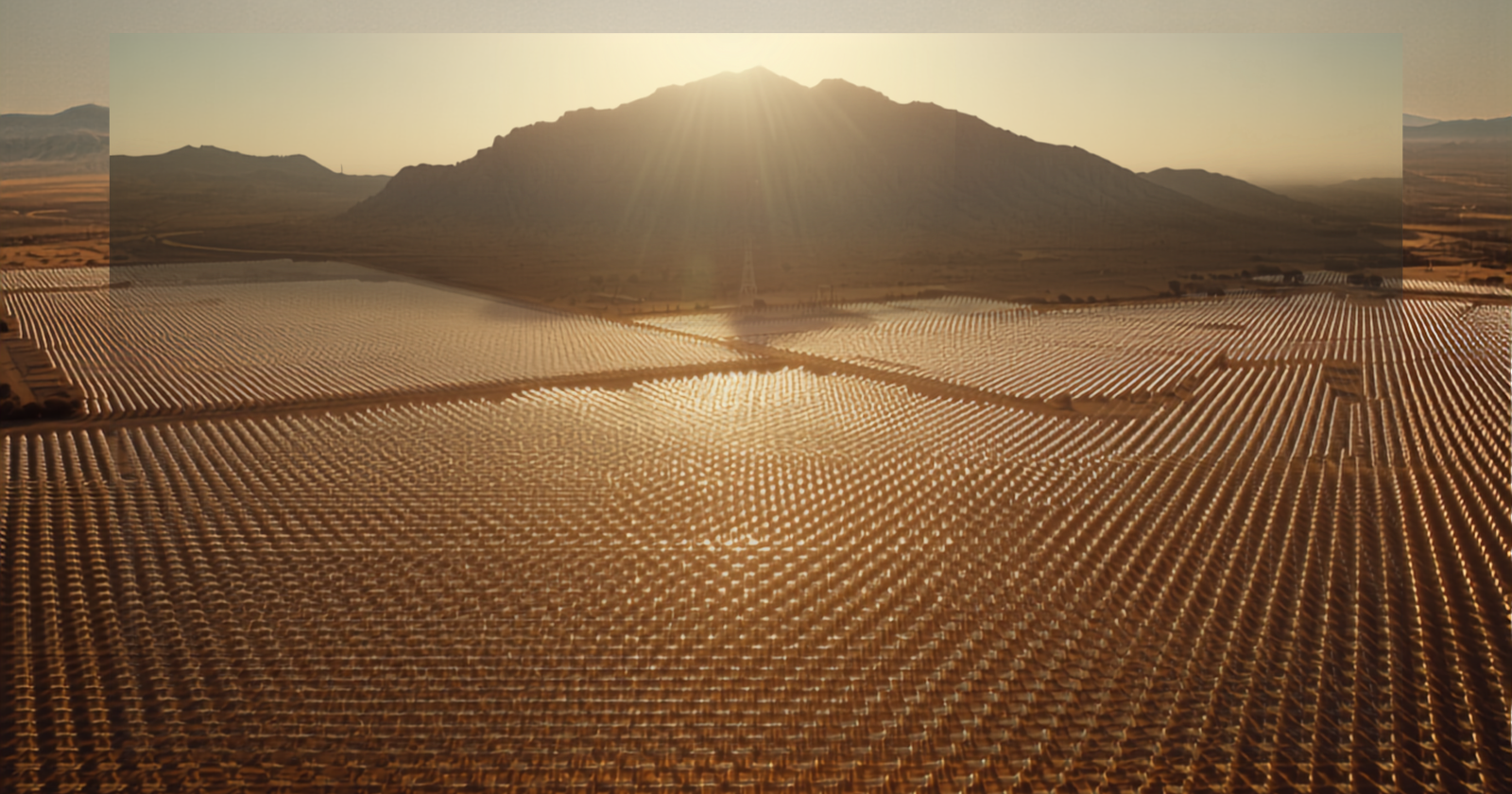
From a few thousand feet over California’s Mojave Desert, the Ivanpah valley can look like water. A pale sheet sits on the bajada at the foot of Clark Mountain, bright enough that pilots on the Las Vegas run have squinted at it from sixty miles out. Three white towers stand in the glare.
It is not a lake. It is glass. Roughly 350,000 heliostat mirrors — about 173,500 sun-tracking stands, each carrying two panels — throw sunlight onto boilers at the top of those 45-storey towers. The receivers heat to nearly 1,000°F, about 540°C, and boil water into steam.
A bird coming in from the air does not see an engine. It sees shine, and insects working the shine. The corridor between the mirrors and the towers is not empty sky.
The shine on the bajada
Ivanpah sits in San Bernardino County near Nipton, just across the state line from Primm, Nevada, on about 3,600 acres of Bureau of Land Management desert. The plant took over ground that held a resident population of federally threatened desert tortoise.
The California Energy Commission certified the project in September 2010 and lists it as three separate solar plants totalling 386 megawatts: 53,500 heliostats around the first tower, 60,000 around each of the other two. Commercial operation began at the end of December 2013.
Each tower is 459 feet, with a boiler on top. BrightSource designed the plant. NRG runs it. The Department of Energy backed it with a $1.6 billion loan guarantee. The mirrors do not make electricity. They only aim.
Aiming is the whole trick, and it is also the hazard. Focus enough mirrors on one point and the air in front of the receiver becomes a cone of concentrated light. Engineers call it the flux. The first thing to fail in that cone is not flesh. It is feathers.
Insects first, then the birds
Three federal wildlife staff, two of them from the National Fish and Wildlife Forensics Laboratory in Ashland, Oregon, spent four days at Ivanpah from 21 to 24 October 2013. Their report is where most of what the public knows about this plant begins.
They found insect carcasses everywhere. In places, hundreds upon hundreds of butterflies — monarchs among them — and dragonflies, some singed, many looking as though they had simply dropped out of the sky. Through binoculars the officers watched insects flying the full height of the tower, active in the bright cloud around the working boiler. Birds were feeding on them.
Then the officers watched birds enter the flux and ignite. Workers already had a word for the puffs of smoke: streamers. The team logged an average of one streamer event every two minutes, and coined a term of their own for the plant — a “mega-trap,” where light draws insects, insects draw insect-eaters, and injured birds draw predators. Ivanpah’s operators argued then, and later, that much of what rose from the flux was debris and bugs. The officers agreed some of it was, and said they had also watched birds burn.
The evidence had been accumulating before the tower ever ran at full load. Reporting in November 2013 on the plant’s own monthly compliance filing, PBS SoCal noted that of 52 birds found dead on the site that October, at least 13 were yellow-rumped warblers, most showing feathers singed, melted or curled by the flux. October is the local peak of the yellow-rump migration.
A warbler that loses its primaries does not need to catch fire. Shortening a small bird’s flight feathers by a couple of centimetres can end its ability to take off at all. Birds that survive the beam can still glide down and then starve, or be taken by a raven. The forensics lab found four birds that had been picked up alive with burnt feathers, sent to rehabilitation, and died within days — all four thin or emaciated, none with burns to the skin beneath.
Seven hundred finds on the ground
The first full year of formal searching ran from 29 October 2013 to 20 October 2014, as the three units came online. Biologists from H.T. Harvey & Associates walked the site and worked it with scent dogs, and their annual report to regulators logged 703 avian detections: 695 dead birds and eight still alive, plus 32 bats. Mourning doves, yellow-rumped warblers, tree swallows, black-throated sparrows and hummingbirds were all on the list — 83 species in all.
The effort behind that number was substantial and still incomplete: 8,935 person-hours and 281 canine-hours of carcass hunting across a site of roughly fourteen square kilometres. Searchers covered the cleared ground around the towers thoroughly and sampled the outer heliostat fields in plots.
They did not search every acre — just under 30 per cent of the footprint — and scavengers did not wait. Ravens, desert kit foxes, white-tailed antelope squirrels, roadrunners and turkey vultures all work the site. Harvey planted carcasses to see how long they lasted: some small bodies were gone within fourteen hours in summer, while larger ones were still there after six weeks. Correcting for what the searchers missed and what the foxes took, the model put first-year deaths at 3,504, inside a range of roughly 2,500 to 6,700.
An earlier figure of 28,380 had circulated widely, and still does. It came from testimony by the independent biologist Shawn Smallwood, who scaled up 183 carcasses recovered at Ivanpah in April and May of 2014 and applied generic correction factors. Smallwood called it a back-of-the-napkin-level estimate himself. It was a conservation-minded guess made in the absence of data. It is not a count.
Singed, struck, or unaccounted for
Of the 703 detections Harvey could examine, 45 per cent — 316 birds and feather spots — showed singeing. Eighty-four showed a collision: a strike mark on a mirror, a smashed keel, a body at the foot of a heliostat. Fifteen were other project causes, mostly birds trapped in the condenser buildings. The remaining 288 carried no clear mark at all.
Stretched across the unsearched ground, that becomes 1,492 estimated deaths from known causes and 2,012 from causes nobody could determine. Within the known group, 47 per cent were singeing and 52 per cent collisions — 707 birds burned and 774 struck, in the same review’s figures. Some of the 2,012 unknowns are birds that would have died anyway, in a desert that kills small birds routinely.
The honest shape of it is a range, not a headline: a few thousand birds in a year, the burned and the struck in roughly equal share, and the largest single category left too degraded to read. The arid heat that makes the site good for solar also destroys the evidence within days.
The lake is mostly not the answer
The image is irresistible and it is half wrong. The forensics lab examined 233 birds from three facilities using three technologies: Desert Sunlight, a photovoltaic plant; Genesis, a parabolic trough; and Ivanpah, the power tower. It is at the photovoltaic site that the water illusion shows up in the bodies.
Birds whose primary habitat is water — coots, grebes, cormorants — made up 44 per cent of the remains at Desert Sunlight, 19 per cent at Genesis, and 10 per cent at Ivanpah. The lab’s explanation was geometric. Desert Sunlight’s panels sit in long continuous banks that read from above as a sheet of sky. Ivanpah’s mirrors are individual panels that, the report says, appear from above as stippling in a desert background. Eight of the fifteen predation deaths at the PV plant were grebes, birds that cannot take off from dry land once they have come down on it.
Waterbirds do reach the bajada. American coots were the fourth most common species in the lab’s Ivanpah sample, along with cinnamon teal, a sora and spotted sandpipers. But they were not the birds turning up with burns. Every flux casualty the lab could identify but two was a bird that eats insects, and the lab found no evidence that these plants attract particular species at all. At Ivanpah the mechanism was the mega-trap and the beam, not a mirage of water.
Dusk on the bajada
Operators did not leave the aim points where they were. New software scattered the standby heliostats so unused mirrors no longer stacked an invisible hot spot in the air beside the boiler — the single change that most obviously worked. Night lights went over to LEDs that draw fewer insects. Perch deterrents went onto the railings near the flux. One tower got a BirdBuffer, a machine that sprays concentrated grape extract into the air, installed in the last week of the monitoring year and therefore untested by it.
By spring 2015, mortality at Unit 1 was reported to be about 70 per cent below the previous year, and well below the two units that had not yet received deterrents. The advisory committee agreed to extend the measures.
The second year did not read as cleanly. A different contractor, Western EcoSystems Technology, estimated about 6,190 deaths for 2014–15, and noted that the two years were not really comparable: Harvey’s first-year survey had missed part of the fall migration and had run during a phased startup. WEST’s own reanalysis of both years put them within a few per cent of each other. Yellow-rumped warblers led its list again, then mourning doves, then greater roadrunners.
Ivanpah was supposed to be winding down by now. Its owners and PG&E agreed in January 2025 to tear up the contracts on two of the three units, and the plan was to switch them off in early 2026. On 4 December 2025 the California Public Utilities Commission rejected the termination agreements without prejudice, and wrote that the plant is expected to continue operating.
So it is still out there on the bajada — three pale towers, a field of glass, a shine you can mistake for water at cruising altitude. At last light the receivers hold the day’s heat and the heliostats go dark in rows, like a lake losing its wind. Feathers begin to degrade at 400°C after half a minute in a laboratory stream of hot air, and singe on contact at 450. The desert does not stop sending birds over it.
