
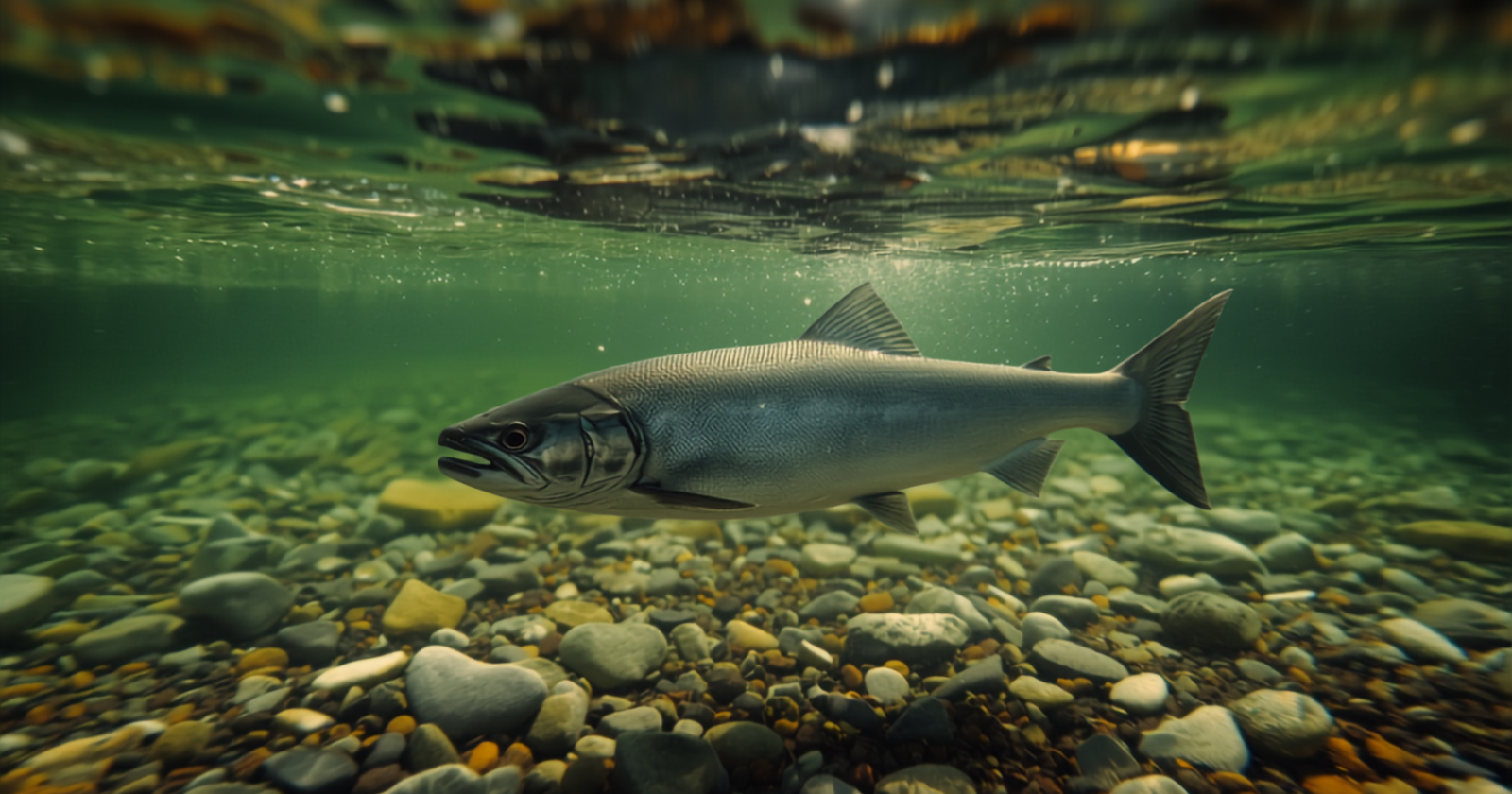
The last wall on the Klamath was a temporary coffer, an earthen plug left so crews could finish taking Iron Gate apart. When they cut it, water that had been stacked behind four hydroelectric machines — J.C. Boyle, Copco 1, Copco 2, and Iron Gate — dropped into a single channel and ran for the Pacific as one current again.
A few weeks later the fish used the same hole. They swam past the rubble of the southernmost dam and into a reach no salmon coming in from the sea had entered in more than a century.
Then came a number. From October to December 2024, a sonar box just below the old Iron Gate site counted about 7,700 fish. Roughly 96 per cent were Chinook salmon.
Four dams, then a hole
Iron Gate was the downstream end of the chain, an earthfill wall finished in 1962. For six decades it was the last barrier a salmon swimming in from the sea could not pass. The three dams above it had already closed the upper basin, beginning with Copco 1 around 1918. NOAA’s account of the hydroelectric project is blunt: none of the four was built with an adequate fish ladder.
Crews opened the main coffers at Iron Gate and Copco 1 in late August 2024. The California Department of Fish and Wildlife said fish could pass on their own from 26 September, when the last California fish barrier came out and the Iron Gate coffer was breached. NOAA Fisheries described the final obstacle as a last cofferdam, taken down in the first days of October. The water that came through was muddy. The point of the last cut was not a clean river. It was a connected one.
NOAA had already said the four removals would reopen more habitat to Pacific salmon than every previous dam removal in the American West combined: more than 400 miles, about 650 kilometres of main stem and tributary. Associated Press put the same reach at 644 kilometres. CDFW’s plan uses 420 miles.
A camera that sees with sound
In July, California Trout and a web of tribal, state and federal partners put a multi-beam ARIS sonar just below the old Iron Gate site. Sound, not light. The water was too dirty for a camera that needed to see. The machine painted fish as moving targets from 1 October to 24 December, when a flood disabled it.
Damon Goodman of CalTrout later put the first season in public numbers: about 7,700 fish past the former dam between October and December 2024, roughly 96 per cent of them Chinook, with daily passage that reached about 588 fish. Those figures travelled. They are also a rounding. The technical sonar report estimated that 7,742 Chinook remained upstream, plus 324 coho, from 9,646 recorded events. The headline numbers compress that estimate; they are not a second census. The 588-a-day figure belongs to the mid-October pulse, when CalTrout’s preliminary count put daily passage between 221 and 588, not to the three-month mean.
The first fish above the old limit
The first confirmation came before the season tally. In October, CalTrout scientists documented Chinook moving above the former Iron Gate site. On 15 October, CDFW crews found spawning fall-run Chinook in Jenny Creek, 4.3 river miles upstream. An adult Pacific lamprey had already passed the Jenny Creek station on 1 October. These, the department said, were the first ocean-going fish seen in California tributaries above Iron Gate since 1961.
A day later, Oregon biologists identified a fall-run Chinook above the former J.C. Boyle dam — the first ocean-going fish recorded in that part of the Oregon basin since 1912. Associated Press reporters, working from Yurok video, described hundreds of salmon already in the tributaries between the Iron Gate and Copco scars. None of this was a stocking. CDFW’s plan was to let ocean-going fish recolonise the new water largely on their own.
Heat batteries, then current
The dams had not only blocked passage. They had held heat. The reservoirs sat through summer as still, shallow water, and the flow they released stayed warm far later than a free river would have allowed. After the machines came out, October daytime temperatures ran about 8C cooler than the same month over the previous nine years, the Klamath River Renewal Corporation told AP. Toz Soto, fisheries programme manager for the Karuk Tribe, said the fish that came up that autumn looked healthy — he was not seeing the bacterial infections that had marked earlier runs.
A year on, Soto’s monitoring, reported by Shasta Scout, put a harder number on the algae. Before removal, 58 per cent of samples taken below Iron Gate sat above the public-health limit for microcystin. Afterwards, every sample was below the limit, and 82 per cent showed none at all. One season of chemistry, not a finished river. Take the heat batteries out, and the current can cool itself.
The people who forced the four dams down were not the contractors. For more than twenty years the Yurok, Karuk and Klamath Tribes had treated removal as a condition of a live river. Bob Pagliuco of NOAA’s habitat office later said the tribes never stopped pushing.
A first season, not a restored run
The 7,700 is a first-autumn figure, not a recovery. Spring-run Chinook, once the basin’s largest Chinook population, are down to a few hundred wild fish, Soto told the same briefing. Fall Chinook used the new water at once. Spring Chinook have not been handed a century back. Preliminary counts from the next autumn ran higher still — more than 10,000 fish over two feet long past the same site — and some Chinook were recorded more than 360 river miles from the ocean. Keno and Link River still stand upstream, with ladders rather than open channel.
There was no single fish leaping a fallen dam. There was a coffer cut in late summer, a current that found its old bed, and then a machine that listens with sound, counting Chinook as they swam into country their kind had not entered from the sea since the last century. The salmon were not celebrating a project. They were using the machine’s absence. That is still only the first season of it.
