
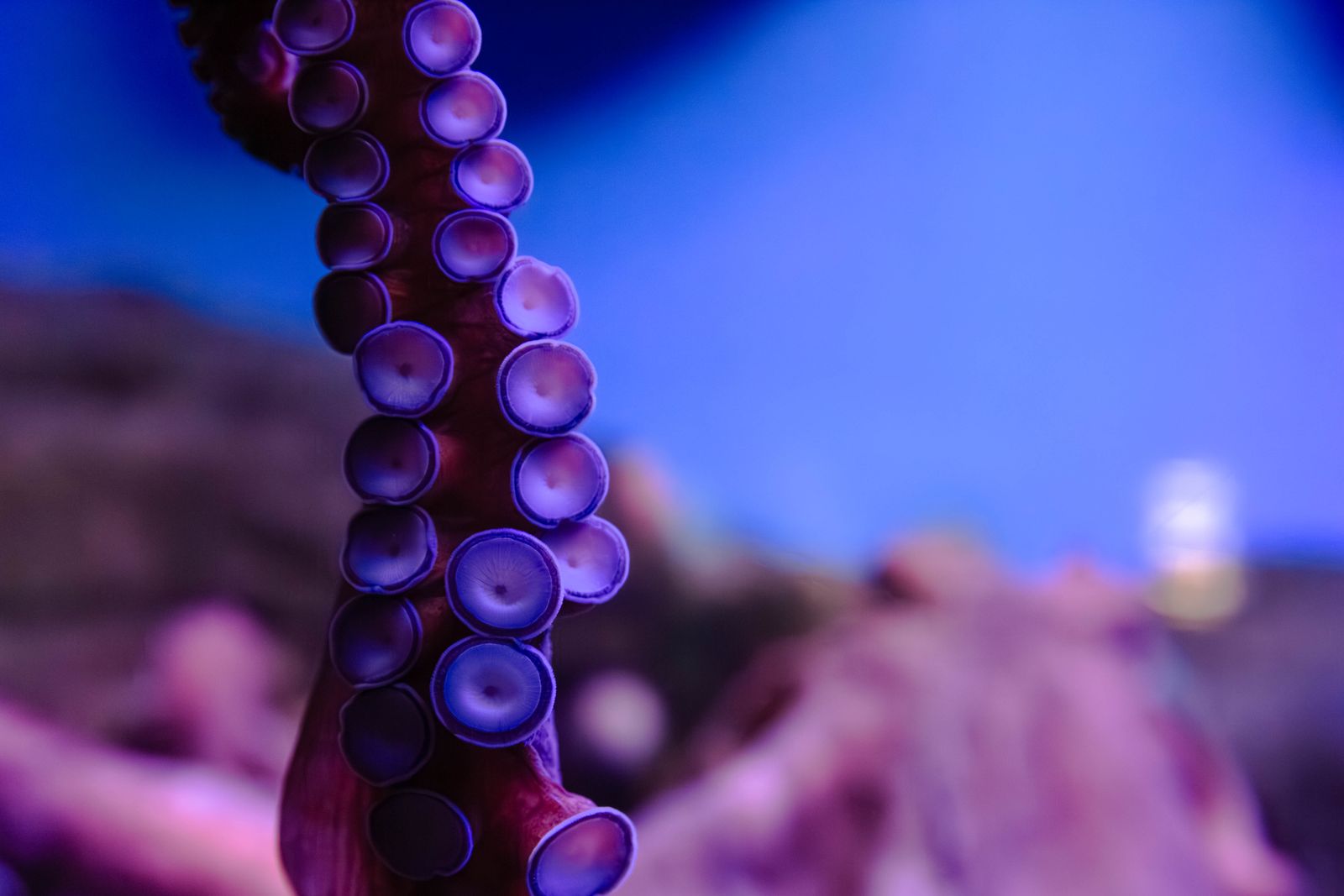
An octopus does not think the way a vertebrate thinks. It thinks with its whole body. Roughly two-thirds of an octopus’s neurons sit outside its central brain, distributed along the eight arms as bundled nerve cords that can taste, grip, and improvise on their own. A hunting arm can identify a crab, wrap it, and pass it toward the mouth without waiting for instructions from headquarters — a fact that has drawn a new generation of neuroscientists into cephalopod labs to figure out what a second, radically different design for intelligence looks like.
The headline anatomy reads like a puzzle. Three hearts. Blue blood. No skeleton. Nine brains, if you count the central doughnut-shaped one plus the eight semi-independent nerve cords in the arms.
The doughnut in the middle
Start with the central brain. It is not a compact ball tucked behind the eyes. It is a ring of tissue wrapped around the oesophagus, so that when an octopus swallows, food passes directly through the middle of its brain. Any object too big or too sharp to fit through that hole is a problem the animal has to solve before eating it. This is one reason octopuses take apart clams and crack crabs with such patience: their throat runs through their thoughts.
The ring holds a small fraction of the animal’s total neurons in a common octopus. The vast majority — around two-thirds — live down the arms. That ratio is why the standard framing — one brain in charge, eight arms taking orders — misses what is actually happening. The arms are not peripherals. They are co-processors.
Cephalopods and vertebrates last shared an ancestor long ago in evolutionary history, probably a worm-like creature with a smear of light-sensitive cells for eyes. Everything after that split evolved on separate tracks. The convergences are eerie — an octopus eye and a human eye look strikingly alike from the outside — but under the hood the wiring is foreign.
Three hearts, and why they need three
The three-heart layout is a plumbing solution to a specific problem. Two of the hearts, called branchial hearts, sit at the base of the gills and push blood through them to pick up oxygen. The third, the systemic heart, then pumps that oxygenated blood out to the rest of the body. The heart’s efficiency during jet propulsion is one reason octopuses prefer to crawl.
The blood itself is blue because it uses hemocyanin, a copper-based molecule, to carry oxygen rather than the iron-based hemoglobin in vertebrates. Copper binds oxygen efficiently in the cold, low-oxygen water where many octopuses live, but it is a less efficient carrier at higher temperatures. That single biochemical choice, made in some ancient mollusc, is one reason octopuses are so sensitive to warming seas.
Arms that taste what they touch
Each of the eight arms carries a substantial neural network of its own, running along a nerve cord that is tiny, apparently disorganised, and yet functional. Along the underside of every arm sit hundreds of suckers, and each sucker is studded with chemoreceptors that let the animal taste by touch. When an octopus probes into a crevice, it is essentially licking the rock.
The suckers do not just sample. They decide. If an arm’s chemoreceptors register a scallop, the local circuitry can grip and manipulate the shell without the central brain issuing step-by-step commands. The central brain seems to give a high-level instruction — food, that direction — and the arm handles the mechanics. This is how an octopus can send four arms out to forage in different directions at once and keep track of what each is doing.
The Natural History Museum has documented how far this distributed control goes: octopus arms severed from the body will still reach for and reject noxious objects for a period after separation, driven by their own neurons.
Skin that sees
The arms are not the only outposts of the nervous system. Octopus skin contains opsins — the same family of light-sensitive proteins used in vertebrate retinas — meaning the skin itself can detect light. This may help explain how an octopus, which is largely colourblind through its eyes, matches the colour of a reef so precisely. The skin appears to be doing some of its own sensing.
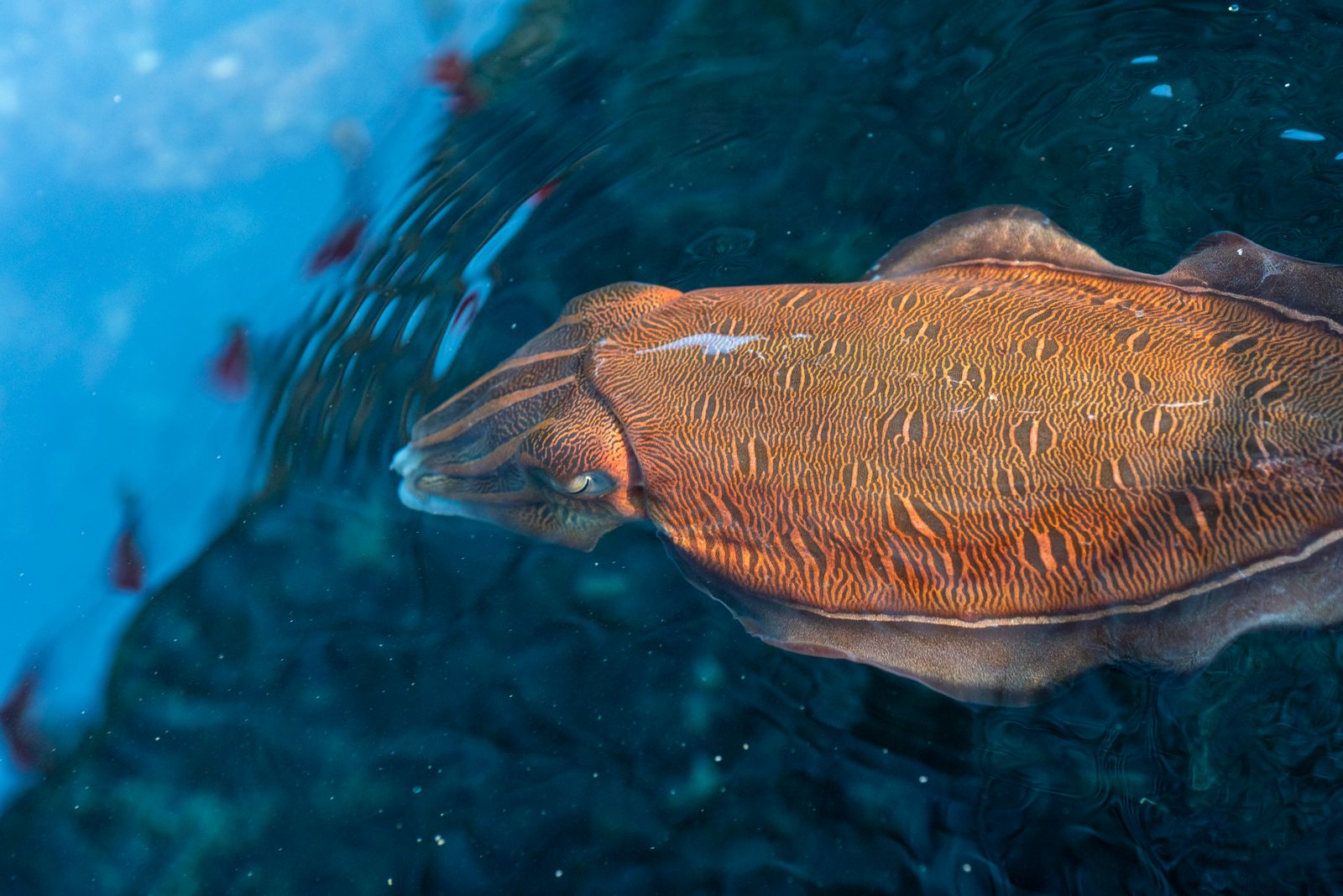
Cuttlefish take the trick further. A cuttlefish settling onto a new background cycles through a sequence of approximate camouflage patterns in seconds, homing in on an optimal match through what looks like a rapid visual feedback loop. Because the skin colour is a direct read-out of neural activity, watching a cuttlefish change is watching a brain think.
The evidence they solve problems
Cephalopods pass tests that were designed for primates. They open screw-top jars. They carry coconut-shell halves across the seafloor to use as portable shelters, a documented example of tool use in an invertebrate. In captivity, they recognise individual keepers and, by many accounts, hold grudges. They pass delayed-gratification tests — refusing a mediocre meal now for a preferred one later — a capacity long thought to require a mammalian prefrontal cortex.
In 2024, a group of researchers gathered at New York University to sign the New York Declaration on Animal Consciousness, arguing that there is now “strong scientific support” for consciousness in all vertebrates and “a realistic possibility” of it in cephalopods, decapod crustaceans and even insects. The declaration, covered by Quanta Magazine, was not a claim that an octopus experiences the world the way a human does. It was a claim that the burden of proof has shifted.
Why the wiring is so strange
An octopus has no bones. Its arms can bend at any point along their length, in any direction, and can shorten, elongate, and twist independently. A vertebrate limb has a fixed set of joints and a spinal cord that maps neatly to muscle groups. An octopus arm has, in principle, infinite degrees of freedom, and a nervous system that had to evolve a way to manage that.
Understanding octopus movement has revealed that a top-down command system simply cannot micromanage that many possible movements in real time. Distributing the computation to the arms is not an eccentric design choice. It is the only one that works for a soft, boneless animal that needs to move like this.
And yet, for memory, there are close parallels to vertebrates. Some octopus brain regions use a form of synaptic strengthening — the cellular process thought to underlie learning — that mirrors the mechanism in the mammalian hippocampus, even though the underlying molecules are different. This convergence has been reached in completely different ways.
The genome that opened the door
For most of the 20th century, octopus research was a niche pursuit hobbled by practical problems. Octopuses do not breed well in captivity. Their nerve cords are hard to record from. Early researchers tried for years to get stable neural recordings from living octopuses and eventually faced significant technical challenges.
The field advanced significantly with the publication of the first octopus genome in 2015. It revealed that two gene families critical to nervous-system patterning in vertebrates had independently expanded in the octopus lineage, through different mechanisms. It also sent a signal to the wider community that the octopus was now a tractable model. A decade later, work on cell-type diversity in the developing octopus brain is beginning to catalogue what those neurons actually are.
Gene expression sequencing in individual neurons of the octopus optic lobe has identified multiple classes of cells and a previously unknown layered organisation. The visual system, in other words, is structured — just not the way a mammalian visual system is structured.
Dreaming, maybe
Sleeping octopuses cycle through episodes of rapid skin-colour change that resemble REM sleep in vertebrates. Researchers in Japan documented the pattern and cautiously suggested the animals may be dreaming, or at least running some analogous nocturnal process. Whether an octopus dream feels like anything is a question no one can answer. But the fact that the question is being asked in serious neuroscience journals is itself a shift. As BBC Wildlife has catalogued across the invertebrate world, cognition keeps turning up in places the older textbooks assumed it could not.
The picture that emerges is of an animal that runs a partly federated nervous system. The central ring handles memory, learning, and high-level decisions. The arms handle the details — texture, chemistry, grip, the fine motor calculus of squeezing through a gap the size of an eye socket. The skin listens for light. Three hearts keep the copper-blue blood moving. And somewhere in the middle of that architecture, an animal that shared no common ancestor with us for hundreds of millions of years appears to have arrived at something recognisably like thinking.
An octopus in an aquarium tank will sometimes press one eye against the glass and follow a person across the room. It is difficult, watching this, to hold on to the idea that intelligence has only one shape.
