
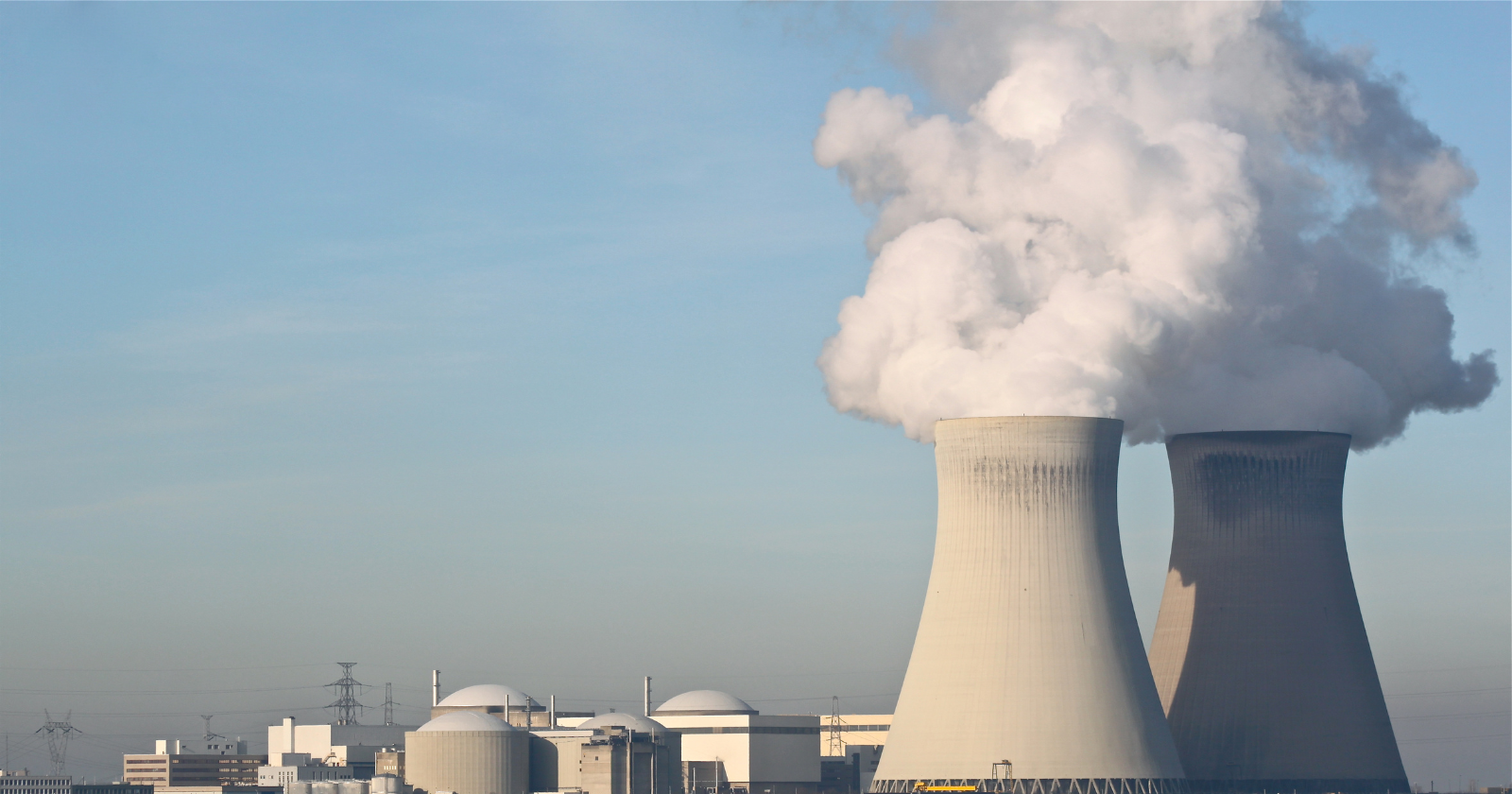
Nine cooling towers in the Sonoran Desert are throwing roughly 45,000 gallons of water a minute into the sky, and not one drop of it came from a river. Three reactor buildings sit on gravel about 50 miles — 80 kilometres — west of Phoenix, near the crossroads called Wintersburg. There is no ocean. There is no lake. America’s second-largest nuclear plant is cooling itself on sewage.
The water arrives in a concrete pipe. It has already been through the 91st Avenue Wastewater Treatment Plant on the west side of the city — the sinks, showers and sewers of five Valley cities, treated until it is effluent. Then it is sent about 36 miles — 58 kilometres — west, most of it downhill, the last stretch pumped uphill, into another works that washes it again. After that it goes into cooling towers. What the towers do not throw into the sky goes into lined ponds.
A 2010 contract with those cities allots the plant up to 26 billion gallons a year — about 98 billion litres — of treated municipal wastewater through 2050. Typical years use less. One documented year, 2014, took 73,071 acre-feet, roughly 24 billion gallons. Almost all of it is boiled off. Nothing liquid leaves the fence.
A machine with no river
Palo Verde Generating Station occupies some 4,000 acres of desert near Wintersburg. Arizona Public Service runs it for a consortium of seven Southwest utilities. Three pressurized-water reactors, built by Combustion Engineering and finished between 1986 and 1988, make more than 32 million megawatt-hours in a typical year — enough, APS says, for more than four million people.
For decades it was the biggest generator in the country by output. POWER magazine recorded 2014 as its twenty-third consecutive year at the top, at 32.3 million megawatt-hours. That run ended on the capacity side. The US Energy Information Administration reports that after Georgia Power brought Vogtle Unit 3 online in 2023 and Unit 4 in 2024, Plant Vogtle became the largest US nuclear plant at roughly 4.5 gigawatts, ahead of Palo Verde’s 3.9. EIA’s Arizona profile now calls Palo Verde the nation’s second-largest nuclear plant, responsible for 4 per cent of American nuclear generation in 2024.
Every other American nuclear plant was sited on a body of water. This one was not. In the mid-1970s, designers looked at the Phoenix basin and concluded surface water and groundwater would not sustain the steam-cycle cooling a three-unit station would drink. What the basin did have was a growing pile of municipal effluent. Testing showed the source was acceptable.
The original pact with the cities was signed in 1973. Deliveries began in 1982. Construction, started in 1976, finished in 1988, and the Nuclear Regulatory Commission approved twenty-year licence renewals for all three units in 2011, extending operation to 2045, 2046 and 2047.
APS still puts it plainly: the nation’s only nuclear plant not located on a body of water, recycling more than 20 billion gallons of wastewater a year to cool itself. A 2021 Sandia paper written with APS engineers goes further and calls it the only nuclear facility in the world not sited on or near a natural body of water. The machine is a desert engine. The coolant is city waste.
Fifty-eight kilometres of someone else’s water
The 91st Avenue plant is owned by the Sub-Regional Operating Group — Glendale, Mesa, Phoenix, Scottsdale and Tempe — with Phoenix running daily operations. After solids are pulled and the biology has done its work, a share of the cleaned water is turned west rather than south toward the Salt and the Gila.
POWER magazine’s account of the plant lays out the run: about 28 miles downhill, then eight miles pumped. That is the 36-mile pipe.
The American Nuclear Society’s description breaks the route down further: six miles of 114-inch pipe on gravity flow, then 22.5 miles of 96-inch, then a pumping station, then eight miles uphill through 66-inch pipe. The concrete narrows as the water climbs.
At the on-site Water Reclamation Facility — a tertiary plant rated at 90 million gallons a day, sometimes called the fourth unit — lime, soda ash and carbon dioxide go in across parallel clarifier trains to strip calcium, magnesium and silica so the water will not scale the towers. Sulfuric acid and hypochlorite finish the job.
What comes out is held in lined reservoirs. POWER puts the main one at 760 million gallons across 80 surface acres; the ANS account describes 45-acre and 85-acre basins holding more than a billion gallons between them, roughly twelve days of supply in the hottest months. Waterfowl use them. So do fish.
Most of the cooling water — about 90 per cent in the Sandia account — is 91st Avenue effluent. Most of the remainder is effluent from Tolleson, with a little from on-site wells. It is not river water. It is not seawater. It is city waste, washed twice, then used as mass.
Twenty-five times around, then the pond
Nine Marley Class 700 mechanical-draft cooling towers take the heat. Combined, the three units evaporate about 45,000 gallons a minute at full load reactor power.
The leftover salts stay behind. Water cycles through until a chemical trigger is hit — magnesium typically in winter, chlorides typically in summer — which at Palo Verde works out to roughly 25 to 30 cycles of concentration. POWER describes the resulting blowdown as approaching the salinity of seawater. An EPA-set ceiling of 30,000 milligrams per litre of total dissolved solids caps how far the concentration can run.
About 600 gallons a minute leaves each unit’s circulating water system as blowdown. It has nowhere to go but the ponds.
The ponds are the end of the line. Sandia and APS describe a zero-liquid-discharge site: about 650 acres — 260 hectares — of lined evaporation cells, three ponds subdivided into eight. Nothing is piped to a river, a wash or the sea.
They were built in stages. The environmental report APS filed with the NRC for licence renewal describes Pond 1 at 250 acres and Pond 2 at 230, with a third 180-acre pond then under construction. A PVC liner keeps the salts out of the groundwater. When a cell’s liner wears out, that cell is drained and relined, which is why the impoundment is subdivided at all.
Of the water the plant takes in, something like 95 per cent leaves as vapour from the towers. The Arizona Department of Water Resources, after touring the reclamation facility, put the share reaching the evaporation ponds at under five per cent — about 3,000 acre-feet a year. The rest sits in the desert until the sun finishes it.
Average demand is about 72,000 acre-feet a year. The 26-billion-gallon allotment is a ceiling, not a meter reading. In 2014 the take was 73,071 acre-feet, closer to 24 billion gallons.
A contract with an end date
The 2010 agreement replaced the 1973 pact and runs forty years, through 2050. The terms announced at signing priced the effluent at roughly $58 an acre-foot to start, rising to about $300 an acre-foot by 2026, alongside a $30 million up-front payment in four annual instalments.
From 2026 the price moves to a four-tier structure keyed to monthly volume, in 2,000-acre-foot increments, so the more the plant draws in a month the more each additional acre-foot costs. The Sandia paper also records a non-usage fee for any year in which the plant takes less than 80,000 acre-feet.
The cities get a buyer for a byproduct that grows with the population. The plant gets the only cooling supply that made a desert reactor possible. After 2050 there is no contract on the paper.
The cheaper water that is not there
APS and Sandia National Laboratories opened a partnership to model the whole water cycle, because the effluent is no longer cheap and municipalities have begun to want it back. Jeff Brown, a consulting engineer at Palo Verde, described the aim as finding the most cost-effective ways to cut the plant’s water use.
The obvious substitute is brackish groundwater from a subflow basin about 20 miles east. The model says no. Without additional treatment it could replace only about three per cent of the cooling flow, and the added chloride would push more blowdown into the ponds than the saving is worth.
The American Nuclear Society account puts the 2021 water bill above $12 million, with chemicals to treat that water running past $9 million. So the pipe from Phoenix is still the system.
Still no river
The towers are throwing a wet plume into dry air. The pipe is full. The ponds hold what the towers will not take as steam. Three reactors are making power on a bench that has never had a river.
Palo Verde is what you get when an energy machine is dropped on a desert and the only mass that will cool it is the waste of a city 58 kilometres away. The allotment is up to 98 billion litres a year. The ponds are 260 hectares of lined dirt. The water goes in as effluent and leaves as cloud and crust. There is no discharge pipe. There is no sea. There is only the city, the pipe, the towers, and the sun.
