
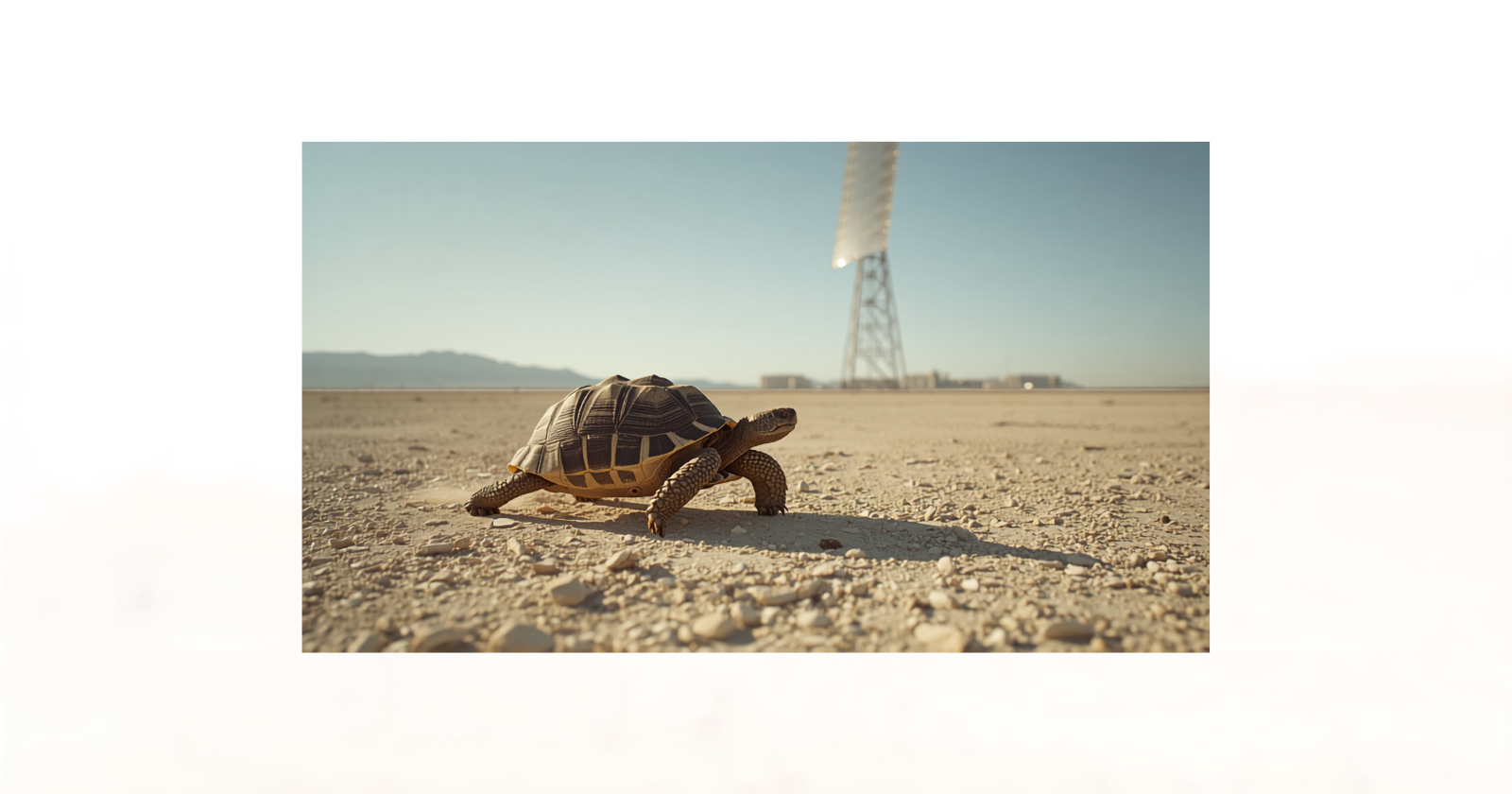
The Ivanpah Valley looks empty from Interstate 15: creosote, pale gravel, and miles of ground the colour of bone. In 2010, construction began on a $2.2-billion solar-thermal plant with three towers and thousands of mirrors. The animal that disrupted the schedule was already underfoot.
A Mojave desert tortoise does not announce itself. The U.S. Fish and Wildlife Service says the species can remain in burrows for as long as nine months each year, emerging mainly in spring and early autumn. A surface survey can therefore cross occupied habitat without seeing many of the animals beneath it.
The first survey cited in contemporary reporting found 16 tortoises. From that work, federal biologists estimated the project might affect no more than 32, and the permit allowed a maximum of 38 adults to be captured and moved. By 2012, biologists had collected 166 adults and juveniles from the plant site.
Across the state line, Fish and Wildlife had been running a different translocation programme since 1997. That programme would eventually move approximately 9,105 tortoises into a large managed site in Nevada between 1997 and 2014. The two numbers describe different animals, different destinations, and different periods.
Thirty-eight, on paper
BrightSource Energy selected Ivanpah for its intense sunlight and access to federal land. During planning, the company reduced the project footprint by about 12 per cent and cut the number of power towers from seven to three. It also agreed to monitor relocated tortoises for five years.
The federal environmental review described a solar-thermal installation designed to generate as much as 400 megawatts by concentrating sunlight to produce steam. The Department of Energy published the final environmental impact statement in July 2010. Ivanpah’s enormous mirror field later produced a separate wildlife controversy involving birds, but the tortoise conflict began at ground level before the towers operated.
The Fish and Wildlife Service finalized its initial biological opinion in November 2010. Contemporary records described an estimated maximum of 32 tortoises across approximately 5.4 square miles. The resulting authorization allowed 38 adults to be captured and moved.
The permit also allowed a limited number of accidental deaths during construction. If the project exceeded the authorized thresholds, work would have to stop while the agencies reconsidered the effects. That limit became important almost immediately.
The Los Angeles Times reported the numbers in sequence: 16 found during the first survey, a permit covering 38 adults, and eventually 166 adults and juveniles collected from the site. Those 166 animals were moved into a nine-acre holding facility. The plan was to release suitable animals into habitat outside the solar facility’s fence.
What the burrows hid
Desert tortoises are cryptic because most of their lives take place underground. Adults occupy burrows that soften the desert’s extremes, while small juveniles can disappear beneath shrubs, rocks, or shallow soil. Detecting them depends on season, weather, recent activity, and how closely surveyors can read the ground.
When construction began in autumn 2010, biologists walked ahead of equipment and searched burrows before machinery advanced. Empty burrows were collapsed so animals could not return to an active work area. Every new detection pushed the project closer to the permit’s limit.
By late March 2011, biologists had found 39 adult tortoises, one more than the authorization covered. Two tortoises had already died, according to High Country News. One overheated while pacing an exclusion fence and attempting to move back toward its previous range.
By February 2011, the agencies and developer understood that the site held more tortoises than the permit anticipated. State and federal authorities suspended construction two months later while a new biological assessment was prepared. The Fish and Wildlife Service issued a revised biological opinion in June.
Project files documented other injuries and deaths. An adult female found with a crushed shell was euthanized after biologists concluded that a vehicle had struck her, although officials ultimately did not attribute that death to the project. Army ants attacked hatchlings in a nursery, killing four animals still inside their eggs and injuring four others.
One tagged female, BS-71, spent four months pacing a holding enclosure and repeatedly attempting to climb its wire mesh. After Fish and Wildlife approved an early release, lead biologist Mercy Vaughn carried her to a wild burrow. The tortoise went underground, reappeared moments later, blinked, and began eating grass.
Nine thousand, another programme
The 166 tortoises collected at the solar facility must not be added to the Nevada total. They were not one continuous group, and the matching geography does not make the programmes interchangeable. Even the appearance of the number 166 later in the genetic study is a coincidence.
In 1996, after hundreds of displaced tortoises accumulated at the Desert Tortoise Conservation Center, wildlife managers established the Large-Scale Translocation Site near Jean, Nevada. The peer-reviewed Science report describes it as a 100-square-kilometre area surrounded by tortoise-barrier fencing or inhospitable mountains. That is approximately 39 square miles.
Between 1997 and 2014, approximately 9,105 tortoises of uncertain origin were moved into the site. About half were adults, and they joined an estimated 1,450 adult tortoises already living there. The full 9,105 total therefore belongs to a 17-year period, not to the moment Ivanpah construction began in 2010.
Many of the relocated animals were former captives collected through Nevada’s pet-tortoise pickup programme. Others had been displaced by construction or other disturbance. Because many arrived without reliable information about where they originally came from, managers could not consistently return them to their native ranges.
The solar-plant tortoises first entered a nine-acre holding facility on the California side. The Nevada programme placed thousands of animals into a much larger managed landscape across the valley. Both involved the threatened Mojave desert tortoise, but their dates, scales, and monitoring histories were different.
The ones who lived
In 2020, researchers from UCLA, the Fish and Wildlife Service, and partner institutions examined which characteristics predicted survival at the Nevada site. Their work did not show that the programme had deliberately selected for a genetic trait. It found that individual heterozygosity was strongly associated with survival after translocation.
The team analysed 166 translocated animals: 79 known to be alive in 2015 and 87 known to have died. This study sample is unrelated to the 166 adults and juveniles collected at the Ivanpah solar facility. The identical total can obscure the fact that the datasets came from different groups.
Survivors averaged 23.09 per cent more heterozygosity than the matched animals that died. Geographic distance from the inferred place of origin did not predict survival, and crossing the study’s broad northern-southern genetic boundary did not produce a detectable survival difference. UCLA’s summary of the research also confirms the sample sizes and the 23 per cent result.
The result has limits. The researchers cautioned that ecology, disease exposure, physical condition, drought, and post-release density could also affect survival, and that the genetic finding needs testing in other systems. Heterozygosity was a measurable predictor, not a complete explanation for why so many tortoises died.
Still a fence
The Mojave population has been federally listed as threatened since 1990. Tortoises maintain home ranges and may attempt to return after being moved, bringing them into contact with roads, construction zones, and barriers. Their predicament is one example of the broader ways human infrastructure restricts animal movement.
In July 2024, the Bureau of Land Management proposed another intervention around the Nevada translocation site. Its draft connectivity and restoration plan called for adding, modifying, or removing fences, improving culverts, treating weeds, and restoring native vegetation. The goal was to reconnect habitat around a block that had been fenced since 1996.
That proposal did not proceed to a completed plan. The BLM’s current National NEPA Register entry lists the project as cancelled. The record does not state a reason, so none can be assigned from the available documentation.
At last light, the Ivanpah bajada turns pale beneath the three towers. Under the gravel, a tortoise can remain beyond the reach of a surface count for months at a time. The numbers belong to different moments: 38 on the permit, 166 in the holding facility, and approximately 9,105 moved into the Nevada site over 17 years.
